



 Chat with AI
Exam 19: An Era of Totalitarianism

Exam 1: The Ancient Near East: the First Civilizations82 Questions
Exam 2: The Hebrews: a New View of God and the Individual74 Questions
Exam 3: The Greeks: From Myth to Reason95 Questions
Exam 4: Rome: From City-State to World Empire93 Questions
Exam 5: Early Christianity: a World Religion79 Questions
Exam 6: The Rise of Europe: Fusion of Classical, Christian, and Germanic Traditions89 Questions
Exam 7: The Flowering and Dissolution of Medieval Civilization84 Questions
Exam 8: Transition to the Modern Age: Renaissance and Reformation92 Questions
Exam 9: Political and Economic Transformation: National States, Overseas Expansion, Commercial Revolution84 Questions
Exam 10: Intellectual Transformation: the Scientific Revolution and the Age of Enlightenment86 Questions
Exam 11: The Era of the French Revolution: Affirmation of Liberty and Equality92 Questions
Exam 12: The Industrial Revolution: the Transformation of Society79 Questions
Exam 13: Thought and Culture in the Early Nineteenth Century82 Questions
Exam 14: Surge of Liberalism and Nationalism: Revolution, Counterrevolution, and Unification78 Questions
Exam 15: Thought and Culture in the Mid-Nineteenth Century: Realism, Positivism, Darwinism, and Social Criticism86 Questions
Exam 16: Europe in the Late Nineteenth Century: Modernization, Nationalism, Imperialism93 Questions
Exam 17: Modern Consciousness: New Views of Nature, Human Nature, and the Arts78 Questions
Exam 18: World War I: the West in Despair83 Questions
Exam 19: An Era of Totalitarianism87 Questions
Exam 20: World War 2: Western Civilization in the Balance55 Questions
Exam 21: Europe After World War 2: Recovery and Realignment, 1945-198963 Questions
Exam 22: The Troubled Present55 Questions
Select questions type


Please use this outline map of Europe to answer the question(s).
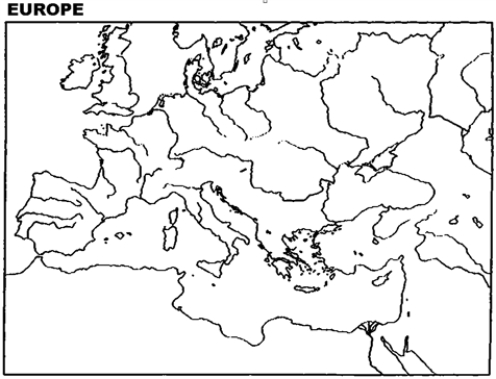 -On a map of Europe, locate the following: Brest-Litovsk, whose name is connected with a treaty; Kronstadt, the site of a naval mutiny; the Ukraine, site of a massive starvation as a result of collectivization and Petrograd, the location in the Soviet Union of which Lenin took charge.
 (Short Answer)
4.8/5  (63)
(63) The Fascist regime in Italy did all of the following except
(Multiple Choice)
4.7/5 (78)
(78) Please define the following key terms. Show Who? What? Where? When? Why Important?
-Lenin
(Short Answer)
4.7/5 (70)
(70) Please define the following key terms. Show Who? What? Where? When? Why Important?
-grain requisitions
(Essay)
4.9/5 (85)
(85) Existentialism does not lend itself to a single definition but some of its basic characteristics include all of the following EXCEPT
(Multiple Choice)
4.8/5 (66)
(66) Please define the following key terms. Show Who? What? Where? When? Why Important?
-Benito Mussolini
(Short Answer)
4.8/5 (100)
(100) Which statement most accurately describes Hitler's relationship with the Reichstag?
(Multiple Choice)
4.8/5 (82)
(82) In the era of the world wars, what philosophical movement best exemplified the anxiety and uncertainty felt in Europe?
(Multiple Choice)
4.8/5 (74)
(74) Please use this outline map of Europe to answer the question(s).
-It has been said that revolutionaries often become more tyrannical than those they have overthrown. Does this remark apply to the era of the early Russian Revolution? Explain.
-It has been said that revolutionaries often become more tyrannical than those they have overthrown. Does this remark apply to the era of the early Russian Revolution? Explain. (Essay)
4.9/5 (67)
(67) Please use this outline map of Europe to answer the question(s).
-On a map of Europe locate the areas mentioned in this chapter where fascism took hold as well the areas where democracy survived and the one new nation after World War One that was able to enact a successful democratic system.
-On a map of Europe locate the areas mentioned in this chapter where fascism took hold as well the areas where democracy survived and the one new nation after World War One that was able to enact a successful democratic system. (Short Answer)
4.9/5 (73)
(73) Please define the following key terms. Show Who? What? Where? When? Why Important?
-Max Beckmann
(Short Answer)
4.7/5 (73)
(73) Please define the following key terms. Show Who? What? Where? When? Why Important?
-Marc Chagall
(Essay)
4.8/5 (95)
(95) Please define the following key terms. Show Who? What? Where? When? Why Important?
-Pablo Picasso
(Essay)
4.8/5 (96)
(96) 
Filters
- Essay(0)
- Multiple Choice(0)
- Short Answer(0)
- True False(0)
- Matching(0)