



 Chat with AI
Exam 18: World War I: the West in Despair


Please define the following key terms. Show Who? What? Where? When? Why Important?
-Mensheviks

 (67)
 Answered by Examlex AI Copilot
The Mensheviks were a faction of the Russian Social Democratic Labour Party, which emerged in 1903. The term "Menshevik" comes from the Russian word for "minority," as they were initially the minority faction within the party. The Mensheviks believed in a more gradual approach to achieving socialism, advocating for a broad-based coalition and working within the existing political system to bring about social and economic reforms. They were opposed to the more radical tactics of the Bolsheviks, who favored a more revolutionary and militant approach.
Who: The Mensheviks were a faction of the Russian Social Democratic Labour Party.
What: They believed in a more gradual approach to achieving socialism and advocated for a broad-based coalition.
Where: The Mensheviks were active in Russia, particularly during the early 20th century.
When: The Menshevik faction emerged in 1903 and was active during the lead-up to the Russian Revolution in 1917.
Why Important: The Mensheviks played a significant role in the political and ideological debates within the Russian revolutionary movement. Their more moderate approach to socialism and their willingness to work within the existing political system had a lasting impact on the development of socialist thought and practice. However, their opposition to the more radical tactics of the Bolsheviks ultimately led to their marginalization and defeat in the power struggle that followed the Russian Revolution.
Please define the following key terms. Show Who? What? Where? When? Why Important?
-Aleksandr Kerensky
(81) Answered by Examlex AI CopilotAleksandr Kerensky was a prominent political figure in Russia during the early 20th century. He was a key leader of the Russian Provisional Government following the abdication of Tsar Nicholas II in 1917.
Who: Aleksandr Kerensky was a Russian political leader.
What: He was a key figure in the Russian Provisional Government.
Where: He was active in Russia during the early 20th century.
When: He was prominent during the period following the abdication of Tsar Nicholas II in 1917.
Why Important: Aleksandr Kerensky is important because he played a significant role in the political upheaval and transition in Russia during this time, particularly during the Russian Revolution. He was a central figure in the attempt to establish a democratic government in Russia, and his actions and decisions had a major impact on the course of Russian history.
Please define the following key terms. Show Who? What? Where? When? Why Important?
-Tannenberg
(83) Answered by Examlex AI CopilotTannenberg refers to the Battle of Tannenberg, which took place during World War I.
Who: The battle was fought between the Russian Empire and the German Empire, with commanders such as Paul von Hindenburg and Max Hoffmann leading the German forces, and Alexander Samsonov and Paul von Rennenkampf leading the Russian forces.
What: The Battle of Tannenberg was a significant military engagement that resulted in a decisive victory for the German Empire. It was a major defeat for the Russian Empire and had a significant impact on the Eastern Front of World War I.
Where: The battle took place near the town of Tannenberg in East Prussia, which is now part of Poland.
When: The battle occurred from August 26 to August 30, 1914.
Why Important: The Battle of Tannenberg was important because it demonstrated the effectiveness of German military strategy and leadership, and it severely weakened the Russian military's ability to continue fighting on the Eastern Front. The German victory at Tannenberg also boosted morale and had a significant impact on the course of the war.
Which of the following would be least associated with Woodrow Wilson?
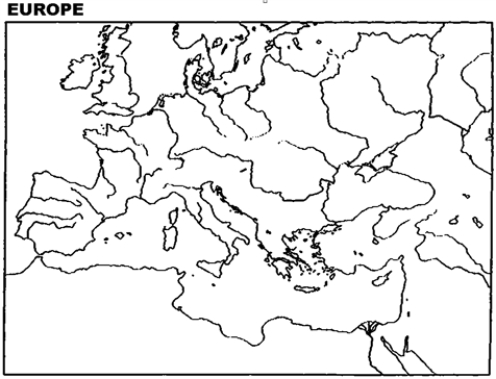
(80) Please use this outline map of Europe to answer the question(s).
 -How did the nationality problem in Austria-Hungary contribute to the outbreak of World War 1?
 (84) Please use this outline map of Europe to answer the question(s).
-Discuss trench warfare during World War I with particular reference to the Western Front.
-Discuss trench warfare during World War I with particular reference to the Western Front. (90) Please define the following key terms. Show Who? What? Where? When? Why Important?
-Lebensraum
(73) Please define the following key terms. Show Who? What? Where? When? Why Important?
-The Bosnian crisis
(76) Which of the following statements does NOT describes how European nations viewed the reign and actions of Wilhelm II?
(80) Which of the following is NOT true in describing how nationalism fueled aggressive publics and nations?
(85) Please define the following key terms. Show Who? What? Where? When? Why Important?
-the Dardanelles
(83) All of the following are major causes for World War One EXCEPT
(88) Please define the following key terms. Show Who? What? Where? When? Why Important?
-Greater Serbia
(89) 
Filters
- Essay(0)
- Multiple Choice(0)
- Short Answer(0)
- True False(0)
- Matching(0)