



 Chat with AI
Exam 19: An Era of Totalitarianism


When Francisco Franco revolted against the Spanish republic, he received the support of

 (88)
 Verified
E
Please define the following key terms. Show Who? What? Where? When? Why Important?
-Bolshevik
(77)  Answered by Examlex AI Copilot
The Bolsheviks were a faction of the Russian Social Democratic Labour Party, led by Vladimir Lenin, which eventually became the Communist Party of the Soviet Union. The Bolsheviks were a revolutionary group that sought to overthrow the Russian monarchy and establish a socialist state. They were based in Russia and gained power during the October Revolution of 1917. The Bolsheviks were important because they played a key role in the Russian Revolution and the establishment of the Soviet Union, which had a major impact on global politics and history.
Please define the following key terms. Show Who? What? Where? When? Why Important?
-Reinhold Niebuhr
(72) Answered by Examlex AI CopilotReinhold Niebuhr (1892–1971) was an American theologian, ethicist, and political commentator known for his profound influence on religious and political thought in the 20th century. He is particularly recognized for his contributions to Christian Realism and for his deep understanding of the complexities of human nature and the challenges of social justice.
Niebuhr's historical significance can be attributed to several key aspects of his work and thought:
1. Christian Realism: Niebuhr developed the concept of Christian Realism, which emphasizes the persistent presence of sin in human affairs and the limitations of human beings to achieve perfect justice. He argued that while individuals are capable of self-transcendence and altruism, social groups tend to be more self-interested and power-seeking. This perspective challenged both the optimistic idealism of liberal Christianity, which often underestimated the power of self-interest and evil, and the pessimism of more conservative theological movements that could lead to political quietism.
2. Moral Man and Immoral Society: In his influential book "Moral Man and Immoral Society" (1932), Niebuhr argued that there is a fundamental difference between the morality of individuals and the behavior of social groups, including nations and economic classes. He contended that while individuals might be capable of self-sacrifice, groups are more likely to pursue their own interests at the expense of others. This work had a significant impact on discussions of social ethics and the role of the church in social justice issues.
3. Influence on Political Thought: Niebuhr's ideas influenced a wide range of political and intellectual figures, from Martin Luther King Jr. to President Barack Obama. His thoughts on the balance between moral idealism and political realism helped shape debates on foreign policy, particularly during the Cold War era, when he advocated for a strong but measured response to the threat of communism.
4. The Serenity Prayer: Niebuhr is often credited with composing the Serenity Prayer, a simple but profound invocation asking for "the serenity to accept the things I cannot change, the courage to change the things I can, and the wisdom to know the difference." While the exact origins of the prayer are debated, its widespread adoption in various forms, including by Alcoholics Anonymous and other twelve-step programs, speaks to its enduring influence.
5. Public Intellectual: Niebuhr was a public intellectual who wrote extensively on the intersection of religion, politics, and ethics. He contributed to the national dialogue through his writings in popular magazines and newspapers, and he was a founding editor of the journal "Christianity and Crisis."
In summary, Reinhold Niebuhr's historical significance lies in his profound impact on theological and political thought, particularly through his articulation of Christian Realism, his analysis of the ethics of social behavior, and his influence on public discourse and policy. His work continues to be studied and referenced for its insights into the human condition and the challenges of achieving justice in a complex and imperfect world.
Please use this outline map of Europe to answer the question(s).
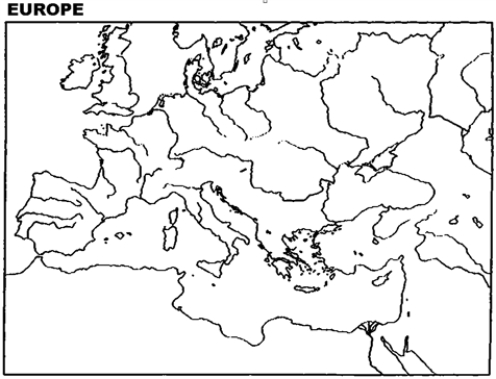 -Why was the Soviet Union so popular to so many intellectuals? Name some who criticized the communist experiment.
 (86) Please define the following key terms. Show Who? What? Where? When? Why Important?
-Martin Heidegger
(85) Please define the following key terms. Show Who? What? Where? When? Why Important?
-Dadaism
(77) Please use this outline map of Europe to answer the question(s).
-Using arrows, designate on a map of Europe various sites of political disturbances during the 1920s: the Spartacist revolt, the Kapp Putsch, and the Beer Hall Putsch of 1923.
-Using arrows, designate on a map of Europe various sites of political disturbances during the 1920s: the Spartacist revolt, the Kapp Putsch, and the Beer Hall Putsch of 1923. (80) Please define the following key terms. Show Who? What? Where? When? Why Important?
-German Workers Party
(88) Oswald Spengler argued that civilizations like living organisms, experience
(71) Please define the following key terms. Show Who? What? Where? When? Why Important?
-First Five-Year Plan
(66) The results of Stalin's collectivization included which of the following?
(70) Which of the following gave the German chancellor the right to make law?
(68) Please define the following key terms. Show Who? What? Where? When? Why Important?
-D. H. Lawrence
(81) Please use this outline map of Europe to answer the question(s).
-In what ways did the work of Lenin contribute to an ideology of world revolution?
-In what ways did the work of Lenin contribute to an ideology of world revolution? (75) Please define the following key terms. Show Who? What? Where? When? Why Important?
-New Economic Policy
(92) Please define the following key terms. Show Who? What? Where? When? Why Important?
-Joseph Stalin
(76) Please define the following key terms. Show Who? What? Where? When? Why Important?
-Ernest Hemingway
(71) The official style in art and literature of the communist regime was known as
(79) 
Filters
- Essay(0)
- Multiple Choice(0)
- Short Answer(0)
- True False(0)
- Matching(0)