



 Chat with AI
Exam 19: An Era of Totalitarianism

Exam 1: The Ancient Near East: the First Civilizations82 Questions
Exam 2: The Hebrews: a New View of God and the Individual74 Questions
Exam 3: The Greeks: From Myth to Reason95 Questions
Exam 4: Rome: From City-State to World Empire93 Questions
Exam 5: Early Christianity: a World Religion79 Questions
Exam 6: The Rise of Europe: Fusion of Classical, Christian, and Germanic Traditions89 Questions
Exam 7: The Flowering and Dissolution of Medieval Civilization84 Questions
Exam 8: Transition to the Modern Age: Renaissance and Reformation92 Questions
Exam 9: Political and Economic Transformation: National States, Overseas Expansion, Commercial Revolution84 Questions
Exam 10: Intellectual Transformation: the Scientific Revolution and the Age of Enlightenment86 Questions
Exam 11: The Era of the French Revolution: Affirmation of Liberty and Equality92 Questions
Exam 12: The Industrial Revolution: the Transformation of Society79 Questions
Exam 13: Thought and Culture in the Early Nineteenth Century82 Questions
Exam 14: Surge of Liberalism and Nationalism: Revolution, Counterrevolution, and Unification78 Questions
Exam 15: Thought and Culture in the Mid-Nineteenth Century: Realism, Positivism, Darwinism, and Social Criticism86 Questions
Exam 16: Europe in the Late Nineteenth Century: Modernization, Nationalism, Imperialism93 Questions
Exam 17: Modern Consciousness: New Views of Nature, Human Nature, and the Arts78 Questions
Exam 18: World War I: the West in Despair83 Questions
Exam 19: An Era of Totalitarianism87 Questions
Exam 20: World War 2: Western Civilization in the Balance55 Questions
Exam 21: Europe After World War 2: Recovery and Realignment, 1945-198963 Questions
Exam 22: The Troubled Present55 Questions
Select questions type


The Dawes Plan contributed to Germany economic recovery in the 1920s because it
(Multiple Choice)
4.8/5  (75)
(75) Please define the following key terms. Show Who? What? Where? When? Why Important?
-Collectivization
(Essay)
4.9/5 (85)
(85) Please define the following key terms. Show Who? What? Where? When? Why Important?
-"November criminals"
(Essay)
4.8/5 (84)
(84) Please define the following key terms. Show Who? What? Where? When? Why Important?
-Kristallnacht
(Short Answer)
4.9/5 (74)
(74) Please define the following key terms. Show Who? What? Where? When? Why Important?
-Otto Dix
(Essay)
4.9/5 (61)
(61) Please use this outline map of Europe to answer the question(s).
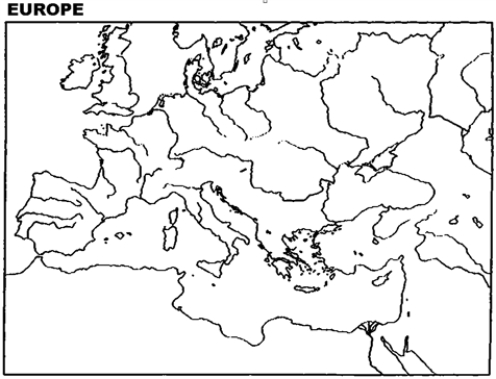 -How would you explain the basic outlook of Oswald Spengler?
 (Essay)
4.9/5 (68)
(68) Please define the following key terms. Show Who? What? Where? When? Why Important?
-March on Rome
(Essay)
4.8/5 (80)
(80) Please use this outline map of Europe to answer the question(s).
-How might different policies of the victorious powers towards Germany in the 1920s have forestalled the rise of Nazism?
-How might different policies of the victorious powers towards Germany in the 1920s have forestalled the rise of Nazism? (Essay)
4.8/5 (79)
(79) Please use this outline map of Europe to answer the question(s).
-How were the totalitarianisms of Italy, Germany, and the Soviet Union different from one another?
-How were the totalitarianisms of Italy, Germany, and the Soviet Union different from one another? (Short Answer)
4.7/5 (78)
(78) Please define the following key terms. Show Who? What? Where? When? Why Important?
-Jean-Paul Sartre
(Essay)
4.9/5 (63)
(63) When the authors of your text refer to "the God that Failed," it is a reference to
(Multiple Choice)
4.9/5 (77)
(77) Each of the following was part of the formative experiences of Hitler except
(Multiple Choice)
4.9/5 (65)
(65) Please define the following key terms. Show Who? What? Where? When? Why Important?
-Mass Man
(Essay)
4.9/5 (76)
(76) Which of the following proved to be a prophet of totalitarianism?
(Multiple Choice)
4.8/5 (66)
(66) 
Filters
- Essay(0)
- Multiple Choice(0)
- Short Answer(0)
- True False(0)
- Matching(0)