



 Chat with AI
Exam 15: Monopoly

Exam 1: Ten Principles of Economics237 Questions
Exam 2: Thinking Like an Economist267 Questions
Exam 3: Interdependence and the Gains From Trade217 Questions
Exam 4: The Market Forces of Supply and Demand303 Questions
Exam 5: Elasticity and Its Applications282 Questions
Exam 6: Supply, demand, and Government Policies252 Questions
Exam 7: Consumers, producers, and the Efficiency of Markets248 Questions
Exam 8: Application: the Costs of Taxation245 Questions
Exam 9: Application: International Trade245 Questions
Exam 10: Externalities288 Questions
Exam 11: Public Goods and Common Resources258 Questions
Exam 12: The Design of the Tax System328 Questions
Exam 13: The Costs of Production303 Questions
Exam 14: Firms in Competitive Markets271 Questions
Exam 15: Monopoly306 Questions
Exam 16: Oligopoly291 Questions
Exam 17: Monopolistic Competition257 Questions
Exam 18: The Markets for the Factors of Production284 Questions
Exam 19: Earnings and Discrimination286 Questions
Exam 20: Income Inequality and Poverty247 Questions
Exam 21: The Theory of Consumer Choice238 Questions
Exam 22: Frontiers of Microeconomics199 Questions
Exam 23: Measuring a Nations Income215 Questions
Exam 24: Measuring the Cost of Living208 Questions
Exam 25: Production and Growth240 Questions
Exam 26: Saving, investment, and the Financial System282 Questions
Exam 27: The Basic Tools of Finance249 Questions
Exam 28: Unemployment242 Questions
Exam 29: The Monetary System277 Questions
Exam 30: Money Growth and Inflation224 Questions
Exam 31: Open-Economy Macroeconomics: Basic Concepts256 Questions
Exam 32: A Macroeconomic Theory of the Open Economy217 Questions
Exam 33: Aggregate Demand and Aggregate Supply302 Questions
Exam 34: The Influence of Monetary and Fiscal Policy on Aggregate Demand249 Questions
Exam 35: The Short Run Trade Off Between Inflation and Unemployment246 Questions
Exam 36: Five Debates Over Macroeconomic Policy140 Questions
Select questions type


The key issue in determining the efficiency of public versus private ownership of a monopoly is
(Multiple Choice)
4.9/5  (83)
(83) The process of buying a good in one market at a low price and selling the good in another market for a higher price in order to profit from the price difference is known as
(Multiple Choice)
4.7/5 (66)
(66) Customers who purchase a book from Dave's Bookstore are charged 20% more than customers who purchase the same book from the Dave's Bookstore website.This is an example of
(Multiple Choice)
4.9/5 (78)
(78) Movie theatres charge different prices to different groups of people based on the differing marginal costs that exist from group to group.
(True/False)
4.8/5 (68)
(68) What is the monopolist's profit under the following conditions? The profit-maximizing price charged for goods produced is $14.The intersection of the marginal revenue curve and the marginal cost curve occurs where output is 15 units and marginal cost is $7.
(Multiple Choice)
4.9/5 (82)
(82) Which of the following is not a way the government can respond to the inefficient allocation of resources associated with monopolies?
(Multiple Choice)
4.8/5 (80)
(80) Table 15-5
Dreher's Designer Shirt Company, a monopolist, has the following cost and revenue information. Assume that Dreher's is able to engage in perfect price discrimination.
 -Refer to Table 15-5.What is the marginal revenue from selling the 5th shirt?
 (Multiple Choice)
4.8/5 (68)
(68) Figure 15-7
The figure below depicts the demand, marginal revenue, and marginal cost curves of a profit-maximizing monopolist.
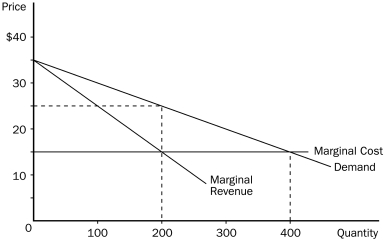 -Refer to Figure 15-7.If there are no fixed costs of production,monopoly profit without price discrimination equals
 (Multiple Choice)
4.8/5 (90)
(90) If one were to compare a competitive market to a monopoly that engages in perfect price discrimination,one could say that
(Multiple Choice)
4.9/5 (80)
(80) After the patent runs out on a brand name drug,generic drugs,which have the same effect as the branded drug,enter the market.Because of this
(Multiple Choice)
4.9/5 (68)
(68) Figure 15-2
The figure below illustrates the cost and revenue structure for a monopoly firm.
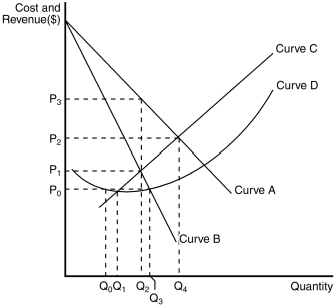 -For a monopoly firm,the shape and position of the demand curve play a role in determining (i) the profit-maximizing price.
(ii) the shape and position of the marginal cost curve.
(iii) the shape and position of the marginal revenue curve.
-For a monopoly firm,the shape and position of the demand curve play a role in determining (i) the profit-maximizing price.
(ii) the shape and position of the marginal cost curve.
(iii) the shape and position of the marginal revenue curve. (Multiple Choice)
4.8/5 (82)
(82) There has been much discussion of deregulating electricity and natural gas delivery companies in the United States.Using your understanding of monopolies,discuss the likely effect of deregulation on prices in these two industries.
(Essay)
4.8/5 (72)
(72) What are the four ways that government policymakers can respond to the problem of monopoly?
(Essay)
4.9/5 (78)
(78) Table 15-5
Dreher's Designer Shirt Company, a monopolist, has the following cost and revenue information. Assume that Dreher's is able to engage in perfect price discrimination.
-Refer to Table 15-5.What is total profit at the profit-maximizing quantity?
-Refer to Table 15-5.What is total profit at the profit-maximizing quantity? (Multiple Choice)
5.0/5 (85)
(85) Table 15-4
Consider the following demand and cost information for a monopoly.
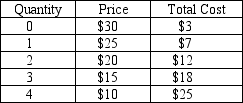 -Refer to Table 15-4.The maximum profit this monopolist can earn is
 (Multiple Choice)
4.9/5 (85)
(85) In a market characterized by monopoly,the market demand curve is
(Multiple Choice)
4.8/5 (75)
(75) Figure 15-7
The figure below depicts the demand, marginal revenue, and marginal cost curves of a profit-maximizing monopolist.
-Refer to Figure 15-7.If the monopoly firm is NOT allowed to price discriminate,then consumer surplus amounts to
-Refer to Figure 15-7.If the monopoly firm is NOT allowed to price discriminate,then consumer surplus amounts to (Multiple Choice)
4.9/5 (92)
(92) The difference in total surplus between the socially efficient level of production and the monopolist's level of production is
(Multiple Choice)
4.8/5 (84)
(84) By offering lower prices to customers who buy a large quantity,a monopoly is price discriminating.
(True/False)
4.9/5 (73)
(73) 
Filters
- Essay(0)
- Multiple Choice(0)
- Short Answer(0)
- True False(0)
- Matching(0)