



 Chat with AI
Exam 15: Monopoly

Exam 1: Ten Principles of Economics237 Questions
Exam 2: Thinking Like an Economist267 Questions
Exam 3: Interdependence and the Gains From Trade217 Questions
Exam 4: The Market Forces of Supply and Demand303 Questions
Exam 5: Elasticity and Its Applications282 Questions
Exam 6: Supply, demand, and Government Policies252 Questions
Exam 7: Consumers, producers, and the Efficiency of Markets248 Questions
Exam 8: Application: the Costs of Taxation245 Questions
Exam 9: Application: International Trade245 Questions
Exam 10: Externalities288 Questions
Exam 11: Public Goods and Common Resources258 Questions
Exam 12: The Design of the Tax System328 Questions
Exam 13: The Costs of Production303 Questions
Exam 14: Firms in Competitive Markets271 Questions
Exam 15: Monopoly306 Questions
Exam 16: Oligopoly291 Questions
Exam 17: Monopolistic Competition257 Questions
Exam 18: The Markets for the Factors of Production284 Questions
Exam 19: Earnings and Discrimination286 Questions
Exam 20: Income Inequality and Poverty247 Questions
Exam 21: The Theory of Consumer Choice238 Questions
Exam 22: Frontiers of Microeconomics199 Questions
Exam 23: Measuring a Nations Income215 Questions
Exam 24: Measuring the Cost of Living208 Questions
Exam 25: Production and Growth240 Questions
Exam 26: Saving, investment, and the Financial System282 Questions
Exam 27: The Basic Tools of Finance249 Questions
Exam 28: Unemployment242 Questions
Exam 29: The Monetary System277 Questions
Exam 30: Money Growth and Inflation224 Questions
Exam 31: Open-Economy Macroeconomics: Basic Concepts256 Questions
Exam 32: A Macroeconomic Theory of the Open Economy217 Questions
Exam 33: Aggregate Demand and Aggregate Supply302 Questions
Exam 34: The Influence of Monetary and Fiscal Policy on Aggregate Demand249 Questions
Exam 35: The Short Run Trade Off Between Inflation and Unemployment246 Questions
Exam 36: Five Debates Over Macroeconomic Policy140 Questions
Select questions type


Scenario 15-2
A monopoly firm maximizes its profit by producing Q = 500 units of output. At that level of output, its marginal revenue is $30, its average revenue is $60, and its average total cost is $34.
-Refer to Scenario 15-2.At Q = 500,the firm's total revenue is
(Multiple Choice)
4.7/5  (74)
(74) Many economists criticize monopolists because they produce at output levels that are not efficient.In other words,monopolists
(Multiple Choice)
5.0/5 (84)
(84) If government officials break a natural monopoly up into several smaller firms,then
(Multiple Choice)
4.7/5 (82)
(82) Why do economists usually prefer private ownership to public ownership of natural monopolies?
(Essay)
4.8/5 (71)
(71) A common solution to monopoly in European countries is public ownership.
(True/False)
4.8/5 (88)
(88) Figure 15-5
The figure below depicts the demand, marginal revenue and marginal cost curves of a profit-maximizing monopolist.
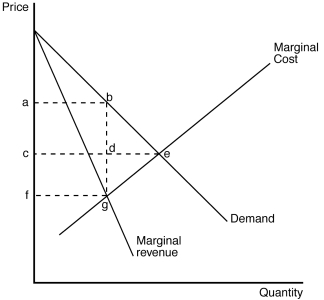 -Refer to Figure 15-5.Which area represents the total surplus lost due to monopoly pricing?
 (Multiple Choice)
4.8/5 (78)
(78) Economic welfare is generally measured by (i) profit.
(ii) total surplus.
(iii) the price consumer's pay for the product.
(Multiple Choice)
4.8/5 (80)
(80) Which of the following would be most likely to have monopoly power?
(Multiple Choice)
4.8/5 (71)
(71) Drug companies are allowed to be monopolists in the drugs they discover in order to
(Multiple Choice)
4.8/5 (70)
(70) Policymakers are discussing various proposals regarding how to deal with natural monopolies.Senator Huff wants to regulate natural monopolies by equating price with average total cost.Huff contends that such a policy will ensure that monopolies make every effort to reduce costs.Senator Puff wants the government to own natural monopolies.Puff argues that government-owned monopolies usually do a better job of holding down costs than privately owned monopolies.Which senator's argument is correct?
(Multiple Choice)
5.0/5 (74)
(74) If the government deems a newly invented drug to be truly original,the pharmaceutical company is given the exclusive right to manufacture and sell the drug for 50 years.
(True/False)
5.0/5 (66)
(66) Which of the following is the most likely reason the city council in New York City consistently denies licenses to independent van drivers selling rides to the public?
(Multiple Choice)
4.8/5 (94)
(94) The following table shows quantity,price,and marginal cost information for a monopoly.What price should the firm charge to maximize its profit? 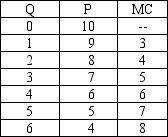
(Multiple Choice)
4.9/5 (82)
(82) Table 15-5
Dreher's Designer Shirt Company, a monopolist, has the following cost and revenue information. Assume that Dreher's is able to engage in perfect price discrimination.
 -Refer to Table 15-5.What is the average revenue when 7 shirts are sold?
 (Multiple Choice)
4.8/5 (74)
(74) 
Filters
- Essay(0)
- Multiple Choice(0)
- Short Answer(0)
- True False(0)
- Matching(0)