



 Chat with AI
Exam 15: Monopoly

Exam 1: Ten Principles of Economics237 Questions
Exam 2: Thinking Like an Economist267 Questions
Exam 3: Interdependence and the Gains From Trade217 Questions
Exam 4: The Market Forces of Supply and Demand303 Questions
Exam 5: Elasticity and Its Applications282 Questions
Exam 6: Supply, demand, and Government Policies252 Questions
Exam 7: Consumers, producers, and the Efficiency of Markets248 Questions
Exam 8: Application: the Costs of Taxation245 Questions
Exam 9: Application: International Trade245 Questions
Exam 10: Externalities288 Questions
Exam 11: Public Goods and Common Resources258 Questions
Exam 12: The Design of the Tax System328 Questions
Exam 13: The Costs of Production303 Questions
Exam 14: Firms in Competitive Markets271 Questions
Exam 15: Monopoly306 Questions
Exam 16: Oligopoly291 Questions
Exam 17: Monopolistic Competition257 Questions
Exam 18: The Markets for the Factors of Production284 Questions
Exam 19: Earnings and Discrimination286 Questions
Exam 20: Income Inequality and Poverty247 Questions
Exam 21: The Theory of Consumer Choice238 Questions
Exam 22: Frontiers of Microeconomics199 Questions
Exam 23: Measuring a Nations Income215 Questions
Exam 24: Measuring the Cost of Living208 Questions
Exam 25: Production and Growth240 Questions
Exam 26: Saving, investment, and the Financial System282 Questions
Exam 27: The Basic Tools of Finance249 Questions
Exam 28: Unemployment242 Questions
Exam 29: The Monetary System277 Questions
Exam 30: Money Growth and Inflation224 Questions
Exam 31: Open-Economy Macroeconomics: Basic Concepts256 Questions
Exam 32: A Macroeconomic Theory of the Open Economy217 Questions
Exam 33: Aggregate Demand and Aggregate Supply302 Questions
Exam 34: The Influence of Monetary and Fiscal Policy on Aggregate Demand249 Questions
Exam 35: The Short Run Trade Off Between Inflation and Unemployment246 Questions
Exam 36: Five Debates Over Macroeconomic Policy140 Questions
Select questions type


Which of the following items is a primary source of barriers to entry?
(Multiple Choice)
4.7/5  (87)
(87) What happens to the price and quantity sold of a drug when its patent runs out? (i) The price will fall.
(ii) The quantity sold will fall.
(iii) The marginal cost of producing the drug will rise.
(Multiple Choice)
4.9/5 (95)
(95) Competitive firms differ from monopolies in which of the following ways? (i) Competitive firms do not have to worry about the price effect lowering their total revenue.
(ii) Marginal revenue for a competitive firm equals price,while marginal revenue for a monopoly is less than the price it is able to charge.
(iii) Monopolies must lower their price in order to sell more of their product,while competitive firms do not.
(Multiple Choice)
4.7/5 (88)
(88) In the market for "home heating" consumers typically have several options (e.g.,electricity,heating fuel,natural gas,propane,etc.)yet we often think of firms in this industry as behaving like monopolists.Using your understanding of monopoly,discuss the context in which your electricity provider is a monopolist.Is this characterization universally applicable? Carefully explain your answer.
(Essay)
4.9/5 (74)
(74) A monopolist faces the following demand curve: 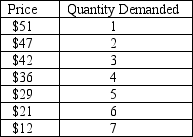 The monopolist has total fixed costs of $60 and has a constant marginal cost of $15.What is the profit-maximizing level of production?
 (Multiple Choice)
4.8/5 (75)
(75) Suppose a monopolist chooses the price and production level which maximizes its profit.From that point,to increase society's economic welfare,output would need to be increased as long as
(Multiple Choice)
4.8/5 (87)
(87) Airlines often separate their customers into business travelers and personal travelers by giving a discount to those travelers who stay over a Saturday night.
(True/False)
4.7/5 (91)
(91) Figure 15-7
The figure below depicts the demand, marginal revenue, and marginal cost curves of a profit-maximizing monopolist.
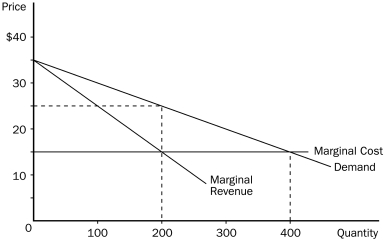 -Refer to Figure 15-7.If there are no fixed costs of production,monopoly profit with perfect price discrimination equals
 (Multiple Choice)
4.8/5 (79)
(79) For a long while,electricity producers were thought to be a classic example of a natural monopoly.People held this view because
(Multiple Choice)
4.9/5 (86)
(86) Which of the following statements comparing monopoly with competition is correct?
(Multiple Choice)
5.0/5 (83)
(83) When a monopoly charges a higher price,fewer of its goods are sold.
(True/False)
4.8/5 (87)
(87) In many countries,the government chooses to "internalize" the monopoly by owning monopoly providers of goods and services.(In some cases these firms are "nationalized" and the government actually buys or confiscates firms that operate in monopoly markets).What would be the advantages and disadvantages of such an approach to ensuring the "best interest of society" is promoted in these markets? Carefully explain your answer.
(Essay)
4.7/5 (92)
(92) If a monopolist sells 100 units at $8 per unit and realizes an average total cost of $6 per unit,what is the monopolist's profit?
(Multiple Choice)
4.9/5 (83)
(83) The amount of power that a monopoly has depends on whether there are close substitutes for its product.
(True/False)
4.8/5 (68)
(68) Figure 15-7
The figure below depicts the demand, marginal revenue, and marginal cost curves of a profit-maximizing monopolist.
-Refer to Figure 15-7.If the monopoly firm perfectly price discriminates,then consumer surplus amounts to
-Refer to Figure 15-7.If the monopoly firm perfectly price discriminates,then consumer surplus amounts to (Multiple Choice)
4.9/5 (74)
(74) 
Filters
- Essay(0)
- Multiple Choice(0)
- Short Answer(0)
- True False(0)
- Matching(0)