



 Chat with AI
Exam 15: Monopoly

Exam 1: Ten Principles of Economics237 Questions
Exam 2: Thinking Like an Economist267 Questions
Exam 3: Interdependence and the Gains From Trade217 Questions
Exam 4: The Market Forces of Supply and Demand303 Questions
Exam 5: Elasticity and Its Applications282 Questions
Exam 6: Supply, demand, and Government Policies252 Questions
Exam 7: Consumers, producers, and the Efficiency of Markets248 Questions
Exam 8: Application: the Costs of Taxation245 Questions
Exam 9: Application: International Trade245 Questions
Exam 10: Externalities288 Questions
Exam 11: Public Goods and Common Resources258 Questions
Exam 12: The Design of the Tax System328 Questions
Exam 13: The Costs of Production303 Questions
Exam 14: Firms in Competitive Markets271 Questions
Exam 15: Monopoly306 Questions
Exam 16: Oligopoly291 Questions
Exam 17: Monopolistic Competition257 Questions
Exam 18: The Markets for the Factors of Production284 Questions
Exam 19: Earnings and Discrimination286 Questions
Exam 20: Income Inequality and Poverty247 Questions
Exam 21: The Theory of Consumer Choice238 Questions
Exam 22: Frontiers of Microeconomics199 Questions
Exam 23: Measuring a Nations Income215 Questions
Exam 24: Measuring the Cost of Living208 Questions
Exam 25: Production and Growth240 Questions
Exam 26: Saving, investment, and the Financial System282 Questions
Exam 27: The Basic Tools of Finance249 Questions
Exam 28: Unemployment242 Questions
Exam 29: The Monetary System277 Questions
Exam 30: Money Growth and Inflation224 Questions
Exam 31: Open-Economy Macroeconomics: Basic Concepts256 Questions
Exam 32: A Macroeconomic Theory of the Open Economy217 Questions
Exam 33: Aggregate Demand and Aggregate Supply302 Questions
Exam 34: The Influence of Monetary and Fiscal Policy on Aggregate Demand249 Questions
Exam 35: The Short Run Trade Off Between Inflation and Unemployment246 Questions
Exam 36: Five Debates Over Macroeconomic Policy140 Questions
Select questions type


Round-trip airline tickets are usually cheaper if you stay over a Saturday night before you fly back.What is the reason for this price discrepancy?
(Multiple Choice)
4.8/5  (65)
(65) When a certain monopoly sets its price at $8 it sells 64 units.When the monopoly sets its price at $10 it sells 60 units.The marginal revenue for the firm over this range is
(Multiple Choice)
4.9/5 (89)
(89) When a monopolist increases the number of units it sells,there are two effects on revenue.They are the
(Multiple Choice)
4.8/5 (87)
(87) Figure 15-6
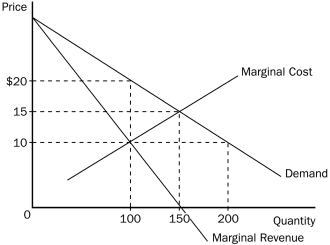 -Refer to Figure 15-6.The deadweight loss caused by a profit-maximizing monopoly amounts to
 (Multiple Choice)
4.8/5 (88)
(88) Figure 15-2
The figure below illustrates the cost and revenue structure for a monopoly firm.
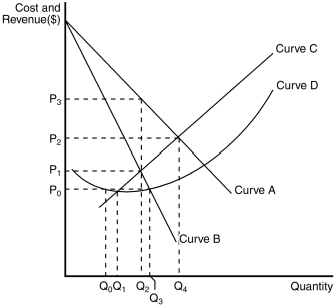 -Which of the following statements is true of a monopoly firm?
 (Multiple Choice)
4.8/5 (75)
(75) Sizable economic profits can persist over time under monopoly if the monopolist
(Multiple Choice)
4.8/5 (88)
(88) A monopolist faces the following demand curve: 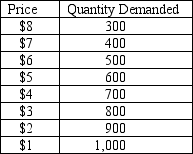 The monopolist has fixed costs of $1,000 and has a constant marginal cost of $2 per unit.If the monopolist were able to perfectly price discriminate,how many units would it sell?
 (Multiple Choice)
4.7/5 (74)
(74) Which of the following statements is (are)true of a monopoly? (i) A monopoly has the ability to set the price of its product at whatever level it desires.
(ii) A monopoly's total revenue will always increase when it increases the price of its product.
(iii) A monopoly can earn unlimited profits.
(Multiple Choice)
4.8/5 (77)
(77) Table 15-1
 -Refer to Table 15-1.Assume this monopolist's marginal cost is constant at $12.What quantity of output (Q)will it produce and what price (P)will it charge?
 (Multiple Choice)
4.8/5 (84)
(84) The key difference between a competitive firm and a monopoly firm is the ability to select
(Multiple Choice)
4.8/5 (87)
(87) Which of the following statements is true about patents and copyrights? (i) They both have benefits and costs.
(ii) They lead to higher prices.
(iii) They enhance the ability of monopolists to earn above-average profits.
(Multiple Choice)
4.9/5 (83)
(83) The practice of selling the same goods to different customers at different prices,but with the same marginal cost,is known as
(Multiple Choice)
5.0/5 (73)
(73) Scenario 15-2
A monopoly firm maximizes its profit by producing Q = 500 units of output. At that level of output, its marginal revenue is $30, its average revenue is $60, and its average total cost is $34.
-Refer to Scenario 15-2.At Q = 500,the firm's marginal cost is
(Multiple Choice)
5.0/5 (86)
(86) It is not uncommon to find that prescription drugs sell for more in the United States than they do in other countries.Which of the following statements about this issue is most likely to be true?
(Multiple Choice)
4.9/5 (69)
(69) 
Filters
- Essay(0)
- Multiple Choice(0)
- Short Answer(0)
- True False(0)
- Matching(0)