



 Chat with AI
Exam 15: Monopoly

Exam 1: Ten Principles of Economics237 Questions
Exam 2: Thinking Like an Economist267 Questions
Exam 3: Interdependence and the Gains From Trade217 Questions
Exam 4: The Market Forces of Supply and Demand303 Questions
Exam 5: Elasticity and Its Applications282 Questions
Exam 6: Supply, demand, and Government Policies252 Questions
Exam 7: Consumers, producers, and the Efficiency of Markets248 Questions
Exam 8: Application: the Costs of Taxation245 Questions
Exam 9: Application: International Trade245 Questions
Exam 10: Externalities288 Questions
Exam 11: Public Goods and Common Resources258 Questions
Exam 12: The Design of the Tax System328 Questions
Exam 13: The Costs of Production303 Questions
Exam 14: Firms in Competitive Markets271 Questions
Exam 15: Monopoly306 Questions
Exam 16: Oligopoly291 Questions
Exam 17: Monopolistic Competition257 Questions
Exam 18: The Markets for the Factors of Production284 Questions
Exam 19: Earnings and Discrimination286 Questions
Exam 20: Income Inequality and Poverty247 Questions
Exam 21: The Theory of Consumer Choice238 Questions
Exam 22: Frontiers of Microeconomics199 Questions
Exam 23: Measuring a Nations Income215 Questions
Exam 24: Measuring the Cost of Living208 Questions
Exam 25: Production and Growth240 Questions
Exam 26: Saving, investment, and the Financial System282 Questions
Exam 27: The Basic Tools of Finance249 Questions
Exam 28: Unemployment242 Questions
Exam 29: The Monetary System277 Questions
Exam 30: Money Growth and Inflation224 Questions
Exam 31: Open-Economy Macroeconomics: Basic Concepts256 Questions
Exam 32: A Macroeconomic Theory of the Open Economy217 Questions
Exam 33: Aggregate Demand and Aggregate Supply302 Questions
Exam 34: The Influence of Monetary and Fiscal Policy on Aggregate Demand249 Questions
Exam 35: The Short Run Trade Off Between Inflation and Unemployment246 Questions
Exam 36: Five Debates Over Macroeconomic Policy140 Questions
Select questions type


Firms with substantial monopoly power are quite common,because many goods are truly unique.
(True/False)
4.8/5  (82)
(82) Table 15-2
Dreher's Designer Shirt Company, a monopolist, has the following cost and revenue information.
 -Refer to Table 15-2.What are Dreher's Designer Shirt Company's fixed costs?
 (Multiple Choice)
4.8/5 (75)
(75) Table 15-2
Dreher's Designer Shirt Company, a monopolist, has the following cost and revenue information.
-Refer to Table 15-2.What is the marginal cost of the 6th shirt?
-Refer to Table 15-2.What is the marginal cost of the 6th shirt? (Multiple Choice)
4.8/5 (102)
(102) When deciding what price to charge consumers,the monopolist may choose to charge them different prices based on the customers'
(Multiple Choice)
4.8/5 (84)
(84) Scenario 15-3
Black Box Cable TV is able to purchase an exclusive right to sell a premium movie channel (PMC) in its market area. Let's assume that Black Box Cable pays $150,000 a year for the exclusive marketing rights to PMC. Since Black Box has already installed cable to all of the homes in its market area, the marginal cost of delivering PMC to subscribers is zero. The manager of Black Box needs to know what price to charge for the PMC service to maximize her profit. Before setting price, she hires an economist to estimate demand for the PMC service. The economist discovers that there are two types of subscribers who value premium movie channels. First are the 4,000 die-hard TV viewers who will pay as much as $150 a year for the new PMC premium channel. Second, the PMC channel will appeal to about 20,000 occasional TV viewers who will pay as much as $20 a year for a subscription to PMC.
-Refer to Scenario 15-3.What is the deadweight loss associated with the nondiscriminating pricing policy compared to the price discriminating policy?
(Multiple Choice)
4.8/5 (86)
(86) Table 15-5
Dreher's Designer Shirt Company, a monopolist, has the following cost and revenue information. Assume that Dreher's is able to engage in perfect price discrimination.
 -Refer to Table 15-5.What is the quantity that maximizes economic profit?
 (Multiple Choice)
4.9/5 (86)
(86) A rational pricing strategy for a profit-maximizing monopolist is
(Multiple Choice)
4.8/5 (71)
(71) Splitting up a monopoly is often justified on the grounds that
(Multiple Choice)
4.9/5 (67)
(67) Table 15-4
Consider the following demand and cost information for a monopoly.
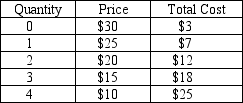 -Refer to Table 15-4.The marginal cost of the fourth unit is
 (Multiple Choice)
4.8/5 (77)
(77) Figure 15-4
The figure below depicts the demand and marginal cost curves of a profit-maximizing monopolist.
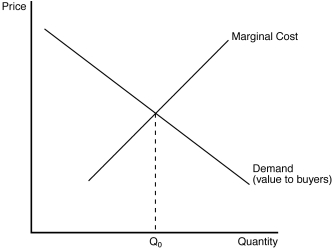 -Refer to Figure 15-4.A benevolent social planner would have the monopoly operate at an output level
 (Multiple Choice)
4.8/5 (77)
(77) Additional firms often do not try to compete with a natural monopoly because
(Multiple Choice)
5.0/5 (75)
(75) When a monopolist increases the amount of output that it produces and sells,the price of its output
(Multiple Choice)
4.9/5 (73)
(73) Goods that do not have close substitutes have downward-sloping demand curves.
(True/False)
4.8/5 (90)
(90) Scenario 15-1
Consider a transportation corporation named C.R. Evans that has just completed the development of a new subway system in a medium-sized town in the Northwest. Currently, there are plenty of seats on the subway, and it is never crowded. Its capacity far exceeds the needs of the city. After just a few years of operation, the shareholders of C.R. Evans experienced incredible rates of return on their investment, due to the profitability of the corporation.
-Refer to Scenario 15-1.C.R.Evans will continue to be a monopolist in the subway transportation industry only if
(Multiple Choice)
4.7/5 (84)
(84) One solution to the problems of marginal-cost pricing of a regulated monopolist is average cost pricing.In this model,the monopolist is allowed to price its production at average total cost.How does average-cost pricing differ from marginal-cost pricing? Does this solution maximize social well-being?
(Essay)
4.9/5 (76)
(76) Scenario 15-3
Black Box Cable TV is able to purchase an exclusive right to sell a premium movie channel (PMC) in its market area. Let's assume that Black Box Cable pays $150,000 a year for the exclusive marketing rights to PMC. Since Black Box has already installed cable to all of the homes in its market area, the marginal cost of delivering PMC to subscribers is zero. The manager of Black Box needs to know what price to charge for the PMC service to maximize her profit. Before setting price, she hires an economist to estimate demand for the PMC service. The economist discovers that there are two types of subscribers who value premium movie channels. First are the 4,000 die-hard TV viewers who will pay as much as $150 a year for the new PMC premium channel. Second, the PMC channel will appeal to about 20,000 occasional TV viewers who will pay as much as $20 a year for a subscription to PMC.
-Refer to Scenario 15-3.If Black Box Cable TV is able to price discriminate,what would be the maximum amount of profit it could generate?
(Multiple Choice)
4.9/5 (84)
(84) 
Filters
- Essay(0)
- Multiple Choice(0)
- Short Answer(0)
- True False(0)
- Matching(0)