



 Chat with AI
Exam 15: Monopoly

Exam 1: Ten Principles of Economics237 Questions
Exam 2: Thinking Like an Economist267 Questions
Exam 3: Interdependence and the Gains From Trade217 Questions
Exam 4: The Market Forces of Supply and Demand303 Questions
Exam 5: Elasticity and Its Applications282 Questions
Exam 6: Supply, demand, and Government Policies252 Questions
Exam 7: Consumers, producers, and the Efficiency of Markets248 Questions
Exam 8: Application: the Costs of Taxation245 Questions
Exam 9: Application: International Trade245 Questions
Exam 10: Externalities288 Questions
Exam 11: Public Goods and Common Resources258 Questions
Exam 12: The Design of the Tax System328 Questions
Exam 13: The Costs of Production303 Questions
Exam 14: Firms in Competitive Markets271 Questions
Exam 15: Monopoly306 Questions
Exam 16: Oligopoly291 Questions
Exam 17: Monopolistic Competition257 Questions
Exam 18: The Markets for the Factors of Production284 Questions
Exam 19: Earnings and Discrimination286 Questions
Exam 20: Income Inequality and Poverty247 Questions
Exam 21: The Theory of Consumer Choice238 Questions
Exam 22: Frontiers of Microeconomics199 Questions
Exam 23: Measuring a Nations Income215 Questions
Exam 24: Measuring the Cost of Living208 Questions
Exam 25: Production and Growth240 Questions
Exam 26: Saving, investment, and the Financial System282 Questions
Exam 27: The Basic Tools of Finance249 Questions
Exam 28: Unemployment242 Questions
Exam 29: The Monetary System277 Questions
Exam 30: Money Growth and Inflation224 Questions
Exam 31: Open-Economy Macroeconomics: Basic Concepts256 Questions
Exam 32: A Macroeconomic Theory of the Open Economy217 Questions
Exam 33: Aggregate Demand and Aggregate Supply302 Questions
Exam 34: The Influence of Monetary and Fiscal Policy on Aggregate Demand249 Questions
Exam 35: The Short Run Trade Off Between Inflation and Unemployment246 Questions
Exam 36: Five Debates Over Macroeconomic Policy140 Questions
Select questions type


If a social planner were running a monopoly,that planner could achieve an efficient outcome by charging the price that is determined by the
(Multiple Choice)
4.8/5  (76)
(76) Name brand drugs are able to continue capitalizing on their market power even after generic drugs enter the market because (i) almost all people fear the generic drug companies are devoting too few resources to research and development.
(ii) some people fear that generic drugs are inferior.
(iii) some people are loyal to the name brand.
(Multiple Choice)
4.9/5 (95)
(95) During the holiday season,high-end retailers frequently place a high price on merchandise on weekends and discount the price during the week.They do this because they believe that two groups of customers exist: shoppers with little free time and bargain hunters.Bargain hunters have time to shop around and frequently shop during the week.What do economists call this price strategy used by high-end retailers?
(Multiple Choice)
4.7/5 (93)
(93) Figure 15-2
The figure below illustrates the cost and revenue structure for a monopoly firm.
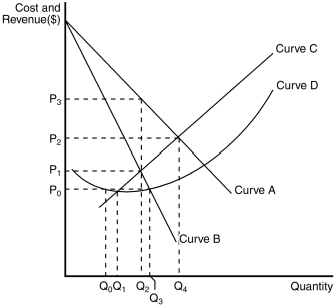 -Refer to Figure 15-2.The average total cost curve for a monopoly firm is depicted by curve
 (Multiple Choice)
4.9/5 (80)
(80) Let's assume that a monopolist decides to maximize revenue,rather than profit.How does this operating objective change the size of the deadweight loss? If you are a "benevolent" manager of a monopoly firm and are interested in reducing the deadweight loss of monopoly,should you maximize profits or maximize revenue? Carefully explain your answer.
(Essay)
4.7/5 (88)
(88) Table 15-5
Dreher's Designer Shirt Company, a monopolist, has the following cost and revenue information. Assume that Dreher's is able to engage in perfect price discrimination.
 -Refer to Table 15-5.What is the marginal revenue from selling the 8th shirt?
 (Multiple Choice)
4.9/5 (81)
(81) Table 15-1
 -Refer to Table 15-1.If the monopolist wants to maximize its revenue,how many units of its product should it sell?
 (Multiple Choice)
4.8/5 (84)
(84) The economic inefficiency of a monopolist can be measured by the
(Multiple Choice)
5.0/5 (79)
(79) Scenario 15-3
Black Box Cable TV is able to purchase an exclusive right to sell a premium movie channel (PMC) in its market area. Let's assume that Black Box Cable pays $150,000 a year for the exclusive marketing rights to PMC. Since Black Box has already installed cable to all of the homes in its market area, the marginal cost of delivering PMC to subscribers is zero. The manager of Black Box needs to know what price to charge for the PMC service to maximize her profit. Before setting price, she hires an economist to estimate demand for the PMC service. The economist discovers that there are two types of subscribers who value premium movie channels. First are the 4,000 die-hard TV viewers who will pay as much as $150 a year for the new PMC premium channel. Second, the PMC channel will appeal to about 20,000 occasional TV viewers who will pay as much as $20 a year for a subscription to PMC.
-Refer to Scenario 15-3.If Black Box Cable TV is unable to price discriminate,what price will it choose to maximize its profit,and what is the amount of the profit?
(Multiple Choice)
5.0/5 (75)
(75) The marginal revenue curve for a monopoly firm starts at the same point on the vertical axis as the (i) average revenue curve.
(ii) marginal cost curve.
(iii) demand curve.
(Multiple Choice)
5.0/5 (86)
(86) What is the defining characteristic of a natural monopoly? Give an example of a natural monopoly.
(Essay)
4.8/5 (80)
(80) An airline knows that there are two types of travelers: business travelers and vacationers.For a particular flight,there are 100 business travelers who will pay $600 for a ticket while there are 50 vacationers who will pay $300 for a ticket.There are 150 seats available on the plane.Suppose the cost to the airline of providing the flight is $20,000,which includes the cost of the pilots,flight attendants,fuel,etc.How much additional profit can the firm earn by charging each customer their willingness to pay relative to charging a flat price of $600 per ticket?
(Multiple Choice)
4.7/5 (86)
(86) In the majority of cases where there is a natural monopoly,the U.S.government usually deals with the problem
(Multiple Choice)
4.9/5 (78)
(78) The assessment by George Stigler concerning the tradeoffs between "market failure" and "political failure" in the American economy provides support for which of the following solutions to the problems of monopolies?
(Multiple Choice)
4.9/5 (98)
(98) A benefit to society of the patent and copyright laws is that those laws
(Multiple Choice)
4.9/5 (87)
(87) For a monopoly,marginal revenue is often greater than the price they charge for their good.
(True/False)
4.9/5 (85)
(85) 
Filters
- Essay(0)
- Multiple Choice(0)
- Short Answer(0)
- True False(0)
- Matching(0)