



 Chat with AI
Exam 9: Application: International Trade

Exam 1: Ten Principles of Economics237 Questions
Exam 2: Thinking Like an Economist267 Questions
Exam 3: Interdependence and the Gains From Trade217 Questions
Exam 4: The Market Forces of Supply and Demand303 Questions
Exam 5: Elasticity and Its Applications282 Questions
Exam 6: Supply, demand, and Government Policies252 Questions
Exam 7: Consumers, producers, and the Efficiency of Markets248 Questions
Exam 8: Application: the Costs of Taxation245 Questions
Exam 9: Application: International Trade245 Questions
Exam 10: Externalities288 Questions
Exam 11: Public Goods and Common Resources258 Questions
Exam 12: The Design of the Tax System328 Questions
Exam 13: The Costs of Production303 Questions
Exam 14: Firms in Competitive Markets271 Questions
Exam 15: Monopoly306 Questions
Exam 16: Oligopoly291 Questions
Exam 17: Monopolistic Competition257 Questions
Exam 18: The Markets for the Factors of Production284 Questions
Exam 19: Earnings and Discrimination286 Questions
Exam 20: Income Inequality and Poverty247 Questions
Exam 21: The Theory of Consumer Choice238 Questions
Exam 22: Frontiers of Microeconomics199 Questions
Exam 23: Measuring a Nations Income215 Questions
Exam 24: Measuring the Cost of Living208 Questions
Exam 25: Production and Growth240 Questions
Exam 26: Saving, investment, and the Financial System282 Questions
Exam 27: The Basic Tools of Finance249 Questions
Exam 28: Unemployment242 Questions
Exam 29: The Monetary System277 Questions
Exam 30: Money Growth and Inflation224 Questions
Exam 31: Open-Economy Macroeconomics: Basic Concepts256 Questions
Exam 32: A Macroeconomic Theory of the Open Economy217 Questions
Exam 33: Aggregate Demand and Aggregate Supply302 Questions
Exam 34: The Influence of Monetary and Fiscal Policy on Aggregate Demand249 Questions
Exam 35: The Short Run Trade Off Between Inflation and Unemployment246 Questions
Exam 36: Five Debates Over Macroeconomic Policy140 Questions
Select questions type


Figure 9-6. The figure applies to the nation of Wales and the good is cheese.
 -Refer to Figure 9-6.Which of the following is a valid equation for Welsh consumer surplus with trade?
 (Multiple Choice)
4.8/5  (77)
(77) Figure 9-1
 -Refer to Figure 9-1.If this country chooses to trade,the price of baskets in this country will be
 (Multiple Choice)
4.9/5 (77)
(77) A major difference between tariffs and import quotas is that
(Multiple Choice)
4.8/5 (82)
(82) After a country goes from disallowing trade in sugar with other countries to allowing trade in sugar with other countries,
(Multiple Choice)
4.7/5 (78)
(78) Which of the following is not an advantage of a multilateral approach to free trade over a unilateral approach?
(Multiple Choice)
4.9/5 (83)
(83) Figure 9-15. The figure below illustrates a tariff. On the graph, Q represents quantity and P represents price.
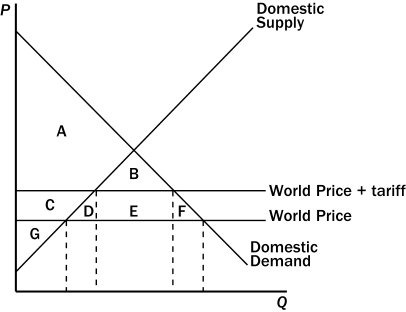 -Refer to Figure 9-15.The tariff
 (Multiple Choice)
4.7/5 (82)
(82) Figure 9-10
 -Refer to Figure 9-10.Consumer surplus in this market before trade is
 (Multiple Choice)
4.8/5 (88)
(88) Figure 9-10
-Refer to Figure 9-10.The change in total surplus in this market because of trade is
-Refer to Figure 9-10.The change in total surplus in this market because of trade is (Multiple Choice)
4.7/5 (68)
(68) Figure 9-5
 -Refer to Figure 9-5.The amount of deadweight loss caused by the tariff equals
 (Multiple Choice)
4.9/5 (86)
(86) Figure 9-1
-Refer to Figure 9-1.As a result of trade,total surplus increases by
-Refer to Figure 9-1.As a result of trade,total surplus increases by (Multiple Choice)
4.7/5 (80)
(80) Import quotas and tariffs make domestic sellers better off and domestic buyers worse off.
(True/False)
4.8/5 (79)
(79) Economists agree that trade ought to be restricted if free trade means that domestic jobs might be lost because of foreign competition.
(True/False)
4.9/5 (89)
(89) Figure 9-10
-Refer to Figure 9-10.Producer surplus in this market after trade is
-Refer to Figure 9-10.Producer surplus in this market after trade is (Multiple Choice)
4.8/5 (87)
(87) Figure 9-4
 -Refer to Figure 9-4.The increase in total surplus resulting from trade is
 (Multiple Choice)
4.9/5 (85)
(85) A tariff increases the quantity of imports and moves the market farther from its equilibrium without trade.
(True/False)
4.8/5 (79)
(79) Figure 9-6. The figure applies to the nation of Wales and the good is cheese.
-Refer to Figure 9-6.The equilibrium price and the equilibrium quantity of cheese in Wales before trade are
-Refer to Figure 9-6.The equilibrium price and the equilibrium quantity of cheese in Wales before trade are (Multiple Choice)
4.9/5 (65)
(65) Figure 9-2. The domestic country is China.
 -Refer to Figure 9-2.The increase in total surplus in China when trade becomes allowed is
 (Multiple Choice)
4.9/5 (83)
(83) The sum of consumer and producer surplus measures the total benefits that buyers and sellers receive from participating in a market.
(True/False)
4.9/5 (82)
(82) Figure 9-12
 -Refer to Figure 9-12.The price and domestic quantity demanded after trade are
 (Multiple Choice)
4.9/5 (95)
(95) 
Filters
- Essay(0)
- Multiple Choice(0)
- Short Answer(0)
- True False(0)
- Matching(0)