



 Chat with AI
Exam 9: Application: International Trade

Exam 1: Ten Principles of Economics237 Questions
Exam 2: Thinking Like an Economist267 Questions
Exam 3: Interdependence and the Gains From Trade217 Questions
Exam 4: The Market Forces of Supply and Demand303 Questions
Exam 5: Elasticity and Its Applications282 Questions
Exam 6: Supply, demand, and Government Policies252 Questions
Exam 7: Consumers, producers, and the Efficiency of Markets248 Questions
Exam 8: Application: the Costs of Taxation245 Questions
Exam 9: Application: International Trade245 Questions
Exam 10: Externalities288 Questions
Exam 11: Public Goods and Common Resources258 Questions
Exam 12: The Design of the Tax System328 Questions
Exam 13: The Costs of Production303 Questions
Exam 14: Firms in Competitive Markets271 Questions
Exam 15: Monopoly306 Questions
Exam 16: Oligopoly291 Questions
Exam 17: Monopolistic Competition257 Questions
Exam 18: The Markets for the Factors of Production284 Questions
Exam 19: Earnings and Discrimination286 Questions
Exam 20: Income Inequality and Poverty247 Questions
Exam 21: The Theory of Consumer Choice238 Questions
Exam 22: Frontiers of Microeconomics199 Questions
Exam 23: Measuring a Nations Income215 Questions
Exam 24: Measuring the Cost of Living208 Questions
Exam 25: Production and Growth240 Questions
Exam 26: Saving, investment, and the Financial System282 Questions
Exam 27: The Basic Tools of Finance249 Questions
Exam 28: Unemployment242 Questions
Exam 29: The Monetary System277 Questions
Exam 30: Money Growth and Inflation224 Questions
Exam 31: Open-Economy Macroeconomics: Basic Concepts256 Questions
Exam 32: A Macroeconomic Theory of the Open Economy217 Questions
Exam 33: Aggregate Demand and Aggregate Supply302 Questions
Exam 34: The Influence of Monetary and Fiscal Policy on Aggregate Demand249 Questions
Exam 35: The Short Run Trade Off Between Inflation and Unemployment246 Questions
Exam 36: Five Debates Over Macroeconomic Policy140 Questions
Select questions type


If a country's domestic price of a good is lower than the world price,then that country has a comparative advantage in producing that good.
(True/False)
4.8/5  (69)
(69) Figure 9-13. On the diagram below, Q represents the quantity of computers and P represents the price of computers.
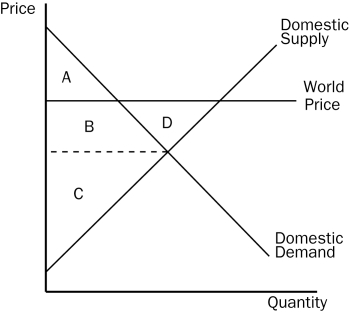 -Refer to Figure 9-13.A result of this country allowing international trade in computers is as follows:
 (Multiple Choice)
4.7/5 (85)
(85) Figure 9-14
 -Refer to Figure 9-14.For the saddle market,area B represents
 (Multiple Choice)
4.7/5 (76)
(76) Figure 9-12
 -Refer to Figure 9-12.Consumer surplus after trade is
 (Multiple Choice)
4.8/5 (68)
(68) Figure 9-6. The figure applies to the nation of Wales and the good is cheese.
 -Refer to Figure 9-6.Which of the following is a valid equation for Welsh producer surplus with trade?
 (Multiple Choice)
4.9/5 (75)
(75) The price of a good that prevails in a world market is called the
(Multiple Choice)
4.8/5 (75)
(75) Policymakers often consider trade restrictions in order to protect domestic producers from foreign competitors.
(True/False)
4.9/5 (75)
(75) Suppose France subsidizes French wheat farmers,while Germany offers no subsidy to German wheat farmers.As a result of the French subsidy,sales of French wheat to Germany
(Multiple Choice)
4.9/5 (79)
(79) Figure 9-5
 -Refer to Figure 9-5.The amount of revenue collected by the government from the tariff is
 (Multiple Choice)
4.9/5 (87)
(87) When a government imposes a tariff on a product,the domestic price will equal the world price.
(True/False)
4.8/5 (88)
(88) Figure 9-4
 -Refer to Figure 9-4.With trade,the price of wagons in this country is
 (Multiple Choice)
4.9/5 (84)
(84) GATT is an example of a successful unilateral approach to achieving free trade.
(True/False)
4.8/5 (78)
(78) An important factor in the decline of the U.S.textile industry over the past 100 or so years is
(Multiple Choice)
4.8/5 (67)
(67) Figure 9-10
 -Refer to Figure 9-10.Producer surplus plus consumer surplus in this market after trade is
 (Multiple Choice)
4.8/5 (86)
(86) When a country allows trade and becomes an exporter of a good,
(Multiple Choice)
4.8/5 (76)
(76) Figure 9-2. The domestic country is China.
 -Refer to Figure 9-2.If China were to abandon a no-trade policy in favor of a free-trade policy,
 (Multiple Choice)
4.8/5 (79)
(79) When the nation of Econoland allows trade and becomes an exporter of televisions,
(Multiple Choice)
4.9/5 (75)
(75) According to the principle of comparative advantage,all countries can benefit from trading with one another because trade allows each country to specialize in doing what it does best.
(True/False)
4.9/5 (92)
(92) 
Filters
- Essay(0)
- Multiple Choice(0)
- Short Answer(0)
- True False(0)
- Matching(0)