



 Chat with AI
Exam 9: Application: International Trade

Exam 1: Ten Principles of Economics237 Questions
Exam 2: Thinking Like an Economist267 Questions
Exam 3: Interdependence and the Gains From Trade217 Questions
Exam 4: The Market Forces of Supply and Demand303 Questions
Exam 5: Elasticity and Its Applications282 Questions
Exam 6: Supply, demand, and Government Policies252 Questions
Exam 7: Consumers, producers, and the Efficiency of Markets248 Questions
Exam 8: Application: the Costs of Taxation245 Questions
Exam 9: Application: International Trade245 Questions
Exam 10: Externalities288 Questions
Exam 11: Public Goods and Common Resources258 Questions
Exam 12: The Design of the Tax System328 Questions
Exam 13: The Costs of Production303 Questions
Exam 14: Firms in Competitive Markets271 Questions
Exam 15: Monopoly306 Questions
Exam 16: Oligopoly291 Questions
Exam 17: Monopolistic Competition257 Questions
Exam 18: The Markets for the Factors of Production284 Questions
Exam 19: Earnings and Discrimination286 Questions
Exam 20: Income Inequality and Poverty247 Questions
Exam 21: The Theory of Consumer Choice238 Questions
Exam 22: Frontiers of Microeconomics199 Questions
Exam 23: Measuring a Nations Income215 Questions
Exam 24: Measuring the Cost of Living208 Questions
Exam 25: Production and Growth240 Questions
Exam 26: Saving, investment, and the Financial System282 Questions
Exam 27: The Basic Tools of Finance249 Questions
Exam 28: Unemployment242 Questions
Exam 29: The Monetary System277 Questions
Exam 30: Money Growth and Inflation224 Questions
Exam 31: Open-Economy Macroeconomics: Basic Concepts256 Questions
Exam 32: A Macroeconomic Theory of the Open Economy217 Questions
Exam 33: Aggregate Demand and Aggregate Supply302 Questions
Exam 34: The Influence of Monetary and Fiscal Policy on Aggregate Demand249 Questions
Exam 35: The Short Run Trade Off Between Inflation and Unemployment246 Questions
Exam 36: Five Debates Over Macroeconomic Policy140 Questions
Select questions type


Figure 9-5
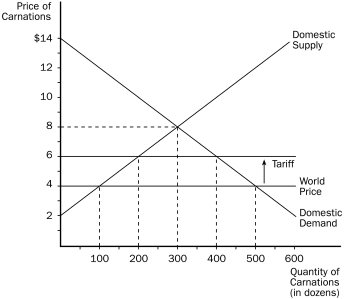 -Refer to Figure 9-5.When the tariff is imposed,domestic consumers
 (Multiple Choice)
4.9/5  (86)
(86) Figure 9-6. The figure applies to the nation of Wales and the good is cheese.
 -Refer to Figure 9-6.With trade,the Welsh price of cheese and the Welsh quantity of cheese demanded are
 (Multiple Choice)
4.8/5 (83)
(83) If Honduras were to subsidize the production of wool blankets and sell them in Sweden at artificially low prices,the Swedish economy would be worse off.
(True/False)
4.8/5 (72)
(72) Figure 9-1
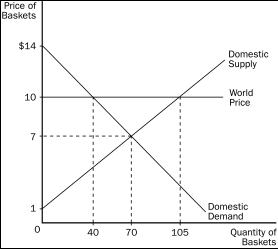 -Refer to Figure 9-1.With free trade,producer surplus is
 (Multiple Choice)
4.8/5 (70)
(70) When a country allows trade and becomes an importer of a good,
(Multiple Choice)
4.8/5 (80)
(80) When a country allows trade and becomes an exporter of a good,
(Multiple Choice)
4.9/5 (75)
(75) Aquilonia has decided to end its policy of not trading with the rest of the world.When it ends its trade restrictions,it discovers that it is importing incense,exporting steel,and neither importing nor exporting rugs.We can conclude that producer surplus in Aquilonia is now
(Multiple Choice)
4.9/5 (81)
(81) Figure 9-2. The domestic country is China.
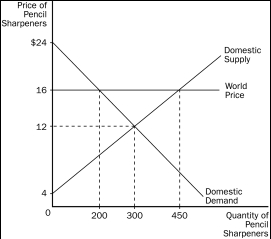 -Refer to Figure 9-2.With trade,China will
 (Multiple Choice)
4.8/5 (73)
(73) Figure 9-4
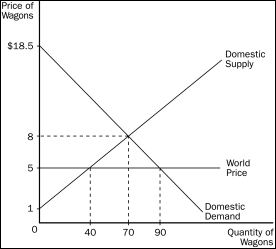 -Refer to Figure 9-4.Total surplus with trade exceeds total surplus without trade by
 (Multiple Choice)
4.9/5 (82)
(82) Aquilonia has decided to end its policy of not trading with the rest of the world.When it ends its trade restrictions,it discovers that it is importing incense,exporting steel,and neither importing nor exporting rugs.We can conclude that Aquilonia's new free-trade policy has
(Multiple Choice)
4.9/5 (86)
(86) Critics of free trade sometimes argue that allowing imports from foreign countries causes a reduction in the number of domestic jobs.An economist would argue that
(Multiple Choice)
4.7/5 (80)
(80) When a country takes a unilateral approach to free trade,it
(Multiple Choice)
4.9/5 (75)
(75) Within a country,the domestic price of a product will equal the world price if
(Multiple Choice)
4.9/5 (85)
(85) Free trade causes job losses in industries in which a country does not have a comparative advantage,but it also causes job gains in industries in which the country has a comparative advantage.
(True/False)
5.0/5 (72)
(72) When a country takes a multilateral approach to free trade,it
(Multiple Choice)
4.7/5 (75)
(75) Figure 9-8
 -Refer to Figure 9-8.Producer surplus in this market before trade is
 (Multiple Choice)
4.9/5 (78)
(78) If the United States threatens to impose a tariff on German cars if Germany does not remove agricultural subsidies,the United States will be
(Multiple Choice)
4.7/5 (79)
(79) Which of the following arguments for trade restrictions is often advanced?
(Multiple Choice)
4.9/5 (80)
(80) 
Filters
- Essay(0)
- Multiple Choice(0)
- Short Answer(0)
- True False(0)
- Matching(0)