



 Chat with AI
Exam 9: Application: International Trade

Exam 1: Ten Principles of Economics237 Questions
Exam 2: Thinking Like an Economist267 Questions
Exam 3: Interdependence and the Gains From Trade217 Questions
Exam 4: The Market Forces of Supply and Demand303 Questions
Exam 5: Elasticity and Its Applications282 Questions
Exam 6: Supply, demand, and Government Policies252 Questions
Exam 7: Consumers, producers, and the Efficiency of Markets248 Questions
Exam 8: Application: the Costs of Taxation245 Questions
Exam 9: Application: International Trade245 Questions
Exam 10: Externalities288 Questions
Exam 11: Public Goods and Common Resources258 Questions
Exam 12: The Design of the Tax System328 Questions
Exam 13: The Costs of Production303 Questions
Exam 14: Firms in Competitive Markets271 Questions
Exam 15: Monopoly306 Questions
Exam 16: Oligopoly291 Questions
Exam 17: Monopolistic Competition257 Questions
Exam 18: The Markets for the Factors of Production284 Questions
Exam 19: Earnings and Discrimination286 Questions
Exam 20: Income Inequality and Poverty247 Questions
Exam 21: The Theory of Consumer Choice238 Questions
Exam 22: Frontiers of Microeconomics199 Questions
Exam 23: Measuring a Nations Income215 Questions
Exam 24: Measuring the Cost of Living208 Questions
Exam 25: Production and Growth240 Questions
Exam 26: Saving, investment, and the Financial System282 Questions
Exam 27: The Basic Tools of Finance249 Questions
Exam 28: Unemployment242 Questions
Exam 29: The Monetary System277 Questions
Exam 30: Money Growth and Inflation224 Questions
Exam 31: Open-Economy Macroeconomics: Basic Concepts256 Questions
Exam 32: A Macroeconomic Theory of the Open Economy217 Questions
Exam 33: Aggregate Demand and Aggregate Supply302 Questions
Exam 34: The Influence of Monetary and Fiscal Policy on Aggregate Demand249 Questions
Exam 35: The Short Run Trade Off Between Inflation and Unemployment246 Questions
Exam 36: Five Debates Over Macroeconomic Policy140 Questions
Select questions type


The price of cotton that prevails in international markets is called the
(Multiple Choice)
4.8/5  (80)
(80) Figure 9-1
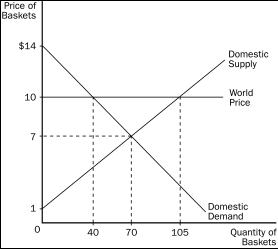 -Refer to Figure 9-1.Without trade,producer surplus is
 (Multiple Choice)
4.7/5 (86)
(86) Figure 9-4
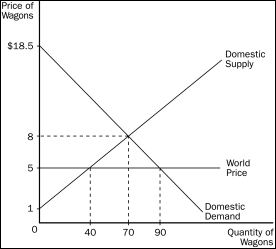 -Refer to Figure 9-4.If this country allows free trade in wagons,
 (Multiple Choice)
4.8/5 (72)
(72) If a country allows trade and,for a certain good,the domestic price without trade is lower than the world price,
(Multiple Choice)
4.7/5 (83)
(83) Figure 9-9. The figure applies to the nation of Kenya and the good is air conditioners.
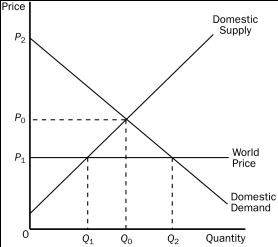 -Refer to Figure 9-9.With trade,the equilibrium price of air conditioners and the equilibrium quantity of air conditioners demanded in Kenya are
 (Multiple Choice)
4.8/5 (63)
(63) Figure 9-14
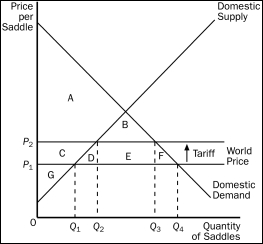 -Refer to Figure 9-14.With trade and without a tariff,the price and domestic quantity demanded are
 (Multiple Choice)
4.9/5 (76)
(76) When a country allows trade and becomes an importer of a good,
(Multiple Choice)
4.9/5 (83)
(83) Figure 9-6. The figure applies to the nation of Wales and the good is cheese.
 -Refer to Figure 9-6.Which of the following is a valid equation for the gains from trade?
 (Multiple Choice)
4.8/5 (95)
(95) If the world price of textiles is higher than Vietnam's domestic price of textiles without trade,then Vietnam
(Multiple Choice)
4.7/5 (87)
(87) The United States has imposed taxes on some imported goods that have been sold here by foreign countries at below their cost of production.These taxes
(Multiple Choice)
4.8/5 (74)
(74) Figure 9-5
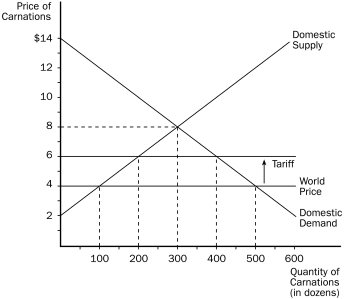 -Refer to Figure 9-5.The imposition of a tariff on carnations
 (Multiple Choice)
4.9/5 (81)
(81) When a country allows international trade and becomes an importer of a good,
(Multiple Choice)
4.9/5 (84)
(84) Figure 9-4
-Refer to Figure 9-4.Bearing in mind that this country is "small," what would happen if there were a decrease in the price of wagon wheels within this country,given that wagons and wagon wheels are complements?
-Refer to Figure 9-4.Bearing in mind that this country is "small," what would happen if there were a decrease in the price of wagon wheels within this country,given that wagons and wagon wheels are complements? (Multiple Choice)
4.7/5 (76)
(76) Senator Blowhard represents a state in which many textile firms are located.He wants to impose tariffs on all imported textiles.Which of the following is the least likely consequence of such tariffs?
(Multiple Choice)
4.9/5 (65)
(65) Deadweight loss measures the decrease in total surplus that results from a tariff or quota.
(True/False)
4.9/5 (71)
(71) Suppose Scotland goes from being an isolated country to being an exporter of wool.As a result,
(Multiple Choice)
5.0/5 (83)
(83) 
Filters
- Essay(0)
- Multiple Choice(0)
- Short Answer(0)
- True False(0)
- Matching(0)