



 Chat with AI
Exam 9: Application: International Trade

Exam 1: Ten Principles of Economics237 Questions
Exam 2: Thinking Like an Economist267 Questions
Exam 3: Interdependence and the Gains From Trade217 Questions
Exam 4: The Market Forces of Supply and Demand303 Questions
Exam 5: Elasticity and Its Applications282 Questions
Exam 6: Supply, demand, and Government Policies252 Questions
Exam 7: Consumers, producers, and the Efficiency of Markets248 Questions
Exam 8: Application: the Costs of Taxation245 Questions
Exam 9: Application: International Trade245 Questions
Exam 10: Externalities288 Questions
Exam 11: Public Goods and Common Resources258 Questions
Exam 12: The Design of the Tax System328 Questions
Exam 13: The Costs of Production303 Questions
Exam 14: Firms in Competitive Markets271 Questions
Exam 15: Monopoly306 Questions
Exam 16: Oligopoly291 Questions
Exam 17: Monopolistic Competition257 Questions
Exam 18: The Markets for the Factors of Production284 Questions
Exam 19: Earnings and Discrimination286 Questions
Exam 20: Income Inequality and Poverty247 Questions
Exam 21: The Theory of Consumer Choice238 Questions
Exam 22: Frontiers of Microeconomics199 Questions
Exam 23: Measuring a Nations Income215 Questions
Exam 24: Measuring the Cost of Living208 Questions
Exam 25: Production and Growth240 Questions
Exam 26: Saving, investment, and the Financial System282 Questions
Exam 27: The Basic Tools of Finance249 Questions
Exam 28: Unemployment242 Questions
Exam 29: The Monetary System277 Questions
Exam 30: Money Growth and Inflation224 Questions
Exam 31: Open-Economy Macroeconomics: Basic Concepts256 Questions
Exam 32: A Macroeconomic Theory of the Open Economy217 Questions
Exam 33: Aggregate Demand and Aggregate Supply302 Questions
Exam 34: The Influence of Monetary and Fiscal Policy on Aggregate Demand249 Questions
Exam 35: The Short Run Trade Off Between Inflation and Unemployment246 Questions
Exam 36: Five Debates Over Macroeconomic Policy140 Questions
Select questions type


Assume,for Canada,that the domestic price of steel without international trade is higher than the world price of steel.This suggests that,in the production of steel,
(Multiple Choice)
4.8/5  (81)
(81) Suppose a country begins to allow international trade in steel.Which of the following outcomes will be observed regardless of whether the country finds itself importing steel or exporting steel?
(Multiple Choice)
4.8/5 (85)
(85) What are the arguments in favor of trade restrictions,and what are the counterarguments? According to most economists,do any of these arguments really justify trade restrictions? Explain.
(Essay)
4.8/5 (75)
(75) Figure 9-8
 -Refer to Figure 9-8.Consumer surplus in this market before trade is
 (Multiple Choice)
4.9/5 (85)
(85) When,in our analysis of the gains and losses of international trade,we assume that a country is small,we are in effect assuming that the country
(Multiple Choice)
4.9/5 (78)
(78) Figure 9-9. The figure applies to the nation of Kenya and the good is air conditioners.
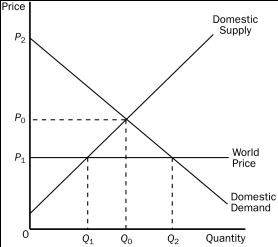 -Refer to Figure 9-9.The area bounded by the points (Q₀,P₀),(Q₂,P₁),and (Q₁,P₁)represents
 (Multiple Choice)
4.8/5 (84)
(84) Figure 9-6. The figure applies to the nation of Wales and the good is cheese.
 -Refer to Figure 9-6.With trade,Wales
 (Multiple Choice)
4.8/5 (84)
(84) Figure 9-2. The domestic country is China.
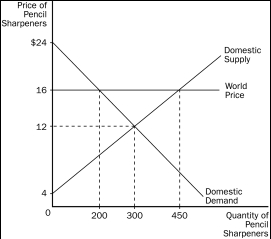 -Refer to Figure 9-2.With no international trade,
 (Multiple Choice)
4.9/5 (72)
(72) Figure 9-4
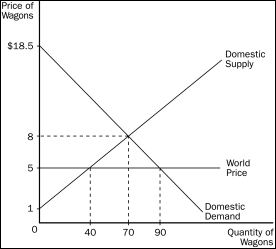 -Refer to Figure 9-4.Bearing in mind that this country is "small," which of the following events conceivably could cause the country to switch from being an importer of wagons to an exporter of wagons?
 (Multiple Choice)
4.8/5 (68)
(68) Figure 9-12
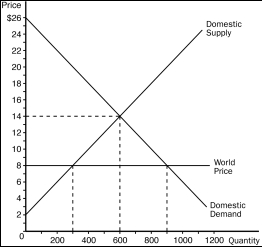 -Refer to Figure 9-12.Producer surplus before trade is
 (Multiple Choice)
4.9/5 (81)
(81) Suppose the United States exports cars to France and imports cheese from Switzerland.This situation suggests that
(Multiple Choice)
4.7/5 (64)
(64) Assume,for the U.S.,that the domestic price of beef without international trade is lower than the world price of beef.This suggests that,in the production of beef,
(Multiple Choice)
4.8/5 (85)
(85) Suppose Mexico imposes a tariff on lumber.For the tariff to have any effect,it must be the case that
(Multiple Choice)
4.7/5 (73)
(73) Trade raises the economic well-being of a nation in the sense that
(Multiple Choice)
4.8/5 (83)
(83) Figure 9-14
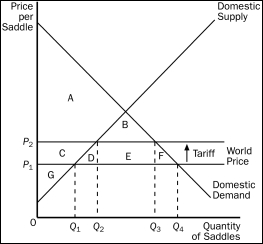 -Refer to Figure 9-14.A result of the tariff is that,relative to the free-trade situation,the quantity of saddles imported decreases by
 (Multiple Choice)
4.9/5 (74)
(74) Figure 9-4
-Refer to Figure 9-4.With trade,total surplus is
-Refer to Figure 9-4.With trade,total surplus is (Multiple Choice)
4.9/5 (82)
(82) Trade decisions are based on the principle of absolute advantage.
(True/False)
4.9/5 (62)
(62) Scenario 9-1
The before-trade domestic price of tomatoes in the United States is $500 per ton. The world price of tomatoes is $600 per ton. The U.S. is a price-taker in the tomatoes market.
-Refer to Scenario 9-1.If trade in tomatoes is allowed,the price of tomatoes in the United States
(Multiple Choice)
4.9/5 (81)
(81) Figure 9-14
-Refer to Figure 9-14.With the tariff,the quantity of saddles imported is
-Refer to Figure 9-14.With the tariff,the quantity of saddles imported is (Multiple Choice)
4.9/5 (72)
(72) Figure 9-5
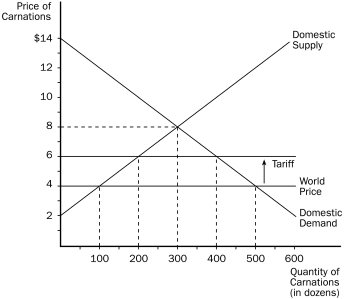 -Refer to Figure 9-5.The size of the tariff on carnations is
 (Multiple Choice)
4.8/5 (79)
(79) 
Filters
- Essay(0)
- Multiple Choice(0)
- Short Answer(0)
- True False(0)
- Matching(0)