



 Chat with AI
Exam 9: Application: International Trade

Exam 1: Ten Principles of Economics237 Questions
Exam 2: Thinking Like an Economist267 Questions
Exam 3: Interdependence and the Gains From Trade217 Questions
Exam 4: The Market Forces of Supply and Demand303 Questions
Exam 5: Elasticity and Its Applications282 Questions
Exam 6: Supply, demand, and Government Policies252 Questions
Exam 7: Consumers, producers, and the Efficiency of Markets248 Questions
Exam 8: Application: the Costs of Taxation245 Questions
Exam 9: Application: International Trade245 Questions
Exam 10: Externalities288 Questions
Exam 11: Public Goods and Common Resources258 Questions
Exam 12: The Design of the Tax System328 Questions
Exam 13: The Costs of Production303 Questions
Exam 14: Firms in Competitive Markets271 Questions
Exam 15: Monopoly306 Questions
Exam 16: Oligopoly291 Questions
Exam 17: Monopolistic Competition257 Questions
Exam 18: The Markets for the Factors of Production284 Questions
Exam 19: Earnings and Discrimination286 Questions
Exam 20: Income Inequality and Poverty247 Questions
Exam 21: The Theory of Consumer Choice238 Questions
Exam 22: Frontiers of Microeconomics199 Questions
Exam 23: Measuring a Nations Income215 Questions
Exam 24: Measuring the Cost of Living208 Questions
Exam 25: Production and Growth240 Questions
Exam 26: Saving, investment, and the Financial System282 Questions
Exam 27: The Basic Tools of Finance249 Questions
Exam 28: Unemployment242 Questions
Exam 29: The Monetary System277 Questions
Exam 30: Money Growth and Inflation224 Questions
Exam 31: Open-Economy Macroeconomics: Basic Concepts256 Questions
Exam 32: A Macroeconomic Theory of the Open Economy217 Questions
Exam 33: Aggregate Demand and Aggregate Supply302 Questions
Exam 34: The Influence of Monetary and Fiscal Policy on Aggregate Demand249 Questions
Exam 35: The Short Run Trade Off Between Inflation and Unemployment246 Questions
Exam 36: Five Debates Over Macroeconomic Policy140 Questions
Select questions type


 -Refer to Figure 9-1.This country

Figure 9-4
 -Refer to Figure 9-4.Without trade,total surplus amounts to
 (Multiple Choice)
4.9/5  (83)
(83) Import quotas and tariffs produce similar results.Which of the following is not one of those results?
(Multiple Choice)
4.8/5 (73)
(73) Figure 9-4
-Refer to Figure 9-4.The horizontal line at the world price of wagons represents the
-Refer to Figure 9-4.The horizontal line at the world price of wagons represents the (Multiple Choice)
4.8/5 (61)
(61) Suppose a country abandons a no-trade policy in favor of a free-trade policy.If,as a result,the domestic price of beans increases to equal the world price of beans,then
(Multiple Choice)
4.8/5 (88)
(88) Figure 9-14
 -Refer to Figure 9-14.The amount of government revenue created by the tariff is
 (Multiple Choice)
4.9/5 (77)
(77) Figure 9-13. On the diagram below, Q represents the quantity of computers and P represents the price of computers.
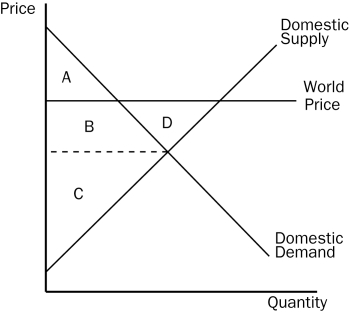 -Refer to Figure 9-13.The country for which the figure is drawn
 (Multiple Choice)
4.8/5 (95)
(95) A country has a comparative advantage in a product if the world price is
(Multiple Choice)
5.0/5 (93)
(93) Aquilonia has decided to end its policy of not trading with the rest of the world.When it ends its trade restrictions,it discovers that it is importing incense,exporting steel,and neither importing nor exporting rugs.Which groups in Aquilonia are better off as a result of the new free-trade policy?
(Multiple Choice)
4.8/5 (89)
(89) Figure 9-3. The domestic country is Jamaica.
 -Refer to Figure 9-3.Which of the following statements is accurate?
 (Multiple Choice)
4.9/5 (89)
(89) When a country allows trade and becomes an importer of steel,
(Multiple Choice)
4.9/5 (95)
(95) When a nation first begins to trade with other countries and the nation becomes an importer of soybeans,
(Multiple Choice)
4.7/5 (77)
(77) If a tariff is placed on watches,the price of both domestic and imported watches will rise by the amount of the tariff.
(True/False)
4.8/5 (69)
(69) Countries usually impose restrictions on trade with other countries in order to protect
(Multiple Choice)
4.9/5 (73)
(73) Figure 9-10
 -Refer to Figure 9-10.Producer surplus plus consumer surplus in this market before trade is
 (Multiple Choice)
4.8/5 (78)
(78) Figure 9-9. The figure applies to the nation of Kenya and the good is air conditioners.
 -Refer to Figure 9-9.The price and quantity of air conditioners in Kenya before trade is
 (Multiple Choice)
4.9/5 (78)
(78) Denmark is an importer of computer chips,taking the world price of $12 per chip as given.Suppose Denmark imposes a $5 tariff on chips.Which of the following outcomes is possible?
(Multiple Choice)
4.9/5 (88)
(88) When a country allows trade and becomes an importer of a good,
(Multiple Choice)
4.9/5 (94)
(94) 
Filters
- Essay(0)
- Multiple Choice(0)
- Short Answer(0)
- True False(0)
- Matching(0)