



 Chat with AI
Exam 23: Signal

Exam 1: The Chemical Foundations of Biochemistry28 Questions
Exam 2: Nucleic Acids32 Questions
Exam 3: Proteins I31 Questions
Exam 4: Proteins Iienzymes41 Questions
Exam 5: Membranes and an Introduction to Signal Transduction33 Questions
Exam 6: Carbohydrates I46 Questions
Exam 7: The Common Catabolic Pathway41 Questions
Exam 8: Carbohydrates II19 Questions
Exam 9: Lipids I37 Questions
Exam 10: Lipids II21 Questions
Exam 11: Amine Metabolism16 Questions
Exam 12: Metabolism Integration19 Questions
Exam 13: Nucleotide Deoxynucleotide Metabolism40 Questions
Exam 14: Dna Replication, Damage and Repair38 Questions
Exam 15: Rna Synthesis40 Questions
Exam 16: Protein45 Questions
Exam 17: Control of Gene45 Questions
Exam 18: Determination of Macromolecular Structure60 Questions
Exam 19: Allosterism and Receptor-Ligand49 Questions
Exam 20: Designer Proteins and Protein Folding59 Questions
Exam 21: Biomolecule Purification57 Questions
Exam 22: Bioinformatics and Omics29 Questions
Exam 23: Signal51 Questions
Exam 24: Protein Trafficking57 Questions
Exam 25: Photosynthesis Nitrogen39 Questions
Select questions type


The following questions refer to the structure below: 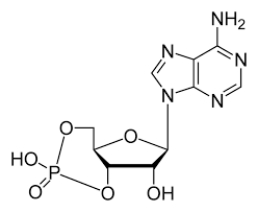 -____ serves as a substrate of ___ to produce this molecule.
 (Multiple Choice)
4.8/5  (86)
(86) Some cell signaling pathways, such as the toll-like receptors (TLRs), are expressed in all cell types. Most signaling pathways have "cross points" that allow them to modulate each other.
(Multiple Choice)
4.8/5 (83)
(83) By lacking an essential serine or tyrosine, proteins with pseudosubstrate domains regulate signaling pathways by blocking kinase
(Multiple Choice)
4.8/5 (73)
(73) PKG and PKA are similar in that both
I. are activated by a cyclic nucleotide monophosphate
II. have nucleotide-binding and kinase domains
III. release their catalytic subunits when activated
IV. phosphorylate downstream proteins to effect cellular change
(Multiple Choice)
4.8/5 (78)
(78) Proteins that bind molecules and elicit a cellular response are called _____.
(Short Answer)
4.9/5 (74)
(74) Phospholipase C cleaves PIP2, resulting in an increased cytosolic concentration of
I. IP3 (inositolpolyphosphate-3)
II. protein kinase C
III. cAMP
IV. Ca2+
(Multiple Choice)
4.9/5 (91)
(91) The following questions refer to the structure below:
-To affect cellular change this molecule
-To affect cellular change this molecule (Multiple Choice)
4.8/5 (85)
(85) The phosphoinositol pathway can respond to tumor promotors to elicit tumor formation. Tumor promoters are
(Multiple Choice)
4.8/5 (73)
(73) Desensitization of a G protein-coupled receptor is caused by phosphorylation of the receptor by a specific kinase. What protein recognizes the phosphorylated receptor?
(Multiple Choice)
5.0/5 (87)
(87) Where are the ultimate targets of the Ras-dependent signaling cascade located within the cell?
(Multiple Choice)
4.8/5 (67)
(67) 
Filters
- Essay(0)
- Multiple Choice(0)
- Short Answer(0)
- True False(0)
- Matching(0)