



 Chat with AI
Exam 23: Signal

Exam 1: The Chemical Foundations of Biochemistry28 Questions
Exam 2: Nucleic Acids32 Questions
Exam 3: Proteins I31 Questions
Exam 4: Proteins Iienzymes41 Questions
Exam 5: Membranes and an Introduction to Signal Transduction33 Questions
Exam 6: Carbohydrates I46 Questions
Exam 7: The Common Catabolic Pathway41 Questions
Exam 8: Carbohydrates II19 Questions
Exam 9: Lipids I37 Questions
Exam 10: Lipids II21 Questions
Exam 11: Amine Metabolism16 Questions
Exam 12: Metabolism Integration19 Questions
Exam 13: Nucleotide Deoxynucleotide Metabolism40 Questions
Exam 14: Dna Replication, Damage and Repair38 Questions
Exam 15: Rna Synthesis40 Questions
Exam 16: Protein45 Questions
Exam 17: Control of Gene45 Questions
Exam 18: Determination of Macromolecular Structure60 Questions
Exam 19: Allosterism and Receptor-Ligand49 Questions
Exam 20: Designer Proteins and Protein Folding59 Questions
Exam 21: Biomolecule Purification57 Questions
Exam 22: Bioinformatics and Omics29 Questions
Exam 23: Signal51 Questions
Exam 24: Protein Trafficking57 Questions
Exam 25: Photosynthesis Nitrogen39 Questions
Select questions type


Second messengers
I. include cGMP
II. are small, soluble molecules
III. are released or generated in response to extracellular signals
IV. include catecholamines
(Multiple Choice)
4.8/5  (80)
(80) MAP kinases generally
I. work through the activation of heterotrimeric G-protein coupled receptors
II. require multiple phosphorylations to be activated
III. are specific tyrosine kinases
IV. include PKA among its cascade members
(Multiple Choice)
4.7/5 (68)
(68) Which is NOT true of insulin?
I. Its receptors must dimerize for activation to occur
II. It recruits scaffolding proteins such as IRS which begins signal amplification
III. It influences cell growth by working through the MAP kinase pathway
IV. It activates lipases leading to release lipids from adipocytes
(Multiple Choice)
4.9/5 (70)
(70) SOCS (Suppressor of Cytokine Signaling) binds ___ and ____ it.
(Multiple Choice)
4.7/5 (78)
(78) The following questions refer to the structure below: 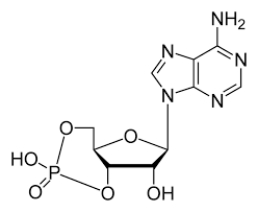 -What is the name of this molecule?
 (Multiple Choice)
4.9/5 (66)
(66) In addition to the soluble form of guanylate cyclase, a transmembrane form is also present in the vasculature, where it serves as a receptor for ___, which also results in vasodilation.
(Multiple Choice)
4.8/5 (90)
(90) The insulin receptor must itself be phosphorylated to be activated. The activation of the insulin receptor occurs through catalysis by protein kinase A.
(Multiple Choice)
4.9/5 (87)
(87) What enzyme is activated by association with an active G protein?
(Multiple Choice)
4.8/5 (87)
(87) The target of phospholipase C is a(n) ___ found in the ___.
(Multiple Choice)
4.8/5 (86)
(86) ____ are genes that code for proteins that encourage cell growth and survival, but when mutated may lead to overgrowth and tumor formation.
(Short Answer)
4.8/5 (65)
(65) The action of phospholipase C produces the second messengers ___ and ___.
(Short Answer)
4.8/5 (69)
(69) When bound to its specific CDK, one cyclin is apparently responsible for assembling metaphase chromosomes. The cyclin responsible for this assembly is likely Cyclin E, which peaks during the G1 phase of the cell cycle.
(Multiple Choice)
4.7/5 (77)
(77) Activation of a G protein in response to hormone binding requires binding of _____ to the _____ subunit.
(Multiple Choice)
4.8/5 (75)
(75) What is common to both the insulin receptor and JAK/STAT receptor?
(Multiple Choice)
4.8/5 (79)
(79) Through its activation in preadipocytes, the JAK-STAT pathway has shown a link between
(Multiple Choice)
4.7/5 (87)
(87) Ligand binding to a receptor tyrosine kinase causes _____ of the receptor which then _____ the next protein in the signaling pathway.
(Multiple Choice)
4.9/5 (77)
(77) 
Filters
- Essay(0)
- Multiple Choice(0)
- Short Answer(0)
- True False(0)
- Matching(0)