



 Chat with AI
Exam 1: The Chemical Foundations of Biochemistry

Exam 1: The Chemical Foundations of Biochemistry28 Questions
Exam 2: Nucleic Acids32 Questions
Exam 3: Proteins I31 Questions
Exam 4: Proteins Iienzymes41 Questions
Exam 5: Membranes and an Introduction to Signal Transduction33 Questions
Exam 6: Carbohydrates I46 Questions
Exam 7: The Common Catabolic Pathway41 Questions
Exam 8: Carbohydrates II19 Questions
Exam 9: Lipids I37 Questions
Exam 10: Lipids II21 Questions
Exam 11: Amine Metabolism16 Questions
Exam 12: Metabolism Integration19 Questions
Exam 13: Nucleotide Deoxynucleotide Metabolism40 Questions
Exam 14: Dna Replication, Damage and Repair38 Questions
Exam 15: Rna Synthesis40 Questions
Exam 16: Protein45 Questions
Exam 17: Control of Gene45 Questions
Exam 18: Determination of Macromolecular Structure60 Questions
Exam 19: Allosterism and Receptor-Ligand49 Questions
Exam 20: Designer Proteins and Protein Folding59 Questions
Exam 21: Biomolecule Purification57 Questions
Exam 22: Bioinformatics and Omics29 Questions
Exam 23: Signal51 Questions
Exam 24: Protein Trafficking57 Questions
Exam 25: Photosynthesis Nitrogen39 Questions
Select questions type


What is the conjugate acid of H2PO4-?

Free
(Multiple Choice)
4.8/5  (80)
(80) Correct Answer: Verified
C
Of the following amino acids, which contains an alcohol? 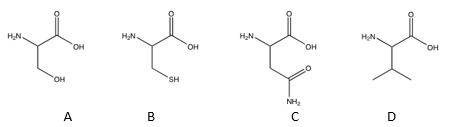
Free
(Multiple Choice)
4.9/5 (72)
(72) Correct Answer:Verified
VerifiedA
What is the [H+] of an aqueous solution with a pH of 6.2?
Free
(Multiple Choice)
4.7/5 (86)
(86) Correct Answer:Verified
VerifiedC
In an aqueous solution, if the [OH-] is 3.0 × 10⁻⁵ M, what is the [H+]?
(Multiple Choice)
4.7/5 (88)
(88) If a reaction at 37 C has a H of 23 kJ/mol and a S of 337 J/K.mol, what is the G for the reaction?
(Multiple Choice)
4.8/5 (76)
(76) What functional groups are present in the following molecule? 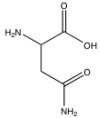
(Multiple Choice)
4.8/5 (85)
(85) Urea is a water-soluble product of nitrogen metabolism. How many hydrogen bonds can one urea molecule donate to surrounding water molecules? 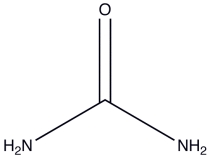
(Multiple Choice)
4.9/5 (73)
(73) Metabolic acidosis often causes increased respiratory rates. What portion of the bloodstream buffer is lost through increased respiration?
(Multiple Choice)
4.8/5 (79)
(79) Which of the following is a physical property of water that results from hydrogen bonding?
(Multiple Choice)
4.8/5 (79)
(79) Keq can be determined from the change in standard free energy using the equation ______.
(Multiple Choice)
4.9/5 (65)
(65) Consider the isomerization reaction R P, in which R is converted to P. The G°' for this reaction is -10. kJ/mol. Calculate the [P]/[R] at equilibrium at 25°C.
(Short Answer)
4.9/5 (79)
(79) What would be the resulting pH if one ml of 1.0 M NaOH was added to one liter of pure water (assume pH 7.0)?
(Multiple Choice)
4.9/5 (85)
(85) 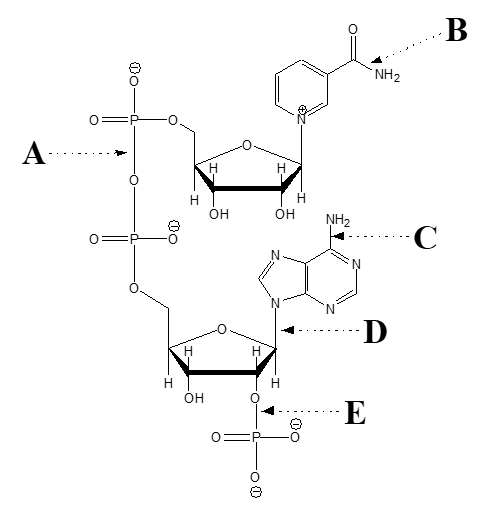 -In a water molecule, hydrogens are partially _____; oxygens are partially _____.
 (Multiple Choice)
5.0/5 (83)
(83) Which of the following shows the buffer that is found in the bloodstream?
(Multiple Choice)
4.8/5 (85)
(85) If a phosphate buffer (pK = 6.82) was formulated such that its pH was 7.3, it would be best suited to buffer against _____. If instead, it was formulated such that its pH was 6.3, it would be best suited to buffer against _____.
(Multiple Choice)
4.8/5 (71)
(71) Due to the formation of hydrogen bonds, _____ is highly soluble in water.
(Multiple Choice)
4.9/5 (86)
(86) Consider a reaction in which H = -20. kJ/mol and S = 10. J/mol · K.
(Short Answer)
4.7/5 (78)
(78) 
Filters
- Essay(0)
- Multiple Choice(0)
- Short Answer(0)
- True False(0)
- Matching(0)