



 Chat with AI
Exam 9: Lipids I

Exam 1: The Chemical Foundations of Biochemistry28 Questions
Exam 2: Nucleic Acids32 Questions
Exam 3: Proteins I31 Questions
Exam 4: Proteins Iienzymes41 Questions
Exam 5: Membranes and an Introduction to Signal Transduction33 Questions
Exam 6: Carbohydrates I46 Questions
Exam 7: The Common Catabolic Pathway41 Questions
Exam 8: Carbohydrates II19 Questions
Exam 9: Lipids I37 Questions
Exam 10: Lipids II21 Questions
Exam 11: Amine Metabolism16 Questions
Exam 12: Metabolism Integration19 Questions
Exam 13: Nucleotide Deoxynucleotide Metabolism40 Questions
Exam 14: Dna Replication, Damage and Repair38 Questions
Exam 15: Rna Synthesis40 Questions
Exam 16: Protein45 Questions
Exam 17: Control of Gene45 Questions
Exam 18: Determination of Macromolecular Structure60 Questions
Exam 19: Allosterism and Receptor-Ligand49 Questions
Exam 20: Designer Proteins and Protein Folding59 Questions
Exam 21: Biomolecule Purification57 Questions
Exam 22: Bioinformatics and Omics29 Questions
Exam 23: Signal51 Questions
Exam 24: Protein Trafficking57 Questions
Exam 25: Photosynthesis Nitrogen39 Questions
Select questions type


An enzyme that is inhibited by many of the most widely used and effective cholesterol-lowering drugs is _____.

Free
(Multiple Choice)
4.9/5  (76)
(76) Correct Answer: Verified
C
Ketone bodies are produced in the _____ and used by the _____ only under conditions such as a prolonged fast.
Free
(Multiple Choice)
4.9/5 (88)
(88) Correct Answer:Verified
VerifiedB
_____ and _____ have the appropriate geometry to form lipid bilayers whereas _____ tends to form micelles.
Dropdown 1: Fatty acids, waxes, glycerophospholipids
Dropdown 2: triacylglycerols, sphingolipids, isoprenoids
Dropdown 3: fatty acids, triacylglycerols, sphingolipids
Free
(Short Answer)
4.7/5 (79)
(79) Correct Answer:Verified
Verifiedglycerophospholipids , sphingolipids,fatty acids
Which of the following is the primary building block for the synthesis of molecules such as cholesterol or ubiquinone?
(Multiple Choice)
4.9/5 (78)
(78) If a reaction that included all of the enzymes involved in fatty acid synthesis was supplied with excess ATP, NADPH, acetyl-CoA, and 14CO2 (where the carbon was a 14C-label), where would the labeled carbon appear in the finished fatty acid?
(Multiple Choice)
4.8/5 (89)
(89) Considering the figure below, what compound would be formed by action of acyl-CoA dehydrogenase? 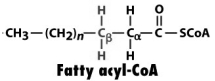
(Multiple Choice)
4.8/5 (83)
(83) What transport system moves activated fatty acids from the cytosol to the mitochondrial matrix?
(Multiple Choice)
4.8/5 (82)
(82) Acetyl-CoA carboxylase requires the coenzyme _____ as well as _____ as an energy source.
(Multiple Choice)
4.9/5 (72)
(72) The conversion of 3-hydroxybutyrate to two molecules of acetyl-CoA produces 1 NADH and consumes 1 equivalent of ATP. What is the net ATP yield from the complete oxidation of 3-hydroxybutyrate?
(Multiple Choice)
4.9/5 (82)
(82) What are the characteristics of most unsaturated fatty acids found within a human cell?
(Multiple Choice)
4.8/5 (90)
(90) Free fatty acids bind to _____ for circulation in the bloodstream.
(Short Answer)
4.8/5 (81)
(81) How many ATP can be produced by the complete oxidation of palmitoleic acid, a 16-carbon monounsaturated fatty acid, considering that the fatty acid must first be activated?
(Multiple Choice)
4.9/5 (73)
(73) What are the -oxidation products of stearic acid, a saturated fatty acid with 18 carbons?
(Multiple Choice)
4.8/5 (80)
(80) Which of the following terms describes all glycerophospholipid?
(Multiple Choice)
4.9/5 (75)
(75) The _____ are a class of amphipathic molecules that constitute the major lipid components of the cell membrane.
(Short Answer)
4.9/5 (75)
(75) The molecules acetoacetate, acetone, and d- -hydroxybutyrate are metabolic fuels termed _____.
(Short Answer)
4.8/5 (67)
(67) Fatty acid oxidation occurs in the _____; fatty acid synthesis occurs in the _____.
(Multiple Choice)
5.0/5 (75)
(75) Fatty acid synthesis requires both acetyl-CoA and _____ as initiator molecules.
(Short Answer)
4.8/5 (87)
(87) 
Filters
- Essay(0)
- Multiple Choice(0)
- Short Answer(0)
- True False(0)
- Matching(0)