



 Chat with AI
Exam 13: Nucleic Acid Biotechnology Techniques

Exam 1: Biochemistry and the Organization of Cells73 Questions
Exam 2: Water: the Solvent for Biochemical Reactions85 Questions
Exam 3: Amino Acids and Peptides75 Questions
Exam 4: The Three-Dimensional Structure of Proteins82 Questions
Exam 5: Protein Purification and Characterization Techniques67 Questions
Exam 6: The Behavior of Proteins: Enzymes83 Questions
Exam 7: The Behavior of Proteins: Enzymes, Mechanisms, and Control81 Questions
Exam 8: Lipids and Proteins Are Associated in Biological Membranes90 Questions
Exam 9: Nucleic Acids: How Structure Conveys Information66 Questions
Exam 10: Biosynthesis of Nucleic Acids: Replication86 Questions
Exam 11: Transcription of the Genetic Code: Biosynthesis of RNA98 Questions
Exam 12: Protein Synthesis: Translation of the Genetic Message85 Questions
Exam 13: Nucleic Acid Biotechnology Techniques94 Questions
Exam 14: Viruses, Cancer, and Immunology42 Questions
Exam 15: The Importance of Energy Changes and Electron Transfer in Metabolism60 Questions
Exam 16: Carbohydrates92 Questions
Exam 17: Glycolysis67 Questions
Exam 18: Storage Mechanisms and Control in Carbohydrate Metabolism82 Questions
Exam 19: The Citric Acid Cycle80 Questions
Exam 20: Electron Transport and Oxidative Phosphorylation66 Questions
Exam 21: Lipid Metabolism95 Questions
Exam 22: Photosynthesis74 Questions
Exam 23: The Metabolism of Nitrogen78 Questions
Exam 24: Integration of Metabolism: Cellular Signaling68 Questions
Select questions type


Which of the following is a unique feature of qPCR compared to the original PCR?
(Multiple Choice)
4.7/5  (82)
(82) The following steps are all involved in genetic recombination:
1)Screening for cells that contain the recombined gene.
2)Cutting the vector with restriction enzyme.
3)Mixing the gene of interest with the vector.
4)Isolating the gene of interest from its original source.
5)Ligating the gene of interest and the vector together.
The following sequence of these five steps would be typical:
(Multiple Choice)
4.8/5 (79)
(79) Which of the following was not a technique researchers used to try to improve shelf life of tomatoes with genetic engineering?
(Multiple Choice)
4.9/5 (101)
(101) Exhibit 13A This is a map of the pBR322 plasmid, numbers on the map refer to the base where the site is located.
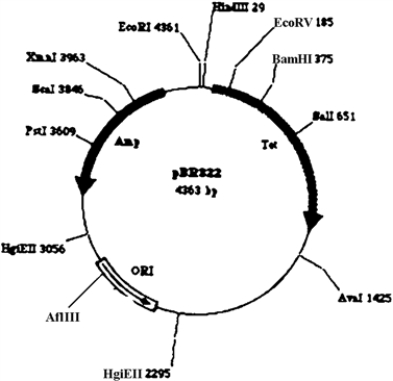 -Refer to Exhibit 13A. If the plasmid were completely digested with the two restriction enzymes BamHI and HgiEII, the resulting fragments would be this large:
 (Multiple Choice)
4.7/5 (82)
(82) Exhibit 13A This is a map of the pBR322 plasmid, numbers on the map refer to the base where the site is located.
-Refer to Exhibit 13A. If a recombinant plasmid were obtained inserting DNA into the AflIII site, the recombinant plasmid would lack which of the following properties?
-Refer to Exhibit 13A. If a recombinant plasmid were obtained inserting DNA into the AflIII site, the recombinant plasmid would lack which of the following properties? (Multiple Choice)
4.8/5 (87)
(87) When fluorescence detection methods are used in biotechnology they
(Multiple Choice)
4.9/5 (73)
(73) Which of the following statements about plants which contain the recombinant form of the gene from Bacillus thuringiensis (Bt gene), is true?
(Multiple Choice)
5.0/5 (95)
(95) Exhibit 13A This is a map of the pBR322 plasmid, numbers on the map refer to the base where the site is located.
-Refer to Exhibit 13A. If a recombinant plasmid were obtained by inserting DNA into the EcoRV site, and the protein corresponding to the recombinant gene were expressed, which of the following statements would be false?
-Refer to Exhibit 13A. If a recombinant plasmid were obtained by inserting DNA into the EcoRV site, and the protein corresponding to the recombinant gene were expressed, which of the following statements would be false? (Multiple Choice)
4.9/5 (73)
(73) Which of the following proteins are produced by recombinant DNA technology but have had their purposes subverted for improving athletic perforrmance?
(Multiple Choice)
4.9/5 (90)
(90) The presence of bacterial or viral clones is detected experimentally by
(Multiple Choice)
4.8/5 (75)
(75) Exhibit 13D?The plasmid pSU922 is a circular DNA containing 25000 base pairs. The β-gal gene codes for the enzyme β-galactosidase, the product of which will turn bacterial colonies blue when grown in the presence of X-gal; the AmpR gene confers ampicillin resistance.
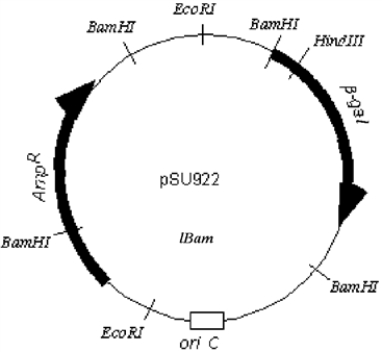 -Refer to Exhibit 13D. In three separate vessels, the plasmid is treated with the restriction endonucleases EcoRI, BamHI, and HindIII. Which of the following best represents the electrophoretic gel one would see from these digests?
 (Multiple Choice)
4.7/5 (68)
(68) 
Filters
- Essay(0)
- Multiple Choice(0)
- Short Answer(0)
- True False(0)
- Matching(0)