



 Chat with AI
Exam 16: The United States and the Global Economy

Exam 1: Scarcity and Choice78 Questions
Exam 2: Market Transactions: Demand and Supply Analysis93 Questions
Exam 3: Demand and Supply Applications92 Questions
Exam 4: Production and the Costs of Production77 Questions
Exam 5: Competition and Monopoly: Virtues and Vices92 Questions
Exam 6: Imperfect Competition90 Questions
Exam 7: Labor Markets86 Questions
Exam 8: Government and Markets89 Questions
Exam 9: The Mixed Economy of the United States80 Questions
Exam 10: Gross Domestic Product and Economic Growth87 Questions
Exam 11: The Business Cycle, Unemployment, and Inflation87 Questions
Exam 12: Macroeconomic Instability: Aggregate Demand and Aggregate Supply78 Questions
Exam 13: Fiscal Policy and the Federal Budget90 Questions
Exam 14: Money and the Banking System92 Questions
Exam 15: The Federal Reserve and Monetary Policy84 Questions
Exam 16: The United States and the Global Economy84 Questions
Exam 17: International Finance70 Questions
Exam 18: Economic Systems and Developing Countries76 Questions
Select questions type


Oranges are both produced in and imported into the United States. Suppose there had been a tariff on imported oranges, and now it is lifted. Who benefits financially from this move to completely free international trade in oranges?
(Multiple Choice)
4.7/5  (72)
(72) International trade yields effects similar to technological progress because they both
(Multiple Choice)
4.8/5 (89)
(89) According to the principle of comparative advantage, it may be efficient for a country to export a good or service for which it has an absolute disadvantage.
(True/False)
5.0/5 (84)
(84) Figure 16.1 Import Tariff Levied by Venezuela
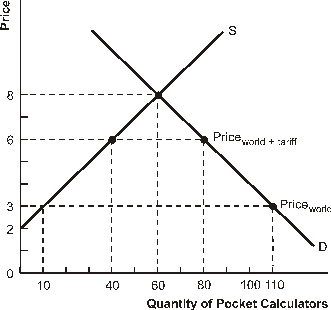 -Consider Figure 16.1. In the absence of trade, Venezuela produces and consumes
 (Multiple Choice)
4.7/5 (87)
(87) 
Filters
- Essay(0)
- Multiple Choice(0)
- Short Answer(0)
- True False(0)
- Matching(0)