



 Chat with AI
Exam 16: The United States and the Global Economy

Exam 1: Scarcity and Choice78 Questions
Exam 2: Market Transactions: Demand and Supply Analysis93 Questions
Exam 3: Demand and Supply Applications92 Questions
Exam 4: Production and the Costs of Production77 Questions
Exam 5: Competition and Monopoly: Virtues and Vices92 Questions
Exam 6: Imperfect Competition90 Questions
Exam 7: Labor Markets86 Questions
Exam 8: Government and Markets89 Questions
Exam 9: The Mixed Economy of the United States80 Questions
Exam 10: Gross Domestic Product and Economic Growth87 Questions
Exam 11: The Business Cycle, Unemployment, and Inflation87 Questions
Exam 12: Macroeconomic Instability: Aggregate Demand and Aggregate Supply78 Questions
Exam 13: Fiscal Policy and the Federal Budget90 Questions
Exam 14: Money and the Banking System92 Questions
Exam 15: The Federal Reserve and Monetary Policy84 Questions
Exam 16: The United States and the Global Economy84 Questions
Exam 17: International Finance70 Questions
Exam 18: Economic Systems and Developing Countries76 Questions
Select questions type


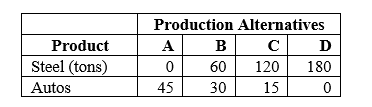
Table 16.1 Production Possibilities Tables for Germany and Canada
Germany's Production Possibilities Table
 Canada's Production Possibilities Table
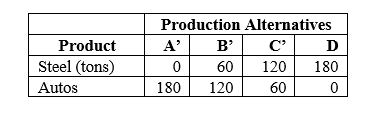 -Refer to Table 16.1. Assume that the desired product combinations prior to specialization were alternative B in Germany and alternative B' in Canada. With specialization, what are the gains in output?
Canada's Production Possibilities Table
-Refer to Table 16.1. Assume that the desired product combinations prior to specialization were alternative B in Germany and alternative B' in Canada. With specialization, what are the gains in output? (Multiple Choice)
4.9/5  (77)
(77) Table 16.1 Production Possibilities Tables for Germany and Canada
Germany's Production Possibilities Table
Canada's Production Possibilities Table
-Refer to Table 16.1. According to the principle of comparative advantage,
Canada's Production Possibilities Table
-Refer to Table 16.1. According to the principle of comparative advantage, (Multiple Choice)
4.9/5 (88)
(88) The U.S. is a major exporter of petroleum and other energy products.
(True/False)
4.8/5 (70)
(70) A sudden reduction in import tariffs is most likely to result in short-term unemployment for workers of companies that
(Multiple Choice)
4.7/5 (66)
(66) Opening up a country to international trade generally results in
(Multiple Choice)
4.9/5 (75)
(75) A country will gain from specialization and trade, even if it is less efficient in producing all goods, as long as it specializes in those goods that it can produce
(Multiple Choice)
4.8/5 (57)
(57) Specialization increases productivity for all of the following reasons except
(Multiple Choice)
4.8/5 (66)
(66) The dominant factor in motivating governments to impose trade restrictions is
(Multiple Choice)
4.9/5 (77)
(77) When the North American Free Trade Agreement was adopted, it was predicted that labor-intensive, import-competing businesses in the U.S. would likely lose from tariffs that were eliminated on competing imports from Mexico.
(True/False)
4.9/5 (58)
(58) Figure 16.1 Import Tariff Levied by Venezuela
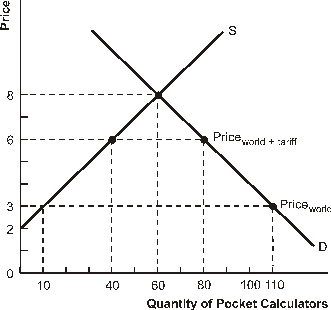 -Consider Figure 16.1. A tariff would completely eliminate imports of calculators if it equaled
 (Multiple Choice)
4.8/5 (78)
(78) Figure 16.1 Import Tariff Levied by Venezuela
-Consider Figure 16.1. With a per-unit tariff of $3, the Venezuelan government collects tariff revenues of
-Consider Figure 16.1. With a per-unit tariff of $3, the Venezuelan government collects tariff revenues of (Multiple Choice)
4.8/5 (80)
(80) Japan is a major exporter of automobiles, steel, and electronics. Using the theory of comparative advantage, we can credit this to
(Multiple Choice)
4.7/5 (91)
(91) All sectors of the domestic economy benefit from protectionist trade policies.
(True/False)
4.8/5 (79)
(79) For the U.S., the imposition of tariffs on imported autos tends to result in
(Multiple Choice)
4.8/5 (73)
(73) The main objective of the North American Free Trade Agreement (NAFTA) is
(Multiple Choice)
4.9/5 (83)
(83) Trade import restrictions tend to harm domestic consumers by increasing the prices, and reducing the availability, of the goods they purchase.
(True/False)
4.9/5 (75)
(75) Since it was established in 1995, one of the most important roles of the World Trade Organization (WTO) has been to
(Multiple Choice)
4.9/5 (79)
(79) The "level playing field argument" refers to an argument against free trade that is based on a desire to protect new and developing industries.
(True/False)
4.9/5 (79)
(79) Trade restrictions tend to reduce competition and increase prices for consumers.
(True/False)
4.9/5 (74)
(74) 
Filters
- Essay(0)
- Multiple Choice(0)
- Short Answer(0)
- True False(0)
- Matching(0)