



 Chat with AI
Exam 17: International Finance

Exam 1: Scarcity and Choice78 Questions
Exam 2: Market Transactions: Demand and Supply Analysis93 Questions
Exam 3: Demand and Supply Applications92 Questions
Exam 4: Production and the Costs of Production77 Questions
Exam 5: Competition and Monopoly: Virtues and Vices92 Questions
Exam 6: Imperfect Competition90 Questions
Exam 7: Labor Markets86 Questions
Exam 8: Government and Markets89 Questions
Exam 9: The Mixed Economy of the United States80 Questions
Exam 10: Gross Domestic Product and Economic Growth87 Questions
Exam 11: The Business Cycle, Unemployment, and Inflation87 Questions
Exam 12: Macroeconomic Instability: Aggregate Demand and Aggregate Supply78 Questions
Exam 13: Fiscal Policy and the Federal Budget90 Questions
Exam 14: Money and the Banking System92 Questions
Exam 15: The Federal Reserve and Monetary Policy84 Questions
Exam 16: The United States and the Global Economy84 Questions
Exam 17: International Finance70 Questions
Exam 18: Economic Systems and Developing Countries76 Questions
Select questions type


Foreign currencies can be bought and sold

Free
(Multiple Choice)
4.8/5  (72)
(72) Correct Answer: Verified
D
Figure 17.1 Supply and Demand Curves for the Swiss Franc
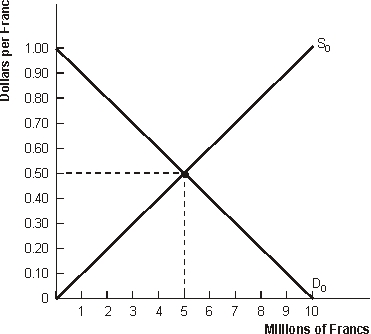 -Refer to Figure 17.1. Suppose the exchange rate is $0.30 per franc. Free-market forces would lead to a(n) ______ of the dollar against the franc and a(n) ______ in U.S. international competitiveness.
Free
(Multiple Choice)
4.9/5 (79)
(79) Correct Answer:Verified
VerifiedA
A depreciation of the dollar refers to a fall in the dollar price of a foreign currency.
Free
(True/False)
4.9/5 (75)
(75) Correct Answer:Verified
VerifiedFalse
Figure 17.1 Supply and Demand Curves for the Swiss Franc
-Refer to Figure 17.1. At the equilibrium exchange rate of ______ per franc, ______ francs will be purchased at a total dollar cost of ______.
-Refer to Figure 17.1. At the equilibrium exchange rate of ______ per franc, ______ francs will be purchased at a total dollar cost of ______. (Multiple Choice)
4.9/5 (92)
(92) If the Mexican peso is appreciating in a floating exchange rate system, then in world markets, Mexican goods become
(Multiple Choice)
4.9/5 (78)
(78) Assume that the U.S. faces an 8 percent inflation rate while no (0%) inflation exists in Japan. With floating exchange rates, we would expect the dollar to
(Multiple Choice)
4.8/5 (81)
(81) Figure 17.3 The Swiss Franc Under a System of Floating Exchange Rates
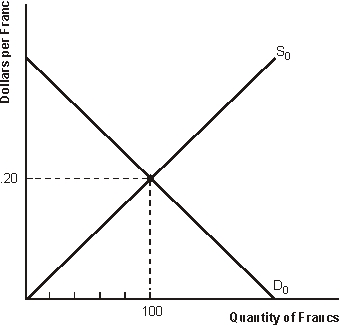 -Refer to Figure 17.3. If interest rates in the U.S. rise relative to interest rates in Switzerland, then we would expect a(n)
 (Multiple Choice)
4.9/5 (94)
(94) Foreign exchange market transactions usually involve movements in electronic balances, rather than actual currencies changing hands.
(True/False)
4.8/5 (83)
(83) Capital transactions in the balance of payments include all international purchases or sales of assets such as real estate, corporate stocks and bonds, and government securities.
(True/False)
4.8/5 (93)
(93) With floating exchange rates, the dollar will appreciate against the Mexican peso if the price level in the U.S. rises relative to the price level in Mexico.
(True/False)
4.9/5 (81)
(81) If the dollar price of the pound is $2 = 1 pound, then the pound price of the dollar is 0.5 pounds = $1.
(True/False)
5.0/5 (93)
(93) ______ in the balance of payments include all international purchases or sales of assets such as real estate, corporate stocks and bonds, and government securities.
(Multiple Choice)
4.9/5 (80)
(80) Figure 17.3 The Swiss Franc Under a System of Floating Exchange Rates
-Refer to Figure 17.3. If Switzerland experienced a disastrous grain harvest, leading to additional grain imports from the United States, then there would be an increase in the
-Refer to Figure 17.3. If Switzerland experienced a disastrous grain harvest, leading to additional grain imports from the United States, then there would be an increase in the (Multiple Choice)
4.9/5 (83)
(83) Figure 17.3 The Swiss Franc Under a System of Floating Exchange Rates
-Refer to Figure 17.3. If Swiss labor productivity rises, leading to a decrease in Swiss manufacturing costs, then there would be a(n)
-Refer to Figure 17.3. If Swiss labor productivity rises, leading to a decrease in Swiss manufacturing costs, then there would be a(n) (Multiple Choice)
4.8/5 (92)
(92) When the dollar price of the pound increases, the dollar appreciates against the pound.
(True/False)
4.8/5 (81)
(81) Figure 17.2 The Market for Swiss Francs
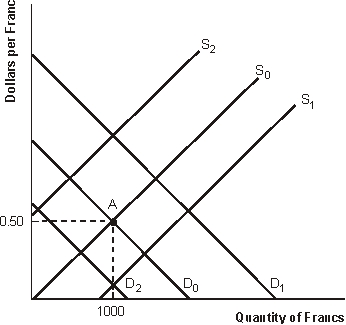 -Refer to Figure 17.2. A shift in the demand for francs from D0 to D1 or a shift in the supply of francs from S0 to S2, would result in a(n)
 (Multiple Choice)
4.7/5 (83)
(83) Table 17.2 Foreign Exchange Quotations
U.S. Dollar Equivalent Currency Per U.S. Dollar
British Pound 1.4270 1.4390 0.7008 0.6949 30-day Forward 1.4211 1.4333 0.7037 0.6977 60-day Forward 1.4090 1.4220 0.7097 0.7032 180-day Forward 1.3930 1.4070 0.7179 0.7107
-Refer to Table 17.2. Based on the change in the dollar's exchange value from Monday to Tuesday, we could expect to see
(Multiple Choice)
4.9/5 (95)
(95) Table 17.1 U.S. International Transactions
Transaction Amount (billions of dollars) Merchandise imports 110 Services, net 15 Unilateral transfers, net -20 U.S. private assets abroad -50 Merchandise exports 115 Investment income, net 10 Foreign private assets in the U.S. 25
-Referring to Table 17.1, the merchandise trade balance shows a
(Multiple Choice)
5.0/5 (71)
(71) Figure 17.3 The Swiss Franc Under a System of Floating Exchange Rates
-Refer to Figure 17.3. If the U.S. price level rises relative to the Swiss price level, then we would expect a(n)
-Refer to Figure 17.3. If the U.S. price level rises relative to the Swiss price level, then we would expect a(n) (Multiple Choice)
4.9/5 (95)
(95) Currency appreciation means that it takes fewer units of a nation's currency to purchase a unit of some foreign currency.
(True/False)
4.7/5 (69)
(69) 
Filters
- Essay(0)
- Multiple Choice(0)
- Short Answer(0)
- True False(0)
- Matching(0)