



 Chat with AI
Exam 16: The United States and the Global Economy

Exam 1: Scarcity and Choice78 Questions
Exam 2: Market Transactions: Demand and Supply Analysis93 Questions
Exam 3: Demand and Supply Applications92 Questions
Exam 4: Production and the Costs of Production77 Questions
Exam 5: Competition and Monopoly: Virtues and Vices92 Questions
Exam 6: Imperfect Competition90 Questions
Exam 7: Labor Markets86 Questions
Exam 8: Government and Markets89 Questions
Exam 9: The Mixed Economy of the United States80 Questions
Exam 10: Gross Domestic Product and Economic Growth87 Questions
Exam 11: The Business Cycle, Unemployment, and Inflation87 Questions
Exam 12: Macroeconomic Instability: Aggregate Demand and Aggregate Supply78 Questions
Exam 13: Fiscal Policy and the Federal Budget90 Questions
Exam 14: Money and the Banking System92 Questions
Exam 15: The Federal Reserve and Monetary Policy84 Questions
Exam 16: The United States and the Global Economy84 Questions
Exam 17: International Finance70 Questions
Exam 18: Economic Systems and Developing Countries76 Questions
Select questions type


Figure 16.1 Import Tariff Levied by Venezuela
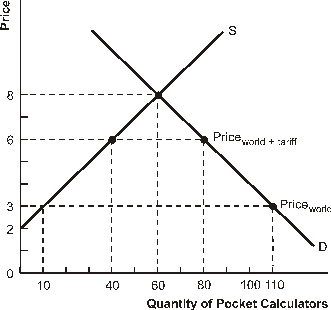 -Consider Figure 16.1. With a per-unit tariff of $3, Venezuela produces ______, consumes ______, and imports ______.
Free
(Multiple Choice)
4.8/5  (74)
(74) Correct Answer: Verified
A
All of the following are justifications for import tariffs except
Free
(Multiple Choice)
4.7/5 (81)
(81) Correct Answer:Verified
VerifiedC
To maximize its gains from trade, the U.S. should export goods and services for which it has an absolute advantage.
Free
(True/False)
4.9/5 (70)
(70) Correct Answer:Verified
VerifiedFalse
Import tariffs introduce inefficiencies by encouraging the overproduction of goods for which a country has a comparative advantage.
(True/False)
4.9/5 (76)
(76) If Canada and Mexico have identical opportunity costs of producing wheat and apples, then there will not be any basis for gainful specialization and trade according to the principle of absolute advantage.
(True/False)
4.8/5 (80)
(80) Which one of the following groups of Americans does not benefit from free trade?
(Multiple Choice)
4.9/5 (74)
(74) Trade between Canada and Mexico allows both countries to gain because they can consume a combination of goods and services that lies
(Multiple Choice)
4.8/5 (76)
(76) It is possible for a high-wage country such as the U.S. to export labor-intensive goods to a low-wage country such as China.
(True/False)
4.9/5 (82)
(82) Supporters of tariffs and other trade restrictions believe that "infant industries"
(Multiple Choice)
4.9/5 (85)
(85) According to the principle of comparative advantage, Canada exports those goods and services for which it has a low
(Multiple Choice)
4.8/5 (91)
(91) Assume that wages in the U.S. are five times as high as wages in Mexico. The U.S. will export labor-intensive goods to Mexico if the productivity of its labor force is more than five times as high as the productivity of the Mexican labor force.
(True/False)
4.8/5 (84)
(84) The degree to which specialization can be practiced is limited the most by the
(Multiple Choice)
5.0/5 (81)
(81) According to the principle of ______, a country will gain from specializing in those goods that it can produce relatively cheaply.
(Multiple Choice)
4.8/5 (77)
(77) Figure 16.1 Import Tariff Levied by Venezuela
-Consider Figure 16.1. With free trade, Venezuela produces ______, consumes ______, and imports ______.
-Consider Figure 16.1. With free trade, Venezuela produces ______, consumes ______, and imports ______. (Multiple Choice)
4.8/5 (75)
(75) Canada, Japan, and Mexico are the leading trading partners of the U.S.
(True/False)
4.9/5 (89)
(89) Babe Ruth was great at both pitching and hitting. He even became the best left-handed pitcher in the American League. However, he eventually gave up pitching and became a legendary hitter for the N.Y. Yankees. This was because he
(Multiple Choice)
4.9/5 (75)
(75) When compared to quotas, tariffs have a relatively small effect on the domestic price of the good.
(True/False)
4.9/5 (85)
(85) 
Filters
- Essay(0)
- Multiple Choice(0)
- Short Answer(0)
- True False(0)
- Matching(0)