



 Chat with AI
Exam 16: The United States and the Global Economy

Exam 1: Scarcity and Choice78 Questions
Exam 2: Market Transactions: Demand and Supply Analysis93 Questions
Exam 3: Demand and Supply Applications92 Questions
Exam 4: Production and the Costs of Production77 Questions
Exam 5: Competition and Monopoly: Virtues and Vices92 Questions
Exam 6: Imperfect Competition90 Questions
Exam 7: Labor Markets86 Questions
Exam 8: Government and Markets89 Questions
Exam 9: The Mixed Economy of the United States80 Questions
Exam 10: Gross Domestic Product and Economic Growth87 Questions
Exam 11: The Business Cycle, Unemployment, and Inflation87 Questions
Exam 12: Macroeconomic Instability: Aggregate Demand and Aggregate Supply78 Questions
Exam 13: Fiscal Policy and the Federal Budget90 Questions
Exam 14: Money and the Banking System92 Questions
Exam 15: The Federal Reserve and Monetary Policy84 Questions
Exam 16: The United States and the Global Economy84 Questions
Exam 17: International Finance70 Questions
Exam 18: Economic Systems and Developing Countries76 Questions
Select questions type


According to the theory of comparative advantage, if the U.S. has an absolute advantage over Canada in the production of all goods, then specialization and trade
(Multiple Choice)
5.0/5  (85)
(85) The most vocal political pressure for tariffs is generally made by
(Multiple Choice)
4.9/5 (74)
(74) The promotion of free trade among the U.S., Canada, and Mexico is the main objective of the
(Multiple Choice)
4.8/5 (74)
(74) If you travel in a Boeing 777 jetliner, you are traveling in a product that is assembled entirely with parts and components that are produced in the U.S.
(True/False)
4.8/5 (73)
(73) Because international trade harms firms in exporting industries, most countries impose tariffs on the international flow of goods and services.
(True/False)
4.9/5 (75)
(75) As a result of United States quotas and tariffs imposed on imported Canadian lumber in 1996, thousands of U.S. families were unable to buy a home.
(True/False)
4.9/5 (69)
(69) All of the following statements about trade restrictions are true except
(Multiple Choice)
4.9/5 (83)
(83) Of the following four choices, which country's exports of goods and services constitute the largest share of its gross domestic product?
(Multiple Choice)
4.7/5 (76)
(76) According to the principle of comparative advantage, an open trading system results in resources being channeled from their highest to their lowest productivity.
(True/False)
4.9/5 (82)
(82) Table 16.1 Production Possibilities Tables for Germany and Canada
Germany's Production Possibilities Table
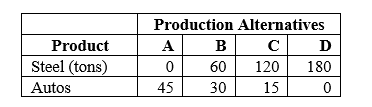 Canada's Production Possibilities Table
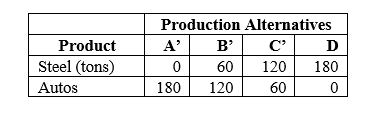 -Refer to Table 16.1. The opportunity cost of producing an auto in Canada is
Canada's Production Possibilities Table
-Refer to Table 16.1. The opportunity cost of producing an auto in Canada is (Multiple Choice)
5.0/5 (88)
(88) In the U.S., quotas on the numbers of Japanese cars that may be imported into the U.S. would be viewed as being superior to import tariffs by
(Multiple Choice)
4.7/5 (68)
(68) Suppose a country produces only two types of goods. If it specializes in the production of one good, then the country will be operating at one of the endpoints of its production possibilities schedules.
(True/False)
4.8/5 (80)
(80) A good way for a country to develop a comparative advantage in a good is by imposing tariffs on imports of that good.
(True/False)
4.9/5 (75)
(75) According to the principle of comparative advantage, France imports those goods and services for which it has a high
(Multiple Choice)
4.8/5 (74)
(74) It is universally agreed that import tariffs can be justified on economic grounds.
(True/False)
4.8/5 (91)
(91) The argument that free trade should be limited in order to protect American jobs is
(Multiple Choice)
4.9/5 (94)
(94) In 2000, wages in Malaysia were 10 percent of those in the U.S., and labor productivity in Malaysia was also 10 percent of that in the U.S. This means the unit labor costs were about the same in both countries.
(True/False)
4.9/5 (73)
(73) 
Filters
- Essay(0)
- Multiple Choice(0)
- Short Answer(0)
- True False(0)
- Matching(0)