



 Chat with AI
Exam 16: The United States and the Global Economy

Exam 1: Scarcity and Choice78 Questions
Exam 2: Market Transactions: Demand and Supply Analysis93 Questions
Exam 3: Demand and Supply Applications92 Questions
Exam 4: Production and the Costs of Production77 Questions
Exam 5: Competition and Monopoly: Virtues and Vices92 Questions
Exam 6: Imperfect Competition90 Questions
Exam 7: Labor Markets86 Questions
Exam 8: Government and Markets89 Questions
Exam 9: The Mixed Economy of the United States80 Questions
Exam 10: Gross Domestic Product and Economic Growth87 Questions
Exam 11: The Business Cycle, Unemployment, and Inflation87 Questions
Exam 12: Macroeconomic Instability: Aggregate Demand and Aggregate Supply78 Questions
Exam 13: Fiscal Policy and the Federal Budget90 Questions
Exam 14: Money and the Banking System92 Questions
Exam 15: The Federal Reserve and Monetary Policy84 Questions
Exam 16: The United States and the Global Economy84 Questions
Exam 17: International Finance70 Questions
Exam 18: Economic Systems and Developing Countries76 Questions
Select questions type


Through specialization and trade, the supply of goods increases, which forces prices up and makes goods less affordable.
(True/False)
5.0/5  (59)
(59) Comparative advantage is determined by all of the following except
(Multiple Choice)
4.8/5 (85)
(85) When the North American Free Trade Agreement was adopted, it was predicted that higher-skill and higher-tech businesses in the U.S. would benefit from the elimination of trade barriers with Mexico.
(True/False)
4.9/5 (81)
(81) According to the principle of comparative advantage, a country is realizing gains from trade when it achieves a level of consumption that lies outside of its production possibilities curve.
(True/False)
4.8/5 (91)
(91) An import quota provides a minimum threshold on the amount of a good that is allowed into the country.
(True/False)
4.7/5 (78)
(78) Import tariffs tend to increase jobs for workers in import-competing industries, but reduce their ability to bargain for higher wages.
(True/False)
4.8/5 (82)
(82) Comparative advantage depends on a variety of factors including technology, the amount of capital per worker, and the productivity of the labor force.
(True/False)
4.8/5 (97)
(97) Import restrictions tend to improve the welfare of producers in the import-competing industry, but worsen the welfare of domestic consumers.
(True/False)
4.8/5 (70)
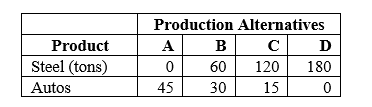
(70) Table 16.1 Production Possibilities Tables for Germany and Canada
Germany's Production Possibilities Table
 Canada's Production Possibilities Table
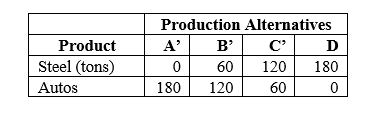 -Refer to Table 16.1. The opportunity cost of producing an auto in Germany is
Canada's Production Possibilities Table
-Refer to Table 16.1. The opportunity cost of producing an auto in Germany is (Multiple Choice)
4.8/5 (81)
(81) All of the following are arguments for protectionism except
(Multiple Choice)
4.8/5 (73)
(73) A disadvantage of increased globalization and free trade is
(Multiple Choice)
4.8/5 (67)
(67) Comparative advantage underlies the gains from trade among countries whose opportunity costs are identical.
(True/False)
4.9/5 (72)
(72) Although the nation as a whole benefits from free trade, inevitably some firms and workers are harmed by trade.
(True/False)
5.0/5 (82)
(82) In terms of production of output, having international specialization and trade is equivalent to
(Multiple Choice)
4.8/5 (75)
(75) Countries that trade on the basis of comparative advantage have ______ than countries that do not.
(Multiple Choice)
4.8/5 (76)
(76) U.S. tariffs tend to be progressive taxes, which predominately affect wealthy consumers.
(True/False)
4.8/5 (74)
(74) The imposition of a tariff on imports tends to promote gains for all of the following groups except
(Multiple Choice)
4.8/5 (75)
(75) CAFTA refers to the trade agreement that the U.S. signed in 2005 with
(Multiple Choice)
4.8/5 (74)
(74) 
Filters
- Essay(0)
- Multiple Choice(0)
- Short Answer(0)
- True False(0)
- Matching(0)