



 Chat with AI
Exam 4: Production and the Costs of Production

Exam 1: Scarcity and Choice78 Questions
Exam 2: Market Transactions: Demand and Supply Analysis93 Questions
Exam 3: Demand and Supply Applications92 Questions
Exam 4: Production and the Costs of Production77 Questions
Exam 5: Competition and Monopoly: Virtues and Vices92 Questions
Exam 6: Imperfect Competition90 Questions
Exam 7: Labor Markets86 Questions
Exam 8: Government and Markets89 Questions
Exam 9: The Mixed Economy of the United States80 Questions
Exam 10: Gross Domestic Product and Economic Growth87 Questions
Exam 11: The Business Cycle, Unemployment, and Inflation87 Questions
Exam 12: Macroeconomic Instability: Aggregate Demand and Aggregate Supply78 Questions
Exam 13: Fiscal Policy and the Federal Budget90 Questions
Exam 14: Money and the Banking System92 Questions
Exam 15: The Federal Reserve and Monetary Policy84 Questions
Exam 16: The United States and the Global Economy84 Questions
Exam 17: International Finance70 Questions
Exam 18: Economic Systems and Developing Countries76 Questions
Select questions type


In 1921, Henry Ford's customers could have a car painted any color as long as it was

Free
(Multiple Choice)
4.9/5  (65)
(65) Correct Answer: Verified
A
It's possible that Al's Auto Supply may not realize an economic profit, even though its total revenues exceed its costs on hired labor and auto parts.
Free
(True/False)
4.8/5 (71)
(71) Correct Answer:Verified
VerifiedTrue
If a firm's receipts are just sufficient to cover all of its economic costs, the firm is said to be earning a(n)
(Multiple Choice)
4.9/5 (80)
(80) The total costs of Fraggini's Pizza include implicit costs plus explicit costs.
(True/False)
4.8/5 (84)
(84) In producing the Model T car, beginning in 1908, Henry Ford pioneered the concept of
(Multiple Choice)
4.9/5 (70)
(70) Which of the following explains why the average variable cost and average total cost curves converge as output increases?
(Multiple Choice)
4.8/5 (70)
(70) Which of the following statements is true with respect to the U.S. steel industry?
(Multiple Choice)
4.9/5 (84)
(84) A technological change that increases productivity shifts a firm's total product curve and marginal product curve upward.
(True/False)
4.9/5 (73)
(73) Which cost curve intersects the average total cost curve at its lowest point?
(Multiple Choice)
4.9/5 (80)
(80) When Sunoco realizes economies of scale, its long-run average total cost curve
(Multiple Choice)
4.8/5 (75)
(75) A technological change that decreases productivity results in a firm moving to the right along its total product curve and marginal product curve.
(True/False)
4.8/5 (79)
(79) The ______ is the period of time during which a firm cannot alter its plant size, although it may alter some resources such as raw materials and labor.
(Multiple Choice)
4.8/5 (89)
(89) Figure 4.2 Short-Run Cost Curves
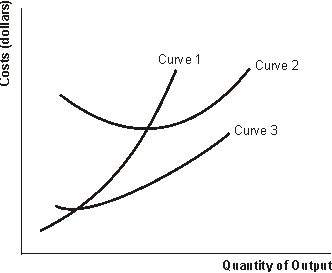 -Refer to Figure 4.2. Curve 1 represents
 (Multiple Choice)
4.8/5 (76)
(76) If Microsoft finds that a 15 percent increase in all inputs results in a 15 percent increase in total output, the firm realizes
(Multiple Choice)
4.9/5 (75)
(75) The long run is a period in which all inputs are considered as fixed in amounts.
(True/False)
4.8/5 (76)
(76) 
Filters
- Essay(0)
- Multiple Choice(0)
- Short Answer(0)
- True False(0)
- Matching(0)