



 Chat with AI
Exam 4: Production and the Costs of Production

Exam 1: Scarcity and Choice78 Questions
Exam 2: Market Transactions: Demand and Supply Analysis93 Questions
Exam 3: Demand and Supply Applications92 Questions
Exam 4: Production and the Costs of Production77 Questions
Exam 5: Competition and Monopoly: Virtues and Vices92 Questions
Exam 6: Imperfect Competition90 Questions
Exam 7: Labor Markets86 Questions
Exam 8: Government and Markets89 Questions
Exam 9: The Mixed Economy of the United States80 Questions
Exam 10: Gross Domestic Product and Economic Growth87 Questions
Exam 11: The Business Cycle, Unemployment, and Inflation87 Questions
Exam 12: Macroeconomic Instability: Aggregate Demand and Aggregate Supply78 Questions
Exam 13: Fiscal Policy and the Federal Budget90 Questions
Exam 14: Money and the Banking System92 Questions
Exam 15: The Federal Reserve and Monetary Policy84 Questions
Exam 16: The United States and the Global Economy84 Questions
Exam 17: International Finance70 Questions
Exam 18: Economic Systems and Developing Countries76 Questions
Select questions type


Miller Technologies has average variable costs of $6 and average total costs of $10 when it produces 1,000 units of output. The firm's total fixed costs equal
(Multiple Choice)
4.8/5  (77)
(77) A firm's explicit costs include all of the following except
(Multiple Choice)
4.8/5 (75)
(75) The marginal product of labor is equal to the change in output that results from changing labor by one unit, holding all other inputs fixed.
(True/False)
4.8/5 (80)
(80) A technological improvement that increases productivity will
(Multiple Choice)
4.9/5 (73)
(73) The fixed costs of General Foods would include all of the following except
(Multiple Choice)
4.7/5 (79)
(79) Smith Tire Co. has total fixed costs of $100,000 per year. The firm's average variable cost is $80 for 10,000 tires. At that level of output, the firm's average total costs equal
(Multiple Choice)
4.7/5 (82)
(82) Figure 4.1 Total Product Curves
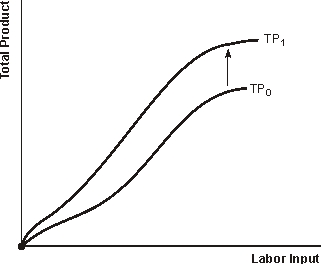 -Refer to Figure 4.1. The shift in the total product curve represents an increase in the firm's
 (Multiple Choice)
4.9/5 (74)
(74) The marginal cost curve and average total cost curve of General Electric will shift downward if the firm realizes technological advances, a reduction in resource prices, or a decrease in taxes.
(True/False)
4.7/5 (81)
(81) In response to a change in demand, a firm can employ more or fewer variable inputs, but not alter the capacity of its factory, in the short run.
(True/False)
5.0/5 (77)
(77) Figure 4.1 Total Product Curves
-Refer to Figure 4.1. Which of the following could explain why the total product curve shifted?
-Refer to Figure 4.1. Which of the following could explain why the total product curve shifted? (Multiple Choice)
4.9/5 (70)
(70) Which of the following is not a source of economies of scale?
(Multiple Choice)
5.0/5 (65)
(65) Normal profit includes the opportunity cost of all of the following except the
(Multiple Choice)
4.8/5 (66)
(66) ______ represents the minimum profit necessary to keep a firm in operation.
(Multiple Choice)
4.9/5 (74)
(74) If the addition of yet ever more workers continues to increase output, but by successively smaller increments, a firm realizes increasing marginal returns.
(True/False)
4.7/5 (97)
(97) The principle that explains the rising portion of the marginal product curve is the law of diminishing marginal returns.
(True/False)
4.8/5 (81)
(81) An economist would argue that accountants tend to understate profits and overstate losses.
(True/False)
4.9/5 (87)
(87) The marginal cost curve intersects the average total cost and average variable cost curves at their maximum points.
(True/False)
4.7/5 (89)
(89) Suppose that Sara's Sandwich Shop initially encounters diminishing marginal returns when it begins production of meatball sandwiches. In this range of output, its marginal product is
(Multiple Choice)
4.7/5 (86)
(86) 
Filters
- Essay(0)
- Multiple Choice(0)
- Short Answer(0)
- True False(0)
- Matching(0)