



 Chat with AI
Exam 17: International Finance

Exam 1: Scarcity and Choice78 Questions
Exam 2: Market Transactions: Demand and Supply Analysis93 Questions
Exam 3: Demand and Supply Applications92 Questions
Exam 4: Production and the Costs of Production77 Questions
Exam 5: Competition and Monopoly: Virtues and Vices92 Questions
Exam 6: Imperfect Competition90 Questions
Exam 7: Labor Markets86 Questions
Exam 8: Government and Markets89 Questions
Exam 9: The Mixed Economy of the United States80 Questions
Exam 10: Gross Domestic Product and Economic Growth87 Questions
Exam 11: The Business Cycle, Unemployment, and Inflation87 Questions
Exam 12: Macroeconomic Instability: Aggregate Demand and Aggregate Supply78 Questions
Exam 13: Fiscal Policy and the Federal Budget90 Questions
Exam 14: Money and the Banking System92 Questions
Exam 15: The Federal Reserve and Monetary Policy84 Questions
Exam 16: The United States and the Global Economy84 Questions
Exam 17: International Finance70 Questions
Exam 18: Economic Systems and Developing Countries76 Questions
Select questions type


Suppose there is an increase in the Canadian demand for Swiss computers. This results in a(n)
(Multiple Choice)
4.7/5  (80)
(80) Which of the following is classified as an outflow in the U.S. balance of payments?
(Multiple Choice)
4.9/5 (67)
(67) When a nation realizes a current account deficit, it becomes a net lender to the rest of the world.
(True/False)
4.9/5 (70)
(70) When the dollar depreciates against the Swiss franc, it is more difficult for U.S. firms to sell their goods in Swiss markets.
(True/False)
5.0/5 (88)
(88) Figure 17.1 Supply and Demand Curves for the Swiss Franc
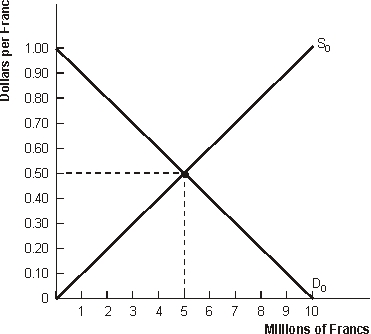 -Refer to Figure 17.1. Suppose the exchange rate is $0.70 per franc. At this exchange rate there is an ______ of francs that leads to a ______ in the dollar price of the franc, a(n) ______ in the quantity of francs supplied, and a(n) ______ in the quantity of francs demanded.
 (Multiple Choice)
4.8/5 (75)
(75) In the current account, the category "unilateral transfers" refers to
(Multiple Choice)
4.8/5 (82)
(82) To offset an appreciation of the dollar, the Federal Reserve can buy dollars in the foreign exchange market.
(True/False)
4.8/5 (80)
(80) When the dollar appreciates against the British pound, U.S. exporting firms find it harder to compete in the British market.
(True/False)
4.9/5 (85)
(85) Figure 17.2 The Market for Swiss Francs
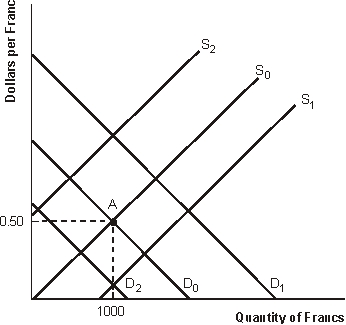 -Refer to Figure 17.2. A shift in the demand for francs from D0 to D2, or a shift in the supply of francs from S0 to S1 would result in
 (Multiple Choice)
4.7/5 (82)
(82) A major difference between the Federal Reserve and the European Central Bank is that
(Multiple Choice)
4.9/5 (66)
(66) 
Filters
- Essay(0)
- Multiple Choice(0)
- Short Answer(0)
- True False(0)
- Matching(0)