



 Chat with AI
Exam 9: Transcriptional Regulation and Epigenetics

Exam 1: An Overview of Cells and Cell Research124 Questions
Exam 2: Molecules and Membranes133 Questions
Exam 3: Bioenergetics and Metabolism138 Questions
Exam 4: Fundamentals of Molecular Biology117 Questions
Exam 5: Genomics, Proteomics, and Systems Biology108 Questions
Exam 6: Genes and Genomes101 Questions
Exam 7: Replication, Maintenance, and Rearrangements of Genomic Dna103 Questions
Exam 8: RNA Synthesis and Processing104 Questions
Exam 9: Transcriptional Regulation and Epigenetics115 Questions
Exam 10: Protein Synthesis, Processing, and Regulation98 Questions
Exam 11: The Nucleus128 Questions
Exam 12: Protein Sorting and Transport110 Questions
Exam 13: Mitochondria, Chloroplasts, and Peroxisomes106 Questions
Exam 14: The Cytoskeleton and Cell Movement106 Questions
Exam 15: The Plasma Membrane109 Questions
Exam 16: Cell Walls, the Extracellular Matrix, and Cell Interactions101 Questions
Exam 17: Cell Signaling114 Questions
Exam 18: The Cell Cycle101 Questions
Exam 19: Cell Death and Cell Renewal107 Questions
Exam 20: Cancer102 Questions
Select questions type


Kadonaga and Tjian were able to isolate the transcription factor Sp1 by exploiting its ability to bind
(Multiple Choice)
4.8/5  (70)
(70) Islet cells in the pancreas are the only cells in the human body that produce the hormone insulin. The table below compares the extent of methylation within the promoter region upstream of the gene encoding the insulin protein in three types of human cells. The results provide an example illustrating that methylation of DNA is correlated with transcriptional _______.
Cell type Extent of methylation of the insulin promoter Pancreatic islet cells 0 Fibroblasts (skin cells) +++ Leukocytes (white blood cells) +++
(Short Answer)
4.8/5 (73)
(73) Transmission of information that is not contained within the sequence of DNA to daughter cells at cell division is called epigenetic inheritance.
(True/False)
4.8/5 (80)
(80) A bacterial operon is said to be under _______ control if it involves an activator protein that functions to stimulate RNA polymerase to initiate transcription of its genes.
(Short Answer)
5.0/5 (90)
(90) The lac operon is regulated by the binding of an enhancer to sequences just upstream of the promoter.
(True/False)
4.8/5 (84)
(84) DNA-affinity chromatography is a useful method for purifying individual transcription factors from cell extracts, even though these proteins are present in extremely low quantities.
(True/False)
5.0/5 (82)
(82) Acetylation of lysine residues on histones causes these proteins to lose _______ charges, which allows the chromatin structure to relax.
(Short Answer)
4.8/5 (73)
(73) How could you use chromatin immunoprecipitation to isolate and identify a lncRNA involved in chromatin modification?
(Essay)
4.8/5 (91)
(91) A mutation in the i gene encoding the lac operon repressor protein causes this protein to lose its ability to bind to the operator site. Which would you expect to observe in an E. coli population having this mutation?
(Multiple Choice)
5.0/5 (87)
(87) Some transcriptional activators have two domains: a _______ domain and an activation domain, each of which carries out specific functions.
(Short Answer)
4.7/5 (71)
(71) How do long noncoding RNAs (lncRNAs) function in regulating gene expression?
(Multiple Choice)
4.8/5 (73)
(73) Refer to the figure below.
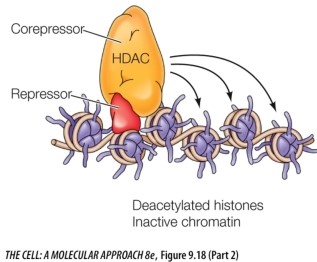 Explain how HDACs function to regulate gene expression.
 (Essay)
4.9/5 (81)
(81) Which is not a mechanism of histone change that is mediated by chromatin remodeling factors?
(Multiple Choice)
4.9/5 (82)
(82) For each protein-coding gene, there is one promoter and one enhancer that act as regulatory elements for that gene.
(True/False)
4.8/5 (77)
(77) Three amino acids, present in histone tails, that are chemically modified as part of gene regulatory processes are lysine, arginine, and _______.
(Short Answer)
4.9/5 (79)
(79) Suppose a culture of E. coli is growing in media containing only glucose. The cells eventually deplete this glucose supply. Just as the last bit of glucose is used up, lactose and other sugars become available. How does both the loss of glucose and the addition of lactose affect expression of the lac operon in these cells?
(Essay)
4.7/5 (78)
(78) The L-arabinose operon in an E. coli strain contains genes that code for enzymes used to break down the sugar L-arabinose. A regulatory gene located upstream from the operon encodes the regulatory protein AraC. AraC undergoes a conformational change when it binds to L-arabinose, and this form of AraC binds to the operator site of the operon, acting as an activator, to stimulate RNA polymerase to begin transcription. Explain whether this is an example of positive or negative control and how this compares to the control mechanism of the lac operon.
(Essay)
4.9/5 (84)
(84) Suppose an E. coli cell is in an environment that is rich in glucose and poor in lactose. Which statement best explains gene expression of enzymes used in lactose breakdown?
(Multiple Choice)
4.9/5 (87)
(87) 
Filters
- Essay(0)
- Multiple Choice(0)
- Short Answer(0)
- True False(0)
- Matching(0)