



 Chat with AI
Exam 9: Transcriptional Regulation and Epigenetics

Exam 1: An Overview of Cells and Cell Research124 Questions
Exam 2: Molecules and Membranes133 Questions
Exam 3: Bioenergetics and Metabolism138 Questions
Exam 4: Fundamentals of Molecular Biology117 Questions
Exam 5: Genomics, Proteomics, and Systems Biology108 Questions
Exam 6: Genes and Genomes101 Questions
Exam 7: Replication, Maintenance, and Rearrangements of Genomic Dna103 Questions
Exam 8: RNA Synthesis and Processing104 Questions
Exam 9: Transcriptional Regulation and Epigenetics115 Questions
Exam 10: Protein Synthesis, Processing, and Regulation98 Questions
Exam 11: The Nucleus128 Questions
Exam 12: Protein Sorting and Transport110 Questions
Exam 13: Mitochondria, Chloroplasts, and Peroxisomes106 Questions
Exam 14: The Cytoskeleton and Cell Movement106 Questions
Exam 15: The Plasma Membrane109 Questions
Exam 16: Cell Walls, the Extracellular Matrix, and Cell Interactions101 Questions
Exam 17: Cell Signaling114 Questions
Exam 18: The Cell Cycle101 Questions
Exam 19: Cell Death and Cell Renewal107 Questions
Exam 20: Cancer102 Questions
Select questions type


An electrophoresis assay used to identify the sequences of DNA to which specific regulatory proteins bind is called

Free
(Multiple Choice)
4.9/5  (78)
(78) Correct Answer: Verified
A
Suppose that gene X is induced in E. coli cells when they are treated with high levels of ethanol. A mutation in region 1 in the upstream region of gene X results in high-level expression under basal conditions, and a mutation in region 2 results in an uninducible gene. What would you expect from a strain in which both regions 1 and 2 are mutated?
Free
(Essay)
4.7/5 (68)
(68) Correct Answer:Verified
VerifiedBecause a mutation in region 1 causes high-level expression even in the absence of ethanol, region 1 must bind a transcriptional repressor and regulation of gene X must occur by relief of repression. Since a mutation in region 2 blocks inducibility of the gene, region 2 must bind a transcriptional activator: In the absence of an activator, the repressor becomes irrelevant, and the gene is inactive, regardless of conditions. Mutations in both regions 1 and 2 would have the same effect as the single mutation in region 2, because in the absence of a bound transcriptional activator, the repressor is irrelevant, and the gene is inactive regardless of the presence or absence of ethanol.
Some corepressors bind to transcription factors at transcription initiation sites and recruit deacetylases that remove acetyl groups from histone lysine groups, leading to condensation of chromatin and repression of transcription.
Free
(True/False)
4.7/5 (65)
(65) Correct Answer:Verified
VerifiedTrue
A eukaryotic regulatory protein controls expression of a gene. Some data regarding this protein are listed in the table below. Which hypothesis about the mechanism of this protein can be ruled out? Binding specificity of protein to DNA Number of domains in protein Domain functions Effect on transcription Regulatory protein X GGAACT 1 DNA binding domain Inhibits
(Multiple Choice)
4.8/5 (79)
(79) You have a cell line that contains a gene that regulates cell cycle re-entry. It is normally repressed by a transcriptional repressor that has two functional domains: a DNA binding domain and a repressor domain that inhibits the activity of RNA polymerase. What would likely happen if a protein encoding only the DNA binding domain became dramatically overexpressed in these cells?
(Essay)
4.8/5 (69)
(69) How are chromatin remodeling factors similar to and different from histone acetyltransferases and deacetylases?
(Essay)
4.9/5 (77)
(77) The molecule providing the scaffolding in the figure below to allow multiple chromatin modifications is a(n) _______.
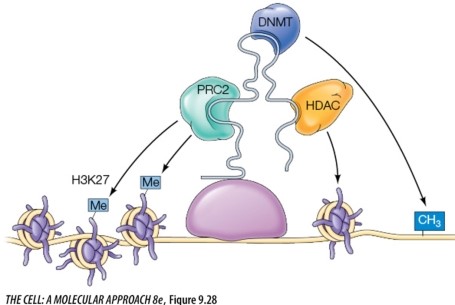
(Short Answer)
4.9/5 (87)
(87) Eukaryotic transcriptional activators have activation domains that interact with
(Multiple Choice)
4.8/5 (83)
(83) What two different mechanisms do transcription factors use to regulate transcription of eukaryotic genes?
(Essay)
4.8/5 (81)
(81) Which of the following experimental approaches is least likely to be used to identify transcription factor binding sites on DNA?
(Multiple Choice)
4.8/5 (64)
(64) Which information would be helpful in determining whether a particular bacterial gene is under positive or negative transcriptional control?
(Multiple Choice)
4.9/5 (77)
(77) Methylation of certain lysine residues in histones leads to gene silencing, whereas methylation of other lysine residues in the same histones leads to transcriptional activation. How can methylation lead to these two different outcomes?
(Essay)
4.8/5 (83)
(83) Cancer cells repress some genes that are expressed in normal cells. Suppose you wanted to design two drugs to treat cancer cells. Which activities would you want your drugs to have?
(Multiple Choice)
5.0/5 (88)
(88) An investigation was carried out to identify different sections of mammalian DNA as either promoters or enhancers of gene Y transcription. Wild-type mammalian cells functioned normally, while mutant cells lacked the ability to produce functional cohesion protein. Based on the data in the table below, which conclusion is valid? Cells Regulatory sequence Expression of gene Wild-type +++ +++ Mutant +++ 0
(Multiple Choice)
4.8/5 (78)
(78) 
Filters
- Essay(0)
- Multiple Choice(0)
- Short Answer(0)
- True False(0)
- Matching(0)