



 Chat with AI
Exam 5: The Nature of Light

Exam 1: Astronomy and the Universe78 Questions
Exam 2: Knowing the Heavens99 Questions
Exam 3: Eclipses and the Motion of the Moon67 Questions
Exam 4: Gravitation and the Waltz of the Planets105 Questions
Exam 5: The Nature of Light91 Questions
Exam 6: Optics and Telescopes97 Questions
Exam 7: Comparative Planetology I: Our Solar System63 Questions
Exam 8: Comparative Planetology II: the Origin of Our Solar System53 Questions
Exam 9: The Living Earth78 Questions
Exam 10: Our Barren Moon101 Questions
Exam 11: Mercury, Venus, and Mars: Terrestrial, yet Unique99 Questions
Exam 12: Jupiter and Saturn: Lords of the Planets97 Questions
Exam 13: Jupiter and Saturns Satellites of Fire and Ice110 Questions
Exam 14: Uranus, Neptune, Pluto, and the Kuiper Belt: Remote Worlds105 Questions
Exam 15: Asteroids, Comets, and Impacts80 Questions
Exam 16: Our Star, the Sun68 Questions
Exam 17: The Nature of the Stars113 Questions
Exam 18: The Birth of Stars97 Questions
Exam 19: Stellar Evolution: on and After the Main Sequence64 Questions
Exam 20: Stellar Evolution: The Death of Stars78 Questions
Exam 21: Stellar Remnants: Neutron Stars and Black Holes107 Questions
Exam 22: Our Galaxy48 Questions
Exam 23: Galaxies85 Questions
Exam 24: Quasars and Active Galaxies73 Questions
Exam 25: Cosmology: The Origin and Evolution of the Universe68 Questions
Exam 26: Exploring the Early Universe72 Questions
Exam 27: The Search for Extraterrestrial Life26 Questions
Select questions type


The majority of the naturally occurring elements in the periodic table that decay radioactively are:
(Multiple Choice)
4.8/5  (79)
(79) At absolute zero temperature, which of the following conditions holds?
(Multiple Choice)
4.7/5 (80)
(80) You are asked to design a detection system for human beings (or animals) in darkness, using infrared detection. If human beings are at a temperature of about 310 K, what would need to be the wavelength of peak sensitivity of your equipment or cameras (1 μm = 10-6 m)? (Hint: Use Wien's law.)
(Multiple Choice)
4.8/5 (86)
(86) The Stefan-Boltzmann law relating energy per unit area F emitted by an object to its temperature T, F = σT 4, is obeyed ideally by what type of object?
(Multiple Choice)
4.9/5 (76)
(76) How is a star's spectrum changed when looking at the absorption spectrum from an approaching star as compared to if the star were stationary?
(Multiple Choice)
4.8/5 (76)
(76) When a solid body is heated to a temperature T, the total radiated energy flux F from this body per second per unit area is given by (where σ is a constant):
(Multiple Choice)
4.9/5 (90)
(90) The diameter of your finger is 1 or 2 cm. What type of electromagnetic wave has a wavelength this size?
(Multiple Choice)
4.7/5 (73)
(73) The temperature of hydrogen gas is such that electrons are excited by atomic collisions up to the n = 3 atomic energy levels. Emission lines from which spectral sequences result when electrons return to the ground state?
(Multiple Choice)
4.8/5 (88)
(88) To what physical parameter is the temperature of a thin gas most closely related?
(Multiple Choice)
4.9/5 (69)
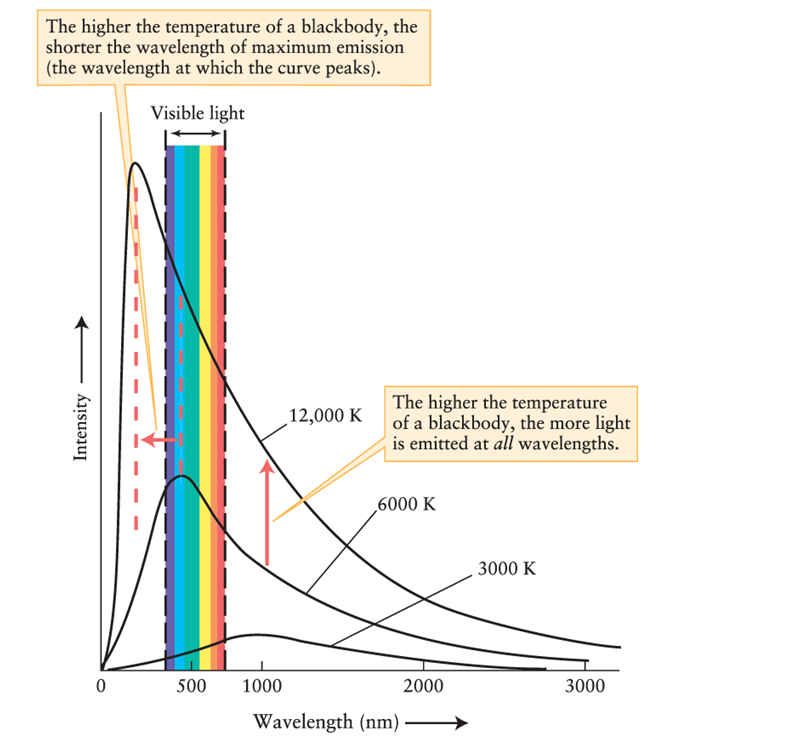
(69) Compare the spectrum emitted from a blackbody at 12,000 K and at 3000 K, using Figure 5-12 of Universe, 11th ed. Where in the spectrum does the object emit more radiation when it is cooler than when it is warmer?
(Multiple Choice)
4.9/5 (77)
(77) 
Filters
- Essay(0)
- Multiple Choice(0)
- Short Answer(0)
- True False(0)
- Matching(0)