



 Chat with AI
Exam 6: Optics and Telescopes

Exam 1: Astronomy and the Universe78 Questions
Exam 2: Knowing the Heavens99 Questions
Exam 3: Eclipses and the Motion of the Moon67 Questions
Exam 4: Gravitation and the Waltz of the Planets105 Questions
Exam 5: The Nature of Light91 Questions
Exam 6: Optics and Telescopes97 Questions
Exam 7: Comparative Planetology I: Our Solar System63 Questions
Exam 8: Comparative Planetology II: the Origin of Our Solar System53 Questions
Exam 9: The Living Earth78 Questions
Exam 10: Our Barren Moon101 Questions
Exam 11: Mercury, Venus, and Mars: Terrestrial, yet Unique99 Questions
Exam 12: Jupiter and Saturn: Lords of the Planets97 Questions
Exam 13: Jupiter and Saturns Satellites of Fire and Ice110 Questions
Exam 14: Uranus, Neptune, Pluto, and the Kuiper Belt: Remote Worlds105 Questions
Exam 15: Asteroids, Comets, and Impacts80 Questions
Exam 16: Our Star, the Sun68 Questions
Exam 17: The Nature of the Stars113 Questions
Exam 18: The Birth of Stars97 Questions
Exam 19: Stellar Evolution: on and After the Main Sequence64 Questions
Exam 20: Stellar Evolution: The Death of Stars78 Questions
Exam 21: Stellar Remnants: Neutron Stars and Black Holes107 Questions
Exam 22: Our Galaxy48 Questions
Exam 23: Galaxies85 Questions
Exam 24: Quasars and Active Galaxies73 Questions
Exam 25: Cosmology: The Origin and Evolution of the Universe68 Questions
Exam 26: Exploring the Early Universe72 Questions
Exam 27: The Search for Extraterrestrial Life26 Questions
Select questions type


For which of the following spectral ranges is it essential that astronomical observations be made from space?
(Multiple Choice)
4.7/5  (77)
(77) A refracting telescope has an objective lens of focal length 80 cm, a diameter of 10 cm, and an eyepiece of focal length 5 cm and diameter 1 cm. What is the magnifying power of this telescope?
(Multiple Choice)
4.9/5 (69)
(69) Chandra, XMM-Newton, and NuSTAR are all orbiting telescopes designed to observe primarily in which part of the spectrum?
(Multiple Choice)
4.8/5 (81)
(81) One important fact to keep in mind when comparing visible and infrared images of Saturn is that:
(Multiple Choice)
4.8/5 (79)
(79) A high mountaintop such as Mauna Kea in Hawaii is a good site for an infrared observatory because it is:
(Multiple Choice)
4.7/5 (90)
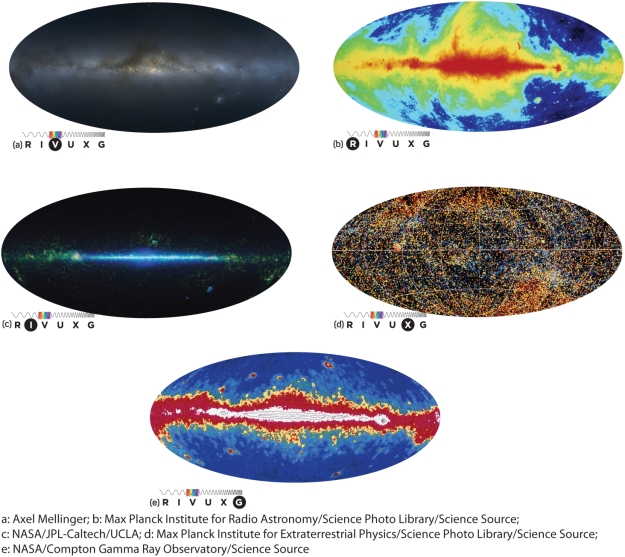
(90) In the x-ray view of the universe (see Figure 6-32 of Universe, 11th ed.), in the wavelength range of 0.1 to 10 nm, the brightest most intense radiation comes from:
(Multiple Choice)
4.8/5 (73)
(73) Refraction of light at a surface between two transparent substances occurs because:
(Multiple Choice)
4.8/5 (64)
(64) Why is the angular resolution of a 20-m-diameter radio telescope worse than that of a 0.5-m-diameter optical telescope?
(Multiple Choice)
4.8/5 (77)
(77) ROSAT was launched into Earth orbit in 1990 to study the universe using:
(Multiple Choice)
4.9/5 (88)
(88) When used for photography, which of the following simple telescopes (with film or detector placed at the appropriate focus) will suffer from chromatic aberration?
(Multiple Choice)
4.8/5 (72)
(72) When making a spectrum of a distant galaxy, it is usual practice to allow light from a laboratory sample of some element, say neon, to fall upon the spectrum as well. Why is this done?
(Multiple Choice)
4.9/5 (67)
(67) At the present time (2018), the largest optical telescope in the world has a primary mirror with a diameter of about:
(Multiple Choice)
4.9/5 (88)
(88) In a spectrograph, a glass prism has a number of disadvantages compared to a diffraction grating. Which of the following is not one of these disadvantages?
(Multiple Choice)
4.9/5 (94)
(94) One major difference between radio waves and light is that:
(Multiple Choice)
4.8/5 (84)
(84) The diffraction-limited angular resolution of one telescope is 0.1 arcsec and that of another is 0.2 arcsec. What does this mean?
(Multiple Choice)
4.8/5 (82)
(82) The quality of images produced by a large radio telescope is limited mostly by:
(Multiple Choice)
4.8/5 (79)
(79) 
Filters
- Essay(0)
- Multiple Choice(0)
- Short Answer(0)
- True False(0)
- Matching(0)