



 Chat with AI
Exam 7: Comparative Planetology I: Our Solar System

Exam 1: Astronomy and the Universe78 Questions
Exam 2: Knowing the Heavens99 Questions
Exam 3: Eclipses and the Motion of the Moon67 Questions
Exam 4: Gravitation and the Waltz of the Planets105 Questions
Exam 5: The Nature of Light91 Questions
Exam 6: Optics and Telescopes97 Questions
Exam 7: Comparative Planetology I: Our Solar System63 Questions
Exam 8: Comparative Planetology II: the Origin of Our Solar System53 Questions
Exam 9: The Living Earth78 Questions
Exam 10: Our Barren Moon101 Questions
Exam 11: Mercury, Venus, and Mars: Terrestrial, yet Unique99 Questions
Exam 12: Jupiter and Saturn: Lords of the Planets97 Questions
Exam 13: Jupiter and Saturns Satellites of Fire and Ice110 Questions
Exam 14: Uranus, Neptune, Pluto, and the Kuiper Belt: Remote Worlds105 Questions
Exam 15: Asteroids, Comets, and Impacts80 Questions
Exam 16: Our Star, the Sun68 Questions
Exam 17: The Nature of the Stars113 Questions
Exam 18: The Birth of Stars97 Questions
Exam 19: Stellar Evolution: on and After the Main Sequence64 Questions
Exam 20: Stellar Evolution: The Death of Stars78 Questions
Exam 21: Stellar Remnants: Neutron Stars and Black Holes107 Questions
Exam 22: Our Galaxy48 Questions
Exam 23: Galaxies85 Questions
Exam 24: Quasars and Active Galaxies73 Questions
Exam 25: Cosmology: The Origin and Evolution of the Universe68 Questions
Exam 26: Exploring the Early Universe72 Questions
Exam 27: The Search for Extraterrestrial Life26 Questions
Select questions type


The wide absorption features in the optical spectrum of Titan's atmosphere (See Figure 7-3 of Universe, 11th ed.) are produced by:
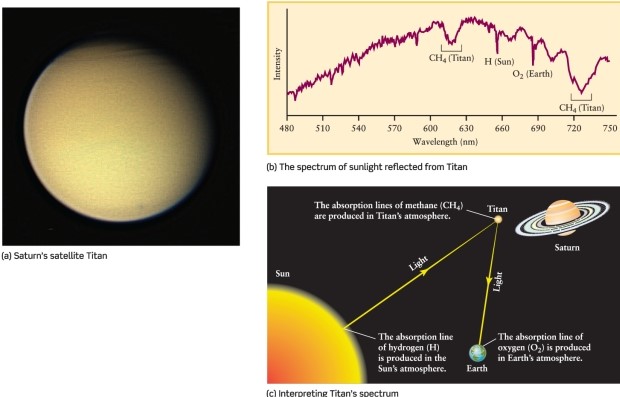
(Multiple Choice)
4.7/5  (78)
(78) The composition of the solid surfaces of planets and satellites (moons) that do not have substantial atmospheres can be found by:
(Multiple Choice)
4.8/5 (83)
(83) Comparing Earth's Moon to the rest of the solar system, which contains about 130 known satellites, it is found that the Moon is:
(Multiple Choice)
4.8/5 (83)
(83) The largest of the terrestrial planets in our solar system is:
(Multiple Choice)
4.8/5 (97)
(97) Which one of the following planets shows the greatest amount of cratering on its surface?
(Multiple Choice)
4.8/5 (74)
(74) In order to produce a planet-wide magnetic field, a planet must have in its interior some material capable of carrying the electric current in such a way as to produce a dynamo effect. All of the following substances appear to be able to fill this role, except one. Which is the exception?
(Multiple Choice)
4.9/5 (64)
(64) The average density of the outer "giant" planets compared to that of liquid water is:
(Multiple Choice)
4.9/5 (85)
(85) Planets and satellites with a large amount of surface cratering generally have insignificant atmospheres. Why are these two conditions correlated?
(Multiple Choice)
4.8/5 (90)
(90) How many orbits of the Sun (sidereal periods) has Neptune completed since its discovery? (See Table 7-1, Universe, 11th ed. (in the text).)
(Multiple Choice)
4.9/5 (83)
(83) An oxygen (O2) molecule has twice the mass of a methane (CH4) molecule. In a planet's atmosphere at some particular temperature, the average kinetic energy of an oxygen molecule is:
(Multiple Choice)
4.8/5 (76)
(76) The natural satellites (moons) of the planets in our solar system:
(Multiple Choice)
4.8/5 (71)
(71) In general, large bodies in the solar system show less evidence of cratering than do small bodies. Why should we expect this correlation?
(Multiple Choice)
4.9/5 (60)
(60) The average speed of hydrogen molecules (H2) in Earth's atmosphere is below the calculated escape speed from Earth (11.2 km/s). So, is hydrogen gas retained in Earth's atmosphere?
(Multiple Choice)
5.0/5 (98)
(98) A laboratory on the surface of Earth makes a spectrum of radiation that originates at the Sun and reflects off a celestial body with an atmosphere such as Saturn's large satellite Titan. Which one of the following statements about the resulting spectrum is correct?
(Multiple Choice)
4.8/5 (78)
(78) In general, a heavily cratered surface should imply a solid interior. Lack of a planet-wide magnetic field should also imply a solid interior. Which one of the following bodies actually possesses both a heavily cratered surface and no planet-wide magnetic field?
(Multiple Choice)
4.9/5 (73)
(73) Which of the large trans-Neptunian objects has the longest orbital period about the Sun?
(Multiple Choice)
4.9/5 (80)
(80) The next planet beyond Saturn is Uranus. The distance from the orbit of Saturn to the orbit of Uranus is about the same as:
(Multiple Choice)
4.8/5 (85)
(85) A molecule moves within the atmosphere of a planet. It would be less likely that this molecule would be retained in the atmosphere of this planet if the:
(Multiple Choice)
4.8/5 (65)
(65) Which of the following planets shows the least amount of cratering on its surface?
(Multiple Choice)
4.8/5 (77)
(77) 
Filters
- Essay(0)
- Multiple Choice(0)
- Short Answer(0)
- True False(0)
- Matching(0)