



 Chat with AI
Exam 10: Our Barren Moon

Exam 1: Astronomy and the Universe78 Questions
Exam 2: Knowing the Heavens99 Questions
Exam 3: Eclipses and the Motion of the Moon67 Questions
Exam 4: Gravitation and the Waltz of the Planets105 Questions
Exam 5: The Nature of Light91 Questions
Exam 6: Optics and Telescopes97 Questions
Exam 7: Comparative Planetology I: Our Solar System63 Questions
Exam 8: Comparative Planetology II: the Origin of Our Solar System53 Questions
Exam 9: The Living Earth78 Questions
Exam 10: Our Barren Moon101 Questions
Exam 11: Mercury, Venus, and Mars: Terrestrial, yet Unique99 Questions
Exam 12: Jupiter and Saturn: Lords of the Planets97 Questions
Exam 13: Jupiter and Saturns Satellites of Fire and Ice110 Questions
Exam 14: Uranus, Neptune, Pluto, and the Kuiper Belt: Remote Worlds105 Questions
Exam 15: Asteroids, Comets, and Impacts80 Questions
Exam 16: Our Star, the Sun68 Questions
Exam 17: The Nature of the Stars113 Questions
Exam 18: The Birth of Stars97 Questions
Exam 19: Stellar Evolution: on and After the Main Sequence64 Questions
Exam 20: Stellar Evolution: The Death of Stars78 Questions
Exam 21: Stellar Remnants: Neutron Stars and Black Holes107 Questions
Exam 22: Our Galaxy48 Questions
Exam 23: Galaxies85 Questions
Exam 24: Quasars and Active Galaxies73 Questions
Exam 25: Cosmology: The Origin and Evolution of the Universe68 Questions
Exam 26: Exploring the Early Universe72 Questions
Exam 27: The Search for Extraterrestrial Life26 Questions
Select questions type


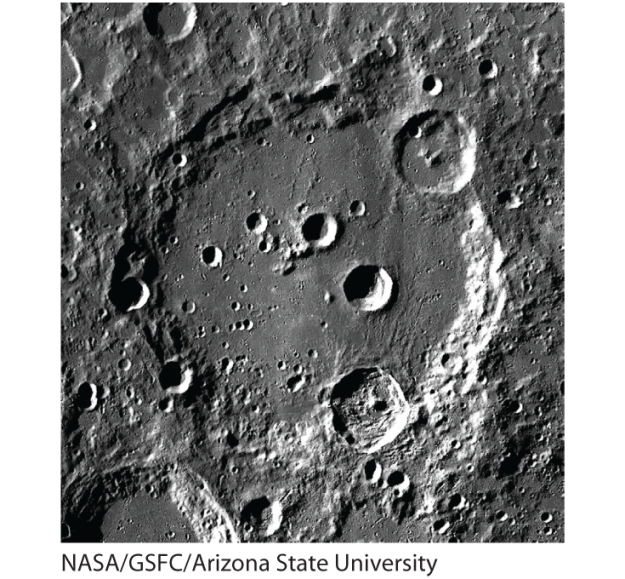
Figure 10-4 of Universe, 11th ed., shows the Crater Clavius. It is 232 km in diameter, but it has relatively few smaller craters within it. This suggests that:
(Multiple Choice)
4.8/5  (65)
(65) What kind of landing did the first spacecraft make in order to reach the surface of the Moon?
(Multiple Choice)
4.9/5 (72)
(72) The theory that seems to account most satisfactorily for the origin of the Moon at the present time is that:
(Multiple Choice)
4.8/5 (68)
(68) The spacecraft Clementine observed the Moon in 1994 and provided evidence for ice near the South Pole. How was this information gathered?
(Multiple Choice)
4.8/5 (67)
(67) Moon rocks contain no water in their crystal structure and contain far less volatile material than those on Earth. Which theory of the origin of the Moon provides the most likely explanation for these differences?
(Multiple Choice)
4.9/5 (76)
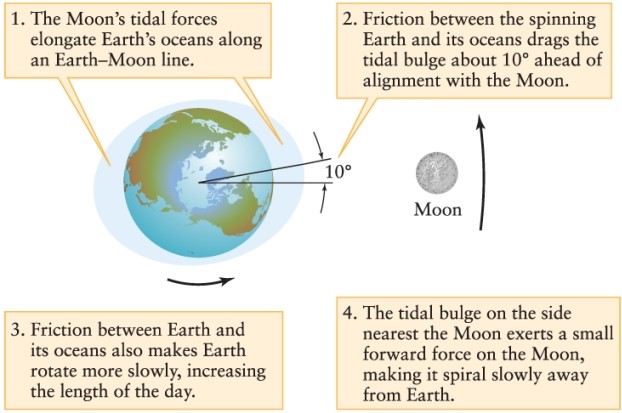
(76) Which statement best describes the average relationship between passage of the Moon through an observer's meridian and the occurrence of high tide in the open ocean? (Hint: See Figure 10-20 of Universe, 11th ed., and think about what you would experience on Earth.)
(Multiple Choice)
4.9/5 (66)
(66) Why do we believe comets are the source of the water detected near the Moon's south pole?
(Multiple Choice)
4.9/5 (74)
(74) Small craters, less than about 400 m, do not last very long on the Moon because they:
(Multiple Choice)
4.7/5 (81)
(81) Although we do not yet know precisely how the Moon was formed, an important clue is provided by the fact that:
(Multiple Choice)
4.7/5 (82)
(82) How were the landing sites for the Apollo missions selected?
(Multiple Choice)
4.8/5 (80)
(80) The ages of Moon rocks have been found through radioactive dating. One major difficulty with this technique is that:
(Multiple Choice)
5.0/5 (83)
(83) Over time, what fraction of the Moon's surface can we see from Earth?
(Multiple Choice)
4.8/5 (77)
(77) Detailed examination of the overall surface of the Moon and of the rocks brought back by Apollo astronauts reveals that:
(Multiple Choice)
4.9/5 (55)
(55) What is considered to be the most likely source for the deposits of ice that have been discovered at the lunar poles?
(Multiple Choice)
4.9/5 (75)
(75) One theory about the origin of the Moon states it was formed from debris thrown out when a Mars-sized object collided with Earth. One fact that strongly supports this theory is that:
(Multiple Choice)
4.9/5 (71)
(71) 
Filters
- Essay(0)
- Multiple Choice(0)
- Short Answer(0)
- True False(0)
- Matching(0)