



 Chat with AI
Exam 12: Jupiter and Saturn: Lords of the Planets

Exam 1: Astronomy and the Universe78 Questions
Exam 2: Knowing the Heavens99 Questions
Exam 3: Eclipses and the Motion of the Moon67 Questions
Exam 4: Gravitation and the Waltz of the Planets105 Questions
Exam 5: The Nature of Light91 Questions
Exam 6: Optics and Telescopes97 Questions
Exam 7: Comparative Planetology I: Our Solar System63 Questions
Exam 8: Comparative Planetology II: the Origin of Our Solar System53 Questions
Exam 9: The Living Earth78 Questions
Exam 10: Our Barren Moon101 Questions
Exam 11: Mercury, Venus, and Mars: Terrestrial, yet Unique99 Questions
Exam 12: Jupiter and Saturn: Lords of the Planets97 Questions
Exam 13: Jupiter and Saturns Satellites of Fire and Ice110 Questions
Exam 14: Uranus, Neptune, Pluto, and the Kuiper Belt: Remote Worlds105 Questions
Exam 15: Asteroids, Comets, and Impacts80 Questions
Exam 16: Our Star, the Sun68 Questions
Exam 17: The Nature of the Stars113 Questions
Exam 18: The Birth of Stars97 Questions
Exam 19: Stellar Evolution: on and After the Main Sequence64 Questions
Exam 20: Stellar Evolution: The Death of Stars78 Questions
Exam 21: Stellar Remnants: Neutron Stars and Black Holes107 Questions
Exam 22: Our Galaxy48 Questions
Exam 23: Galaxies85 Questions
Exam 24: Quasars and Active Galaxies73 Questions
Exam 25: Cosmology: The Origin and Evolution of the Universe68 Questions
Exam 26: Exploring the Early Universe72 Questions
Exam 27: The Search for Extraterrestrial Life26 Questions
Select questions type


The reason for the slightly flattened or oblate shape of Jupiter is:
(Multiple Choice)
5.0/5  (81)
(81) The internal structure of the two largest jovian planets (from center outward) is a(an):
(Multiple Choice)
4.9/5 (84)
(84) The main gravitational effect that organizes the particles in the rings of Saturn into specific orbits is:
(Multiple Choice)
5.0/5 (71)
(71) What was the nationality of the first person to correctly interpret Galileo's observations of "ears" on Saturn?
(Multiple Choice)
4.8/5 (75)
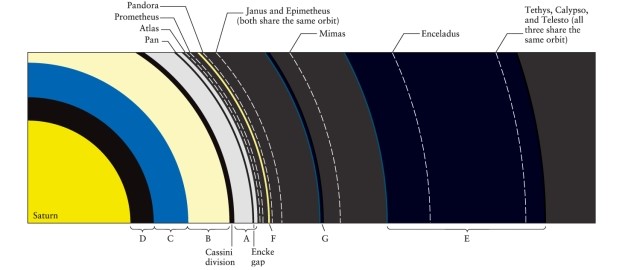
(75) Mimas, the inner large moon of Saturn, orbits the planet at what distance compared to the rings of Saturn? (See Figure 12-24.)
(Multiple Choice)
4.9/5 (91)
(91) Saturn's rotation rate is very fast but slower than Jupiter's. The wind speed at Saturn's equator, compared to the wind speed at Jupiter's equator, is:
(Multiple Choice)
4.8/5 (100)
(100) The Pioneer 2 and Voyager 1 and 2 spacecrafts discovered four new rings of Saturn-the D, F, G, and E rings. How do these four rings compare to each other?
(Multiple Choice)
4.9/5 (82)
(82) Suppose we are viewing Saturn's ring system exactly edge on. How long must we wait until the rings are again edge on? (Assume Saturn's orbital period is 30 years.)
(Multiple Choice)
4.9/5 (73)
(73) The relative proportions of hydrogen and helium that the Galileo Probe found in the atmosphere of Jupiter were almost exactly the same as in the Sun (as was expected), but the abundances of carbon, nitrogen, and sulfur were proportionally higher than in the Sun. What is believed to be the reason for this?
(Multiple Choice)
4.8/5 (86)
(86) The oblateness of Jupiter, which is a measure of the amount by which its polar diameter is less than its equatorial diameter and is a consequence of its fluid structure and rapid rotation, is:
(Multiple Choice)
4.8/5 (83)
(83) We have discovered that the temperature in Jupiter's atmosphere increases as one moves inward toward the planet, and that the planet gives out more energy than it receives from the Sun. What is the cause of this?
(Multiple Choice)
4.8/5 (73)
(73) One observational fact that is common to both Jupiter and Saturn is that:
(Multiple Choice)
4.8/5 (76)
(76) The Galileo Probe found that the wind speed was an almost constant 650 km/h over the entire 200 km of its descent below Jupiter's cloud tops. What does this result imply for Jupiter?
(Multiple Choice)
4.8/5 (75)
(75) The origin of the particles that make up Jupiter's rings is believed to be:
(Multiple Choice)
4.7/5 (94)
(94) What are the fractional proportions of the components that make up the mass of Jupiter?
(Multiple Choice)
5.0/5 (82)
(82) Jupiter and Saturn each have the same three basic cloud layers, but the spacing of the layers differs on the two planets. Why is this?
(Multiple Choice)
4.9/5 (79)
(79) 
Filters
- Essay(0)
- Multiple Choice(0)
- Short Answer(0)
- True False(0)
- Matching(0)