



 Chat with AI
Exam 22: Our Galaxy

Exam 1: Astronomy and the Universe78 Questions
Exam 2: Knowing the Heavens99 Questions
Exam 3: Eclipses and the Motion of the Moon67 Questions
Exam 4: Gravitation and the Waltz of the Planets105 Questions
Exam 5: The Nature of Light91 Questions
Exam 6: Optics and Telescopes97 Questions
Exam 7: Comparative Planetology I: Our Solar System63 Questions
Exam 8: Comparative Planetology II: the Origin of Our Solar System53 Questions
Exam 9: The Living Earth78 Questions
Exam 10: Our Barren Moon101 Questions
Exam 11: Mercury, Venus, and Mars: Terrestrial, yet Unique99 Questions
Exam 12: Jupiter and Saturn: Lords of the Planets97 Questions
Exam 13: Jupiter and Saturns Satellites of Fire and Ice110 Questions
Exam 14: Uranus, Neptune, Pluto, and the Kuiper Belt: Remote Worlds105 Questions
Exam 15: Asteroids, Comets, and Impacts80 Questions
Exam 16: Our Star, the Sun68 Questions
Exam 17: The Nature of the Stars113 Questions
Exam 18: The Birth of Stars97 Questions
Exam 19: Stellar Evolution: on and After the Main Sequence64 Questions
Exam 20: Stellar Evolution: The Death of Stars78 Questions
Exam 21: Stellar Remnants: Neutron Stars and Black Holes107 Questions
Exam 22: Our Galaxy48 Questions
Exam 23: Galaxies85 Questions
Exam 24: Quasars and Active Galaxies73 Questions
Exam 25: Cosmology: The Origin and Evolution of the Universe68 Questions
Exam 26: Exploring the Early Universe72 Questions
Exam 27: The Search for Extraterrestrial Life26 Questions
Select questions type


Suppose it is discovered that the earliest galaxies were flocculent spirals. What implications might this have?
(Multiple Choice)
4.7/5  (78)
(78) High-velocity stars are isolated stars that swing in and out of the plane of the galaxy at relatively high velocities with respect to the solar system. Where would you expect to find them?
(Multiple Choice)
4.9/5 (79)
(79) Harlow Shapley determined the position of the Sun in the galaxy by measuring the distances to 93 globular clusters of stars. How did Shapley obtain the distances to these very distant clusters?
(Multiple Choice)
4.8/5 (74)
(74) If you want to find the distribution of stars in the Milky Way Galaxy, you should observe in which portion of the spectrum?
(Multiple Choice)
4.9/5 (88)
(88) Because the rotation curve for the Milky Way Galaxy is approximately flat, a star in a circular orbit 13 kpc from the galactic center has the same orbital speed as the Sun, namely 220 km/sec. How much mass is interior to this star's orbit (in solar masses)?
(Multiple Choice)
4.9/5 (77)
(77) Which physical process is thought to have created the Local Bubble near our Sun in the galaxy?
(Multiple Choice)
4.8/5 (75)
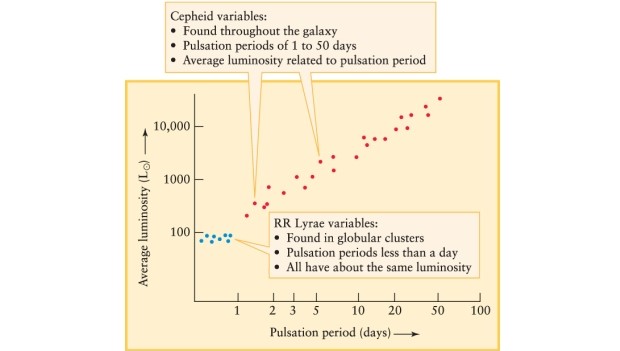
(75) A Cepheid variable star is seen to vary regularly with a period of 25 days. How many times more luminous than the Sun would this star appear to be if it were to replace the Sun in our solar system? (See Figure 22-4 of Universe, 11th ed.)
(Multiple Choice)
4.9/5 (76)
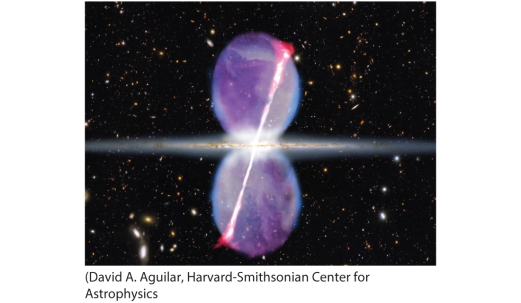
(76) Gamma-ray "bubbles" have been found above and below the plane of our galaxy. (See Figure 22-30 of Universe, 11th ed.) These are:
(Multiple Choice)
4.9/5 (78)
(78) The neutrino has been proposed as a dark matter candidate. What is the current status of this idea?
(Multiple Choice)
4.8/5 (74)
(74) According to the density-wave theory of spiral structure in galaxies:
(Multiple Choice)
4.8/5 (84)
(84) If the Milky Way Galaxy were rescaled to the size of the continental United States, the average distance between stars would be about:
(Multiple Choice)
4.9/5 (94)
(94) What would be the wavelength of maximum emission of interstellar dust grains at a temperature of 65 K? (See Wien's law, Section 5-4, Universe, 11th ed.)
(Multiple Choice)
4.8/5 (74)
(74) If you want to find the distribution of dust in the Milky Way Galaxy, you should observe in which portion of the spectrum?
(Multiple Choice)
4.7/5 (67)
(67) How would the value of the orbital speed of a star on the observable outer edge of the plane of a galaxy change if there were no dark matter?
(Multiple Choice)
4.9/5 (81)
(81) Which of the following BEST describes of the object at the center of our galaxy?
(Multiple Choice)
4.8/5 (85)
(85) Where is the Sun located in our galaxy? (i.e., What is our address in the universe?)
(Multiple Choice)
4.7/5 (76)
(76) The star S2 orbits Sagittarius A* with a period of 15.2 years and a semi-major axis of 950 au. What does Kepler's third law suggest as the total amount of mass inside the orbital radius of S2?
(Multiple Choice)
4.8/5 (70)
(70) A map of our galaxy deduced from radio observations of the 21-cm line emission from cool hydrogen gas reveals:
(Multiple Choice)
4.9/5 (84)
(84) 
Filters
- Essay(0)
- Multiple Choice(0)
- Short Answer(0)
- True False(0)
- Matching(0)