



 Chat with AI
Exam 11: Factor Markets

Exam 1: Foundations of Economics100 Questions
Exam 1: Extension: Understanding Graphs27 Questions
Exam 2: Markets and Economies104 Questions
Exam 3: Demand116 Questions
Exam 4: Supply118 Questions
Exam 5: Market Equilibrium118 Questions
Exam 6: Elasticity126 Questions
Exam 7: Consumer Behavior104 Questions
Exam 8: Production Costs125 Questions
Exam 9: Perfect Competition117 Questions
Exam 10: Market Power102 Questions
Exam 11: Factor Markets105 Questions
Exam 12: Market Failure and Government Failure82 Questions
Exam 13: Measuring an Economys Performance103 Questions
Exam 14: Aggregate Demand and Aggregate Supply105 Questions
Exam 15: Fiscal Policy105 Questions
Exam 16: Money and Banking74 Questions
Exam 17: Monetary Policy103 Questions
Exam 18: Economic Growth and Development49 Questions
Exam 19: International Trade and Finance110 Questions
Select questions type


If a firm has a perfectly inelastic labor demand curve, then an increase in minimum wage will lead to _____ in the quantity of workers hired and _____ in the wage of workers.
(Multiple Choice)
4.8/5  (91)
(91) Use Figure: Minimum Wage and Job Loss I. If the government sets a minimum wage of $14 per hour, then how many of the total number of unemployed workers are new entrants into the labor market who were not present at the competitive wage?
Minimum Wage and Job Loss I

(Multiple Choice)
4.8/5 (86)
(86) All else equal, if a technological improvement increases the marginal product of workers, then the marginal revenue product of workers will _____, and the firms will hire _____ workers.
(Multiple Choice)
4.7/5 (77)
(77) All else equal, if the price of the good that a firm produces decreases, then the marginal revenue product of workers will _____, and the firms will hire _____ workers.
(Multiple Choice)
4.9/5 (87)
(87) All else equal, if the demand for Starbucks coffee increases, then which of the following will follow in the labor market for baristas?
(Multiple Choice)
4.8/5 (80)
(80) Use Figure: Minimum Wage and Job Loss II. If the government sets a minimum wage of $12 per hour, then the quantity of labor demanded is _____, and the quantity of labor supplied is:
Minimum Wage and Job Loss II

(Multiple Choice)
4.9/5 (87)
(87) A firm in a perfectly competitive goods and labor market produces a good that sells for $3. If the competitive wage is $12, then the firm will keep hiring workers until the marginal product is equal to:
(Multiple Choice)
4.9/5 (66)
(66) Both Starbucks and McDonald's have a similar supply of labor for their retail outlets, and in both chains, workers earn a competitively determined wage of $10 per hour. Suppose that the government increases the minimum wage to $15 per hour. If more McDonald's workers lose their jobs than Starbucks employees, what can you conclude about the demand for workers in both outlets? Use graphs to justify your answer.
(Essay)
4.9/5 (87)
(87) Because the demand for labor is more _____ in the long run, a minimum wage increase will lead to _____ job losses in the long run.
(Multiple Choice)
4.8/5 (92)
(92) Use Table: Production and Revenue. The table shows the number workers and the total production of a firm in a competitive market. Use the table to answer the following questions:
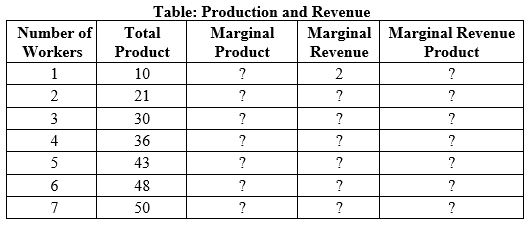 a. Fill in the missing numbers in the table.
b. If the wage that is determined by the labor market is $12, then how many workers should the firm hire?
c. If the firm is currently hiring six workers, then what can you say about the equilibrium wage rate in the labor market? Justify your answer.
a. Fill in the missing numbers in the table.
b. If the wage that is determined by the labor market is $12, then how many workers should the firm hire?
c. If the firm is currently hiring six workers, then what can you say about the equilibrium wage rate in the labor market? Justify your answer. (Essay)
4.9/5 (88)
(88) Use Table: Marginal Revenue Product. The table lists the number of workers and the marginal revenue product per hour that is generated by each worker for a firm in a perfectly competitive market. If the hourly wage of workers is $12 per hour, then the firm will hire _____ workers.

(Multiple Choice)
4.9/5 (74)
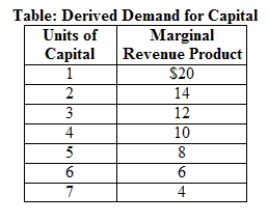
(74) Use Table: Derived Demand for Capital. The table lists the units of capital and the marginal revenue product per hour that are generated by each unit for a firm in a perfectly competitive market. If we know that the firm is hiring six units of capital, then the wage of labor is greater than _____ and less than or equal to:
(Multiple Choice)
4.7/5 (95)
(95) Which of the following can increase simultaneously the equilibrium quantity of workers hired and the equilibrium wage rate?
(Multiple Choice)
4.7/5 (75)
(75) If a government sets a minimum wage higher than the equilibrium wage rate, then the quantity demanded of labor _____, and the quantity supplied of labor:
(Multiple Choice)
4.8/5 (88)
(88) If a firm increases the total amount of capital that is used in production, then all else equal, the marginal revenue product curve will shift _____, and the firms will hire _____ workers.
(Multiple Choice)
4.9/5 (83)
(83) Use Figure: Equilibrium in the Labor Market. Which one of the following can shift the equilibrium from point A to point B?
Figure: Equilibrium in the Labor Market

(Multiple Choice)
4.7/5 (82)
(82) A firm in a perfectly competitive goods and labor market hires an additional worker, which leads to a three-unit increase in output. If the competitive wage is $15, then the price of the good that the firm sells should be at least _____ for the firm to hire the worker.
(Multiple Choice)
4.8/5 (80)
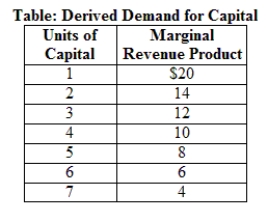
(80) Use Table: Derived Demand for Capital. The table lists the units of capital and the marginal revenue product per hour that are generated by each unit for a firm in a perfectly competitive market. If we know that the firm is hiring five units of capital, then the rental rate of capital is greater than _____ and less than or equal to:
(Multiple Choice)
4.9/5 (72)
(72) Which of the following statements is TRUE for a firm in a perfectly competitive labor market?
(Multiple Choice)
4.8/5 (83)
(83) 
Filters
- Essay(0)
- Multiple Choice(0)
- Short Answer(0)
- True False(0)
- Matching(0)