



 Chat with AI
Exam 19: International Trade and Finance

Exam 1: Foundations of Economics100 Questions
Exam 1: Extension: Understanding Graphs27 Questions
Exam 2: Markets and Economies104 Questions
Exam 3: Demand116 Questions
Exam 4: Supply118 Questions
Exam 5: Market Equilibrium118 Questions
Exam 6: Elasticity126 Questions
Exam 7: Consumer Behavior104 Questions
Exam 8: Production Costs125 Questions
Exam 9: Perfect Competition117 Questions
Exam 10: Market Power102 Questions
Exam 11: Factor Markets105 Questions
Exam 12: Market Failure and Government Failure82 Questions
Exam 13: Measuring an Economys Performance103 Questions
Exam 14: Aggregate Demand and Aggregate Supply105 Questions
Exam 15: Fiscal Policy105 Questions
Exam 16: Money and Banking74 Questions
Exam 17: Monetary Policy103 Questions
Exam 18: Economic Growth and Development49 Questions
Exam 19: International Trade and Finance110 Questions
Select questions type


Refer to the table Comparative and Absolute Advantage I. The table summarizes the amount of tennis rackets and tennis balls that can be produced per unit of labor in Stewarton and Colberton. If both countries have the same amount of labor, then it can be concluded that Stewarton has a comparative advantage in producing _____ and has an absolute advantage in producing:


Free
(Multiple Choice)
4.9/5  (82)
(82) Correct Answer: Verified
D
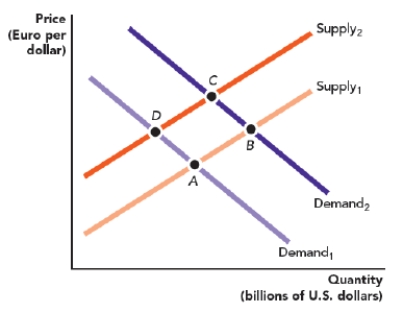
Refer to the figure Currency Appreciation and Depreciation. The figure shows the supply and demand of U.S. dollars in the euro-U.S. dollar foreign exchange market. Which of the following shifts in the equilibrium represents a depreciation in the euro?
Figure: Currency Appreciation and Depreciation
Free
(Multiple Choice)
4.8/5 (84)
(84) Correct Answer:Verified
VerifiedC
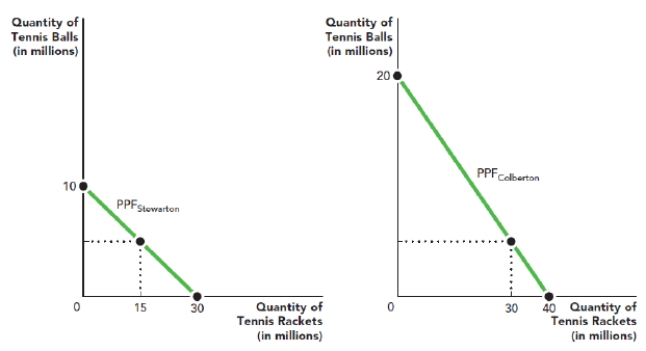
Refer to the figure Mutually Beneficial Trade II. The figure shows the production possibility frontier (PPF) for producing tennis rackets and tennis balls in Stewarton and Colberton. In the absence of trade, if Colberton produces and consumes 30 million tennis rackets, how many tennis balls can it produce and consume?
Figure: Mutually Beneficial Trade II
Free
(Multiple Choice)
4.8/5 (74)
(74) Correct Answer:Verified
VerifiedA
A country produces bread and cheese using only labor as input. The production possibility frontier of the country represents the:
(Multiple Choice)
4.7/5 (80)
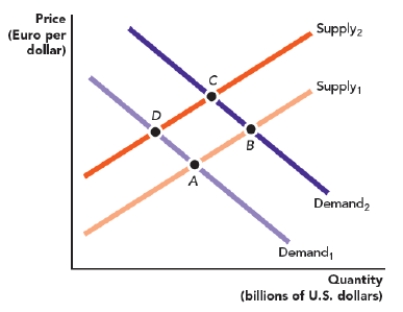
(80) Refer to the figure Currency Appreciation and Depreciation. The figure shows the supply and demand of U.S. dollars in the euro-U.S. dollar foreign exchange market. Which of the following shifts in the equilibrium does NOT represent an appreciation in the U.S. dollar?
Figure: Currency Appreciation and Depreciation
(Multiple Choice)
4.9/5 (88)
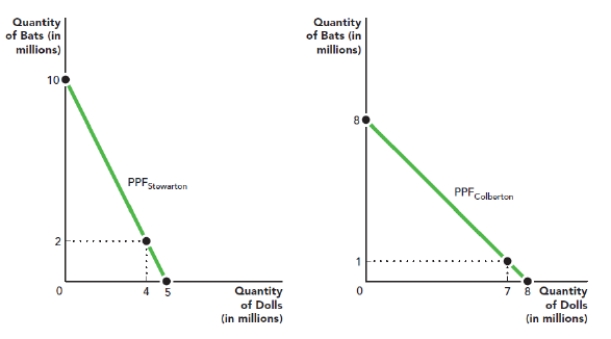
(88) Refer to the figure PPF and Comparative Advantage. The figure shows the production possibility frontier for producing baseball bats and bobblehead dolls in Stewarton and Colberton. If both countries have identical resources, then Colberton has a comparative advantage in producing_____ and has an absolute advantage in:
Figure: PPF and Comparative Advantage
(Multiple Choice)
4.9/5 (88)
(88) Portugal specializes in the production of wine and produces 10 million bottles. The United Kingdom specializes in the production of cheese and produces 100 million pounds. If the terms of trade is 10 pounds of cheese for a bottle of wine and the UK consumes 3 million bottles of wine, then Portugal consumes _____ million pounds of cheese and _____ million bottles of wine.
(Multiple Choice)
4.9/5 (71)
(71) A country's balance of trade refers to the difference between:
(Multiple Choice)
4.9/5 (74)
(74) Refer to the table Comparative and Absolute Advantage I. The table summarizes the amount of tennis rackets and tennis balls that can be produced per unit of labor in Stewarton and Colberton. The opportunity cost of producing tennis balls in Stewarton is:

(Multiple Choice)
4.8/5 (81)
(81) A country produces tennis rackets and tennis balls using only labor as input. One unit of labor can produce one tennis racket or four tennis balls, and the country has 200 units of labor. If the country is operating on its production possibility frontier (PPF) and producing 50 rackets, then how many balls is it producing?
(Multiple Choice)
4.9/5 (90)
(90) Refer to the figure Free Trade and Imports. The figure shows the U.S. demand, U.S. supply, and world supply curves for baseball bats. With free trade, the consumers will purchase _____ million bats, of which _____ million will be imported from the rest of the world.
Figure: Free Trade and Imports
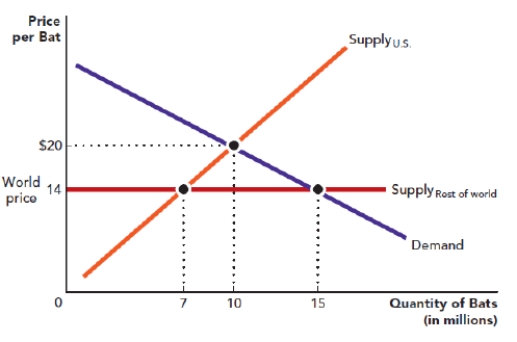
(Multiple Choice)
4.8/5 (70)
(70) Refer to the figure Mutually Beneficial Trade II. The figure shows the production possibility frontier (PPF) for producing tennis rackets and tennis balls in Stewarton and Colberton. If the countries trade according to their comparative advantage, then terms of trade for tennis rackets will be between:
Figure: Mutually Beneficial Trade II
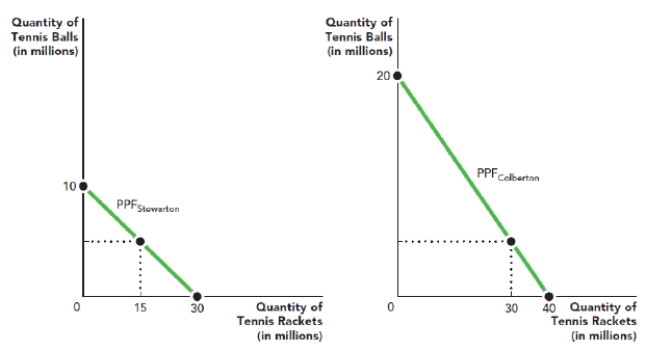
(Multiple Choice)
4.8/5 (77)
(77) Refer to the table Comparative and Absolute Advantage I. The table summarizes the amount of tennis rackets and tennis balls that can be produced per unit of labor in Stewarton and Colberton. The opportunity cost of producing tennis balls in Colberton is:

(Multiple Choice)
4.7/5 (76)
(76) Refer to the figure PPF and Comparative Advantage. The figure shows the production possibility frontier for producing baseball bats and bobblehead dolls in Stewarton and Colberton. The opportunity cost of producing dolls in Stewarton is:
Figure: PPF and Comparative Advantage
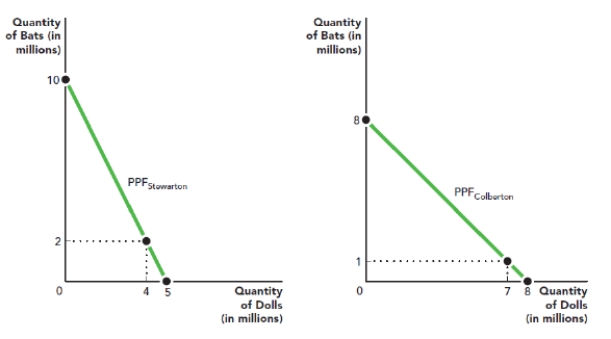
(Multiple Choice)
4.7/5 (77)
(77) Refer to the figure Currency Appreciation and Depreciation. The figure shows the supply and demand of U.S. dollars in the euro-U.S. dollar foreign exchange market. Which of the following shifts in the equilibrium represents a depreciation in the U.S. dollar?
Figure: Currency Appreciation and Depreciation
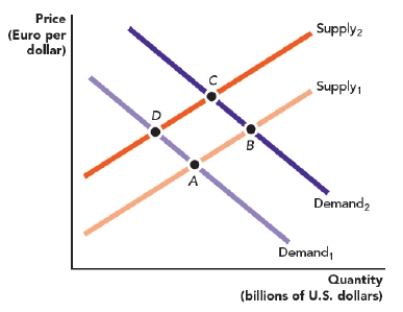
(Multiple Choice)
4.8/5 (95)
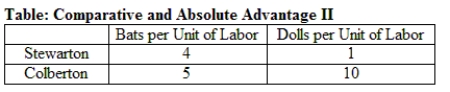
(95) Refer to the table Comparative and Absolute Advantage II. The table summarizes the amount of baseball bats and bobblehead dolls that can be produced per unit of labor in Stewarton and Colberton. The opportunity cost of producing bats in Colberton is:
(Multiple Choice)
4.8/5 (88)
(88) Which of the following can lead to an increase in the demand for Japanese yen compared to the U.S. dollar?
(Multiple Choice)
4.8/5 (81)
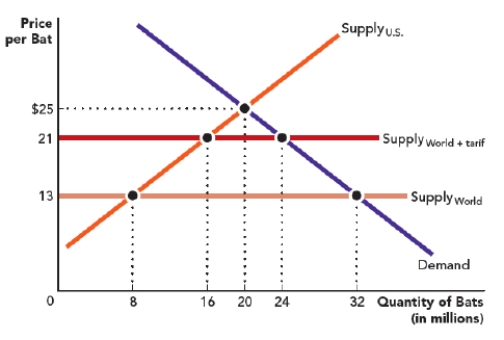
(81) Refer to the figure Import Tariffs. The figure shows the U.S. demand, U.S. supply, and world supply curves for baseball bats. If the United States imposes a $8 tariff on imports, then the consumers will purchase _____ million bats, of which _____ million will be supplied domestically.
Figure: Import Tariffs
(Multiple Choice)
4.9/5 (91)
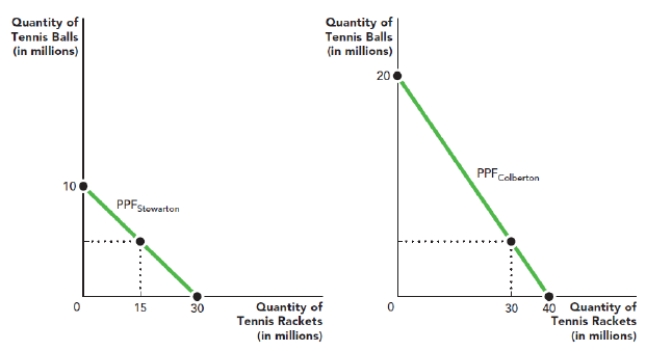
(91) Refer to the figure Mutually Beneficial Trade II. The figure shows the production possibility frontier (PPF) for producing tennis rackets and tennis balls in Stewarton and Colberton. The opportunity cost of producing tennis rackets in Colberton is:
Figure: Mutually Beneficial Trade II
(Multiple Choice)
5.0/5 (72)
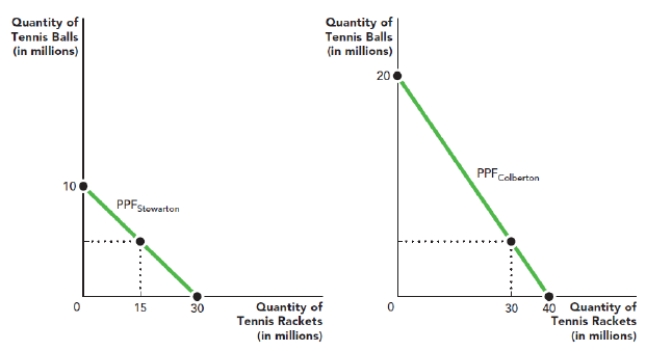
(72) Refer to the figure Mutually Beneficial Trade II. The figure shows the production possibility frontier (PPF) for producing tennis rackets and tennis balls in Stewarton and Colberton. Suppose that the countries trade according to their comparative advantage and the terms of trade for tennis rackets is 0.4 tennis ball. If Colberton ends up consuming 5 million tennis balls, then how many tennis rackets will it be able to consume?
Figure: Mutually Beneficial Trade II
(Multiple Choice)
4.9/5 (91)
(91) 
Filters
- Essay(0)
- Multiple Choice(0)
- Short Answer(0)
- True False(0)
- Matching(0)