



 Chat with AI
Exam 10: Market Power

Exam 1: Foundations of Economics100 Questions
Exam 1: Extension: Understanding Graphs27 Questions
Exam 2: Markets and Economies104 Questions
Exam 3: Demand116 Questions
Exam 4: Supply118 Questions
Exam 5: Market Equilibrium118 Questions
Exam 6: Elasticity126 Questions
Exam 7: Consumer Behavior104 Questions
Exam 8: Production Costs125 Questions
Exam 9: Perfect Competition117 Questions
Exam 10: Market Power102 Questions
Exam 11: Factor Markets105 Questions
Exam 12: Market Failure and Government Failure82 Questions
Exam 13: Measuring an Economys Performance103 Questions
Exam 14: Aggregate Demand and Aggregate Supply105 Questions
Exam 15: Fiscal Policy105 Questions
Exam 16: Money and Banking74 Questions
Exam 17: Monetary Policy103 Questions
Exam 18: Economic Growth and Development49 Questions
Exam 19: International Trade and Finance110 Questions
Select questions type


Resource allocation is efficient from a societal standpoint if a good is produced until the_____ is equal to the _____ of production.

Free
(Multiple Choice)
4.9/5  (74)
(74) Correct Answer: Verified
B
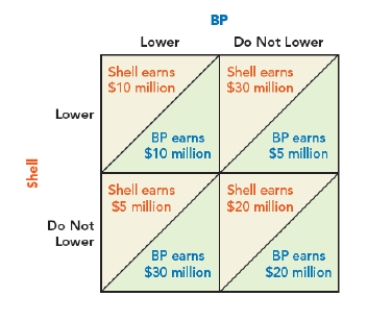
Use Figure: Payoff Matrix Shell & BP I. The figure shows the payoff matrix where the hypothetical daily profits of BP and Shell (in millions of dollars) depend on each other's decision about whether to lower prices. If each firm follows its dominant strategy, then BP's payoff would be _____, and Shell's payoff would be:
Figure: Payoff Matrix Shell & BP I
Free
(Multiple Choice)
4.9/5 (84)
(84) Correct Answer:Verified
VerifiedA
Suppose that a firm in a monopolistically competitive market is operating at its profit-maximizing point in the long run. The firm has a total revenue of $800, its marginal revenue is $10, and it sells 50 units of output. Given this, we can conclude that the price of the good is _____ and the marginal cost of production is:
Free
(Multiple Choice)
4.7/5 (85)
(85) Correct Answer:Verified
VerifiedC
A firm will NOT have any market power if it operates in which one of the following types of markets?
(Multiple Choice)
5.0/5 (83)
(83) A monopolist maximizes profit at the point where the _____ of production is equal to:
(Multiple Choice)
4.8/5 (90)
(90) Which one of the following type of markets has many identical firms selling the same goods or services?
(Multiple Choice)
4.7/5 (84)
(84) Suppose that a monopolist is operating at its profit-maximizing point where the profit per unit is $8. If the average total cost of production is $4, then what is the price charged by the monopolist?
(Multiple Choice)
4.9/5 (77)
(77) Which one of the following is NOT a characteristic of monopolistically competitive markets?
(Multiple Choice)
4.8/5 (79)
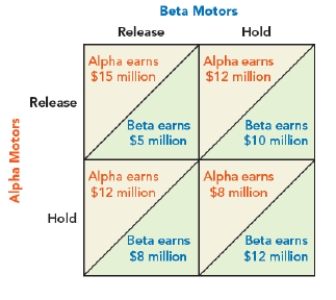
(79) Use Figure: Payoff Matrix Alpha and Beta Motors II. The figure shows the payoff matrix where the hypothetical daily profits of Alpha Motor and Beta Motors (in millions of dollars) depend on each other's decision about whether to hold on to their inventories or release them at a discount at the end of the year. If both firms follow their dominant strategy, then Alpha Motor's payoff will be _____, and Beta Motor's payoff will be:
Figure: Payoff Matrix Alpha and Beta Motors II
(Multiple Choice)
4.8/5 (79)
(79) Because a monopolist must _____ price to sell additional output, its marginal revenue is _____ than the price.
(Multiple Choice)
4.8/5 (77)
(77) In a natural monopoly, the government regulations often require firms to price their goods at:
(Multiple Choice)
5.0/5 (83)
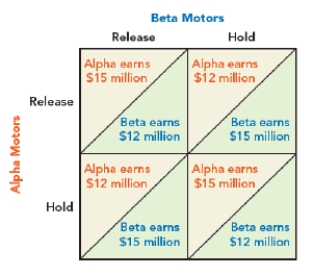
(83) Use Figure: Payoff Matrix Alpha and Beta Motors III. The figure shows the payoff matrix where the hypothetical daily profits of Alpha Motor and Beta Motor (in millions of dollars) depend on each other's decision about whether to hold on to their inventories or release them at a discount at the end of the year. Based on these payoffs, which one of the following statements is true?
Figure: Payoff Matrix Alpha and Beta Motors III
(Multiple Choice)
5.0/5 (82)
(82) If _____ in output causes _____ in average total cost, then a firm is said to be experiencing economies of scale.
(Multiple Choice)
4.7/5 (78)
(78) In any type of market, the profit per unit of output for a firm is equal to:
(Multiple Choice)
4.8/5 (98)
(98) If the average total cost of a firm decreases with an increase in its output, then the firm experiences:
(Multiple Choice)
4.9/5 (76)
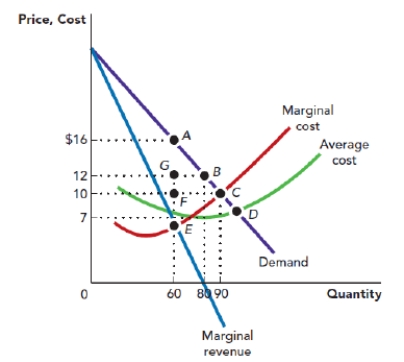
(76) Use Figure: Monopoly Profit-Maximization and Deadweight Loss. The figure shows the demand curve, marginal revenue curve, marginal cost curve, and average total cost curve that are facing a monopolist. Based on this information, the profit-maximizing price for the firm is_____, and the profit-maximizing quantity is _____ units.
Figure: Monopoly Profit-Maximization and Deadweight Loss
(Multiple Choice)
4.9/5 (90)
(90) Suppose that the profit-maximizing price for a monopolist is $10 and the profit-maximizing quantity is 50 units. Further, the average total cost of producing 50 units is $8. The total profit for the monopolist in this scenario is:
(Multiple Choice)
4.8/5 (82)
(82) 
Filters
- Essay(0)
- Multiple Choice(0)
- Short Answer(0)
- True False(0)
- Matching(0)