



 Chat with AI
Exam 12: Market Failure and Government Failure

Exam 1: Foundations of Economics100 Questions
Exam 1: Extension: Understanding Graphs27 Questions
Exam 2: Markets and Economies104 Questions
Exam 3: Demand116 Questions
Exam 4: Supply118 Questions
Exam 5: Market Equilibrium118 Questions
Exam 6: Elasticity126 Questions
Exam 7: Consumer Behavior104 Questions
Exam 8: Production Costs125 Questions
Exam 9: Perfect Competition117 Questions
Exam 10: Market Power102 Questions
Exam 11: Factor Markets105 Questions
Exam 12: Market Failure and Government Failure82 Questions
Exam 13: Measuring an Economys Performance103 Questions
Exam 14: Aggregate Demand and Aggregate Supply105 Questions
Exam 15: Fiscal Policy105 Questions
Exam 16: Money and Banking74 Questions
Exam 17: Monetary Policy103 Questions
Exam 18: Economic Growth and Development49 Questions
Exam 19: International Trade and Finance110 Questions
Select questions type


The extra benefit received by everyone in the society by the purchase of one more unit of a good is called the _____ benefit.

Free
(Multiple Choice)
4.7/5  (77)
(77) Correct Answer: Verified
B
The marginal social benefit is the sum of marginal private benefit and marginal:
Free
(Multiple Choice)
4.9/5 (103)
(103) Correct Answer:Verified
VerifiedB
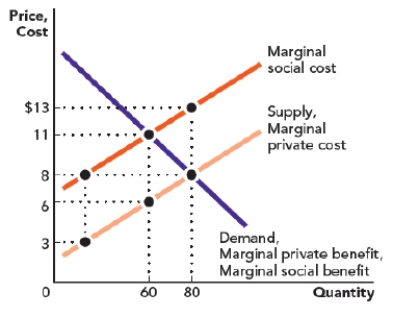
Use Figure: Negative Externality and Deadweight Loss I. The figure shows the marginal benefit, marginal private cost, and marginal social cost that are associated with producing a good. At the free-market equilibrium, the deadweight loss resulting from the externality is:
Figure: Negative Externality and Deadweight Loss I
Free
(Multiple Choice)
4.9/5 (61)
(61) Correct Answer:Verified
VerifiedC
_____ refers to the situation where markets fail to allocate resources efficiently.
(Multiple Choice)
4.8/5 (82)
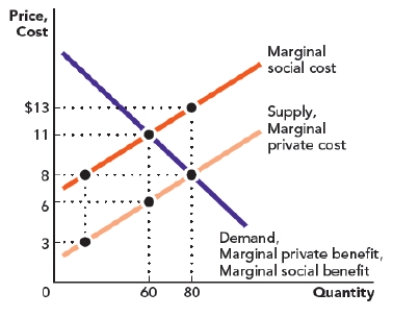
(82) Use Figure: Negative Externality and Deadweight Loss I. The figure shows the marginal benefit, marginal private cost, and marginal social cost that are associated with producing a good. Based on the graph, producing the good involves a marginal external cost of:
Figure: Negative Externality and Deadweight Loss I
(Multiple Choice)
4.8/5 (90)
(90) If the marginal private benefit from consuming a good is $5 and the marginal social benefit from consuming the good is $7, then the consumption of the good involves a _____ externality, and the government must _____ the consumption of the good to ensure that the socially optimal amount of the good is purchased.
(Multiple Choice)
4.8/5 (71)
(71) If Raj buys car insurance and then drives the car irresponsibly because he thinks that the insurance covers any accident, then Raj's behavior is an example of:
(Multiple Choice)
4.9/5 (79)
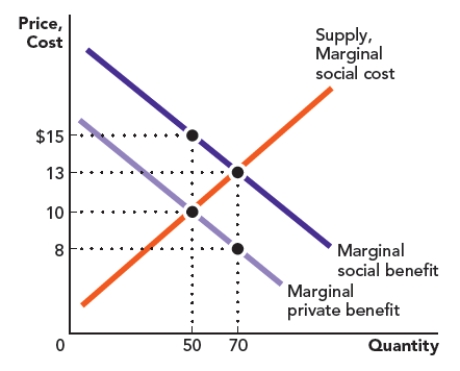
(79) Use Figure: Positive Externalities and Deadweight Loss. The figure shows the marginal private benefit, marginal social benefit, and marginal private cost for a good. The socially optimal price of the good is _____, and the socially optimal quantity is_____ units.
Figure: Positive Externalities and Deadweight Loss
(Multiple Choice)
4.9/5 (75)
(75) Because public goods are both nonrival and nonexcludable, it is possible for people to use these goods without having to pay for them. Enjoying the benefits of a good without paying for it is known as:
(Multiple Choice)
4.9/5 (79)
(79) Which of the following actions can help eliminate the deadweight loss that results from positive externalities?
(Multiple Choice)
4.9/5 (63)
(63) The marginal private cost of producing a good is $8, and the marginal social cost is $9. Therefore, the production of the good creates a ______ externality, and the equilibrium quantity produced will be _____ the socially optimal quantity.
(Multiple Choice)
4.7/5 (79)
(79) If the marginal external cost of producing a good is positive, then the production of the good involves a _____ externality, and the marginal social cost curve lies _____ the marginal private cost curve.
(Multiple Choice)
4.8/5 (92)
(92) Desirable effects that are felt by people who are uninvolved in the decisions that created those effects are known as:
(Multiple Choice)
4.9/5 (70)
(70) It is widely known that the marginal social benefit from having a more educated population is greater than the marginal private benefit received from education. Therefore, education creates _____ externalities, and the free market leads to _____ education compared to the social optimal.
(Multiple Choice)
4.8/5 (79)
(79) Suppose that the purchase of a good creates a positive marginal external benefit. Given this, which of the following statements is NOT true?
(Multiple Choice)
4.8/5 (73)
(73) After a government introduces a new regulation, it must spend considerable resources to ensure compliance with that regulation. The resources spent toward ensuring the compliance is an example of _____ costs.
(Multiple Choice)
4.7/5 (82)
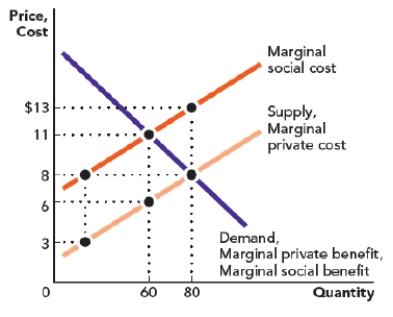
(82) Use Figure: Negative Externality and Deadweight Loss I. The figure shows the marginal benefit, marginal private cost, and marginal social cost that are associated with producing a good. The free-market equilibrium price of the good is _____, and the equilibrium quantity is _____ units.
Figure: Negative Externality and Deadweight Loss I
(Multiple Choice)
4.7/5 (73)
(73) If the purchase of a good creates a positive externality, then the marginal _____ benefit is greater than the marginal _____ benefit.
(Multiple Choice)
4.9/5 (87)
(87) 
Filters
- Essay(0)
- Multiple Choice(0)
- Short Answer(0)
- True False(0)
- Matching(0)