



 Chat with AI
Exam 12: Market Failure and Government Failure

Exam 1: Foundations of Economics100 Questions
Exam 1: Extension: Understanding Graphs27 Questions
Exam 2: Markets and Economies104 Questions
Exam 3: Demand116 Questions
Exam 4: Supply118 Questions
Exam 5: Market Equilibrium118 Questions
Exam 6: Elasticity126 Questions
Exam 7: Consumer Behavior104 Questions
Exam 8: Production Costs125 Questions
Exam 9: Perfect Competition117 Questions
Exam 10: Market Power102 Questions
Exam 11: Factor Markets105 Questions
Exam 12: Market Failure and Government Failure82 Questions
Exam 13: Measuring an Economys Performance103 Questions
Exam 14: Aggregate Demand and Aggregate Supply105 Questions
Exam 15: Fiscal Policy105 Questions
Exam 16: Money and Banking74 Questions
Exam 17: Monetary Policy103 Questions
Exam 18: Economic Growth and Development49 Questions
Exam 19: International Trade and Finance110 Questions
Select questions type


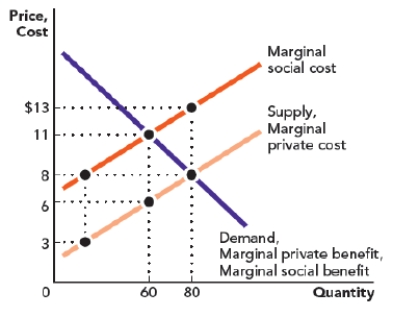
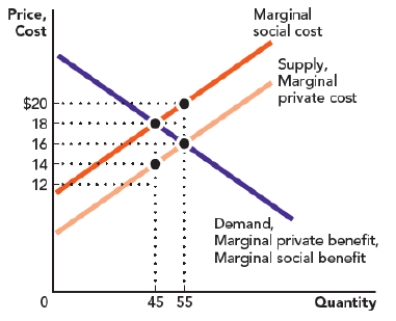
Use Figure: Negative Externality and Deadweight Loss I. The figure shows the marginal benefit, marginal private cost, and marginal social cost that are associated with producing a good. The government should impose an excise tax of _____ to arrive at the socially optimal quantity.
Figure: Negative Externality and Deadweight Loss I
(Multiple Choice)
4.9/5  (88)
(88) A national highway that requires its users to pay a toll is an example of a good that is both:
(Multiple Choice)
4.9/5 (81)
(81) If the marginal social cost of producing a good is $8 and the marginal external cost of producing it is $2, then the marginal private cost of producing the good is _____, and the production of the good creates a _____ externality.
(Multiple Choice)
4.8/5 (75)
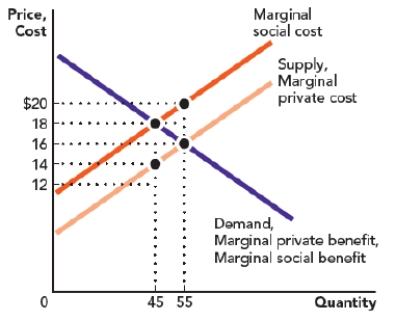
(75) Use Figure: Negative Externality and Deadweight Loss II. The figure shows the marginal benefit, marginal private cost, and marginal social cost that are associated with producing a good. The marginal external cost that is associated with producing the good is:
Figure: Negative Externality and Deadweight Loss II
(Multiple Choice)
5.0/5 (80)
(80) Which of the following is a solution to the free-riding problem of providing public goods?
(Multiple Choice)
4.9/5 (70)
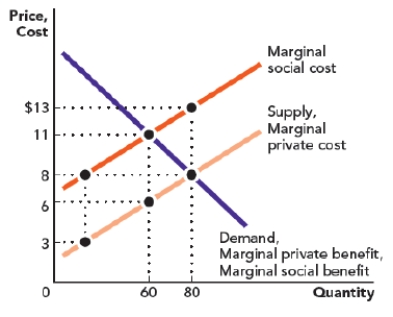
(70) Use Figure: Negative Externality and Deadweight Loss I. The figure shows the marginal benefit, marginal private cost, and marginal social cost that are associated with producing a good. The socially optimal price is _____, and the socially optimal quantity is _____ units.
Figure: Negative Externality and Deadweight Loss I
(Multiple Choice)
4.7/5 (65)
(65) How can imperfectly competitive markets contribute to market failure? Justify your answer with a graph.
(Essay)
4.7/5 (76)
(76) Michael is selling a used PlayStation video game console on eBay. However, this PlayStation does not work properly, and the buyers are not aware of the problem. This situation is an example of:
(Multiple Choice)
4.8/5 (72)
(72) If the marginal private cost of producing the fiftieth unit of a good is $3 and the marginal social cost of producing the fiftieth unit of the good is $5, then producing the good creates _____ externalities, and the marginal external cost is:
(Multiple Choice)
4.9/5 (73)
(73) Which of the following conditions will lead a market away from an efficient allocation of resources?
(Multiple Choice)
5.0/5 (94)
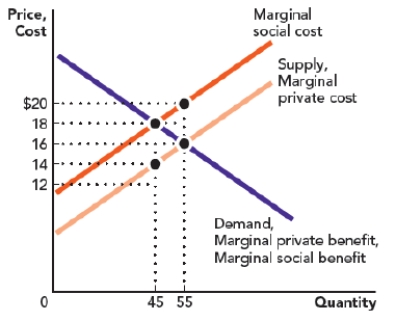
(94) Use Figure: Negative Externality and Deadweight Loss II. The figure shows the marginal benefit, marginal private cost, and marginal social cost that are associated with producing a good. The free-market equilibrium price of the good is _____, and the equilibrium quantity is _____ units.
Figure: Negative Externality and Deadweight Loss II
(Multiple Choice)
4.9/5 (73)
(73) Use Figure: Negative Externality and Deadweight Loss II. The figure shows the marginal benefit, marginal private cost, and marginal social cost that are associated with producing a good. At the free-market equilibrium, the deadweight loss associated with the externality is:
Figure: Negative Externality and Deadweight Loss II
(Multiple Choice)
4.7/5 (79)
(79) If beekeepers benefit from their neighbor's flower garden, then the flower garden is a source of:
(Multiple Choice)
4.9/5 (69)
(69) Suppose that the marginal private benefit from buying an extra unit of a good is $10 and the marginal social benefit of buying the extra unit is $13. In this case, the purchase of the good involves a _____ externality, and the equilibrium quantity purchased in a free market will be ____ than socially optimal.
(Multiple Choice)
4.9/5 (84)
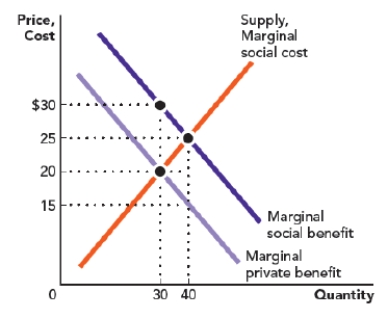
(84) Use Figure: Externalities and Deadweight Loss I. The figure shows the marginal private benefit, marginal social benefit, and marginal private cost for a good. The socially optimal price of the good is _____, and the socially optimal quantity is_____ units.
Figure: Externalities and Deadweight Loss I
(Multiple Choice)
4.9/5 (77)
(77) Honey bees are one of the foremost natural pollinators. Therefore, if someone keeps them for their honey, then a positive externality is created for flower growers. Suppose that a beekeeper who sells honey also creates a $1 positive externality for all the flower growers.
a. Draw a supply and demand graph that clearly marks the following:
1) marginal private benefit curve
2) marginal social benefit curve
3) marginal cost curve (assume that private and social costs are the same)
b. On the graph, mark the points that show the free-market equilibrium and the socially optimal level of price and quantity.
c. Mark the area of deadweight loss, and explain why the free-market equilibrium leads to a deadweight loss.
d. Provide one remedy for the negative externality associated with the production of plastic.
(Essay)
4.8/5 (72)
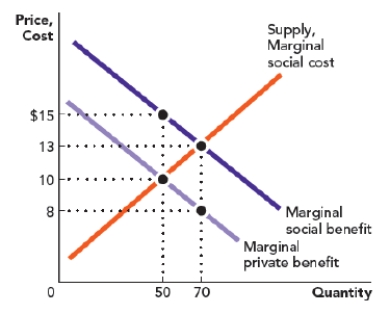
(72) Use Figure: Positive Externalities and Deadweight Loss. The figure shows the marginal private benefit, marginal social benefit, and marginal private cost for a good. The government should offer a _____ subsidy to arrive at the socially optimal quantity.
Figure: Positive Externalities and Deadweight Loss
(Multiple Choice)
4.9/5 (83)
(83) 
Filters
- Essay(0)
- Multiple Choice(0)
- Short Answer(0)
- True False(0)
- Matching(0)