



 Chat with AI
Exam 17: Monetary Policy

Exam 1: Foundations of Economics100 Questions
Exam 1: Extension: Understanding Graphs27 Questions
Exam 2: Markets and Economies104 Questions
Exam 3: Demand116 Questions
Exam 4: Supply118 Questions
Exam 5: Market Equilibrium118 Questions
Exam 6: Elasticity126 Questions
Exam 7: Consumer Behavior104 Questions
Exam 8: Production Costs125 Questions
Exam 9: Perfect Competition117 Questions
Exam 10: Market Power102 Questions
Exam 11: Factor Markets105 Questions
Exam 12: Market Failure and Government Failure82 Questions
Exam 13: Measuring an Economys Performance103 Questions
Exam 14: Aggregate Demand and Aggregate Supply105 Questions
Exam 15: Fiscal Policy105 Questions
Exam 16: Money and Banking74 Questions
Exam 17: Monetary Policy103 Questions
Exam 18: Economic Growth and Development49 Questions
Exam 19: International Trade and Finance110 Questions
Select questions type


If a borrower does not repay a loan and forfeits an asset to a lender, the asset is called a:

Free
(Multiple Choice)
4.7/5  (81)
(81) Correct Answer: Verified
C
A policy that _____ money supply and _____ interest rate is known as an expansionary monetary policy.
Free
(Multiple Choice)
4.8/5 (79)
(79) Correct Answer:Verified
VerifiedA
An increase in money supply _____ the interest rate and ______ aggregate demand.
Free
(Multiple Choice)
4.8/5 (58)
(58) Correct Answer:Verified
VerifiedC
All else equal, if the price level in an economy decreases, then the equilibrium interest rate will _____. In this case, the Federal Reserve can _____ the money supply to bring the interest rate back to its original value.
(Multiple Choice)
4.8/5 (73)
(73) All else equal, an increase in the real GDP increases the _____ demand for money and therefore causes a _____ shift in the money demand curve.
(Multiple Choice)
4.8/5 (74)
(74) The interest rate that banks charge each other for short-term loans is known as the:
(Multiple Choice)
4.8/5 (83)
(83) All else equal, if the Federal Reserve follows _____ monetary policy, then the money supply curve will shift left, and the equilibrium interest rate will:
(Multiple Choice)
4.9/5 (74)
(74) If the Federal Reserve raises the reserve requirement, banks can lend out a _____ percentage of their deposits; therefore, _____ money will be created when the Fed buys Treasury securities.
(Multiple Choice)
4.8/5 (95)
(95) All else equal, a higher price level implies a _____ transaction demand for money and therefore a _____ shift in the money demand curve.
(Multiple Choice)
4.9/5 (79)
(79) All else equal, if the real GDP of the United States increases, the equilibrium interest rate will _____. In this case, the Federal Reserve can _____ Treasury securities in the open market to bring the interest rate back to its original level.
(Multiple Choice)
4.8/5 (71)
(71) If the people who live in a developing country increasingly use ATM machines to dispense cash, then the overall demand for money in that economy will ______, and the demand curve for money will shift:
(Multiple Choice)
4.9/5 (93)
(93) The Federal Reserve's policy between 2008 and 2014 of buying large amounts of Treasury securities in order to inject more money and liquidity in the banking system is known as:
(Multiple Choice)
4.9/5 (89)
(89) The interest rate that the Federal Reserve banks charge financial institutions for short-term loans is known as the _____ rate.
(Multiple Choice)
4.8/5 (63)
(63) Assume that all money in the economy is deposited with banks and that banks hold no excess reserves. If the reserve requirement is 10 percent and the Federal Reserve buys $10 million worth of Treasury securities, then the money supply will increase by:
(Multiple Choice)
4.8/5 (72)
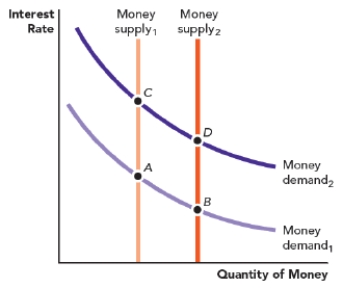
(72) Use Figure: Money Market Equilibrium II. Which of the following can shift the equilibrium from point B to point D?
Money Market Equilibrium II
(Multiple Choice)
4.8/5 (85)
(85) If the Federal Reserve buys securities in the open market, then the money supply will _____, leading to _____ in the interest rate.
(Multiple Choice)
5.0/5 (67)
(67) All else equal, an increase in the price level leads to a _____ shift in the money _____ curve.
(Multiple Choice)
4.8/5 (78)
(78) All else equal, if the price level in the U.S economy decreases, the equilibrium interest rate will _____. In this case, the Federal Reserve can _____ Treasury securities to bring the interest rate back to its original level.
(Multiple Choice)
4.8/5 (87)
(87) 
Filters
- Essay(0)
- Multiple Choice(0)
- Short Answer(0)
- True False(0)
- Matching(0)