



 Chat with AI
Exam 17: Monetary Policy

Exam 1: Foundations of Economics100 Questions
Exam 1: Extension: Understanding Graphs27 Questions
Exam 2: Markets and Economies104 Questions
Exam 3: Demand116 Questions
Exam 4: Supply118 Questions
Exam 5: Market Equilibrium118 Questions
Exam 6: Elasticity126 Questions
Exam 7: Consumer Behavior104 Questions
Exam 8: Production Costs125 Questions
Exam 9: Perfect Competition117 Questions
Exam 10: Market Power102 Questions
Exam 11: Factor Markets105 Questions
Exam 12: Market Failure and Government Failure82 Questions
Exam 13: Measuring an Economys Performance103 Questions
Exam 14: Aggregate Demand and Aggregate Supply105 Questions
Exam 15: Fiscal Policy105 Questions
Exam 16: Money and Banking74 Questions
Exam 17: Monetary Policy103 Questions
Exam 18: Economic Growth and Development49 Questions
Exam 19: International Trade and Finance110 Questions
Select questions type


Higher the interest rate, the _____ the opportunity cost of holding money, and _____ the quantity demanded of money.
(Multiple Choice)
4.8/5  (72)
(72) All else equal, if the real GDP of an economy increases, then the equilibrium interest rate will _____. In this case, the Federal Reserve can _____ the money supply to bring the interest rate back to its original value.
(Multiple Choice)
4.9/5 (69)
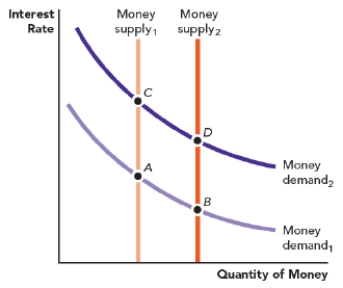
(69) Use Figure: Money Market Equilibrium II. Which of the following can shift the equilibrium from point A to point C?
Money Market Equilibrium II
(Multiple Choice)
4.9/5 (83)
(83) How many Federal Reserve districts comprise the Federal Reserve System?
(Multiple Choice)
4.9/5 (79)
(79) _____ Treasury securities and _____ the discount rate are examples of the expansionary monetary policy of the Federal Reserve.
(Multiple Choice)
4.8/5 (74)
(74) Because the Federal Reserve determines the total amount of money in the economy, the money _____ curve is _____ at that quantity of money.
(Multiple Choice)
4.8/5 (71)
(71) Expansionary monetary policy _____ the interest rate and _____ investment spending by firms.
(Multiple Choice)
4.9/5 (80)
(80) All else equal, if the Federal Reserve follows a contractionary monetary policy, then the money supply curve will shift _____, and the equilibrium interest rate will:
(Multiple Choice)
4.8/5 (80)
(80) If the Federal Reserve wants to decrease the total spending in the economy, it can either _____ the discount rate or _____ the reserve requirement.
(Multiple Choice)
4.9/5 (82)
(82) Large investment banks and securities firms that are authorized to deal directly with the Federal Reserve are known as:
(Multiple Choice)
4.9/5 (81)
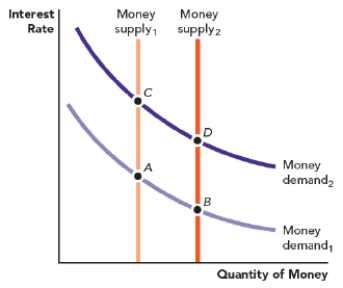
(81) Use Figure: Money Market Equilibrium II. Which of the following can shift the equilibrium from point A to point B?
Money Market Equilibrium II
(Multiple Choice)
5.0/5 (75)
(75) Assume that all money in the economy is deposited with banks and that banks hold no excess reserves. If the reserve requirement for banks is 5 percent and the Federal Reserve wants to decrease money supply by $100 million, then the Fed must _____ million worth of Treasury securities.
(Multiple Choice)
4.8/5 (85)
(85) If the Federal Reserve wants to decrease the total spending in the economy, it can either _____ the discount rate or _____ Treasury securities.
(Multiple Choice)
4.9/5 (73)
(73) If the Federal Reserve _____ securities in the open market, the money supply will increase, which leads to _____ in the interest rate.
(Multiple Choice)
4.7/5 (84)
(84) Suppose that the Federal Reserve sets the supply of money at $2 trillion and the money demand curve intersects the money supply curve at an interest rate of 4 percent.
a. Draw the money supply curve and money demand curve to illustrate the above money market equilibrium. Label the money supply curve and money demand curve with the equilibrium quantity of money and the interest rate.
b. What will happen to the equilibrium interest rate if, all else equal, the price level in the economy goes down?
c. The Federal Reserve wants the interest rate to return to 4 percent and wants to achieve this by changing the reserve requirement. Should it increase or decrease the reserve requirement? Explain your answer.
(Essay)
4.9/5 (81)
(81) All else equal, if the Federal Reserve follows _____ monetary policy, then the money supply curve will shift right, and the equilibrium interest rate will:
(Multiple Choice)
4.9/5 (69)
(69) If the Federal Reserve lowers the reserve requirement, banks can lend out a _____ percentage of their deposits; therefore, _____ money will be created when the Fed buys Treasury securities.
(Multiple Choice)
4.9/5 (91)
(91) All else equal, if the Federal Reserve purchases Treasury securities in the open market, then the money supply curve will shift _____, and the equilibrium interest rate will:
(Multiple Choice)
4.9/5 (70)
(70) The Federal Reserve's purchases and sales of Treasury securities is called:
(Multiple Choice)
4.8/5 (78)
(78) 
Filters
- Essay(0)
- Multiple Choice(0)
- Short Answer(0)
- True False(0)
- Matching(0)