



 Chat with AI
Exam 17: Monetary Policy

Exam 1: Foundations of Economics100 Questions
Exam 1: Extension: Understanding Graphs27 Questions
Exam 2: Markets and Economies104 Questions
Exam 3: Demand116 Questions
Exam 4: Supply118 Questions
Exam 5: Market Equilibrium118 Questions
Exam 6: Elasticity126 Questions
Exam 7: Consumer Behavior104 Questions
Exam 8: Production Costs125 Questions
Exam 9: Perfect Competition117 Questions
Exam 10: Market Power102 Questions
Exam 11: Factor Markets105 Questions
Exam 12: Market Failure and Government Failure82 Questions
Exam 13: Measuring an Economys Performance103 Questions
Exam 14: Aggregate Demand and Aggregate Supply105 Questions
Exam 15: Fiscal Policy105 Questions
Exam 16: Money and Banking74 Questions
Exam 17: Monetary Policy103 Questions
Exam 18: Economic Growth and Development49 Questions
Exam 19: International Trade and Finance110 Questions
Select questions type


All else equal, an increase in the real GDP _____ the transaction demand for money and therefore causes a _____ shift in the money demand curve.
(Multiple Choice)
4.9/5  (67)
(67) The demand for money that arises from a desire to take advantage of investment opportunities or to avoid losses from anticipated changes in value of alternative investments is known as the _____ demand for money.
(Multiple Choice)
4.8/5 (80)
(80) Suppose that the U.S economy is in a recession and the Federal Reserve decides to use monetary policy to help the economy recover. The goal is to increase the real GDP by $500 billion. The Federal Reserve chooses open-market operations as the desired tool to achieve this. It has the following information about the economy: (1) all money is held as deposits and banks do not hold excess reserves; (2) a $1 dollar change in money supply leads to a $2 change in real GDP; and (3) the reserve requirement on banks is 10 percent. Given this information, answer the following questions:
a. What is the value of open-market operations that the Federal Reserve must carry out to help the economy recover from the recession? Should it buy or sell Treasury securities to achieve this?
b. Show the impact of the open-market operations on the money market graph.
c. Explain the logic behind how the open-market operations can help the economy recover.
(Essay)
4.9/5 (78)
(78) Why can a country use monetary policy to recover from a recession but not achieve sustained long-run growth in real GDP using expansionary monetary policy?
(Essay)
4.9/5 (76)
(76) If the total money supply in the economy is $1,000, the price level is $10, and the real GDP is 600 units, then the velocity of money must be:
(Multiple Choice)
4.9/5 (94)
(94) _____ the reserve requirement and _____ the discount rate are examples of the expansionary monetary policy of the Federal Reserve.
(Multiple Choice)
4.8/5 (74)
(74) The members of the Board of Governors of the Federal Reserve System serve a _____-year nonrenewable term.
(Multiple Choice)
4.9/5 (81)
(81) The relationship between money supply (M), price level (P), real GDP (Y), and velocity of money (V) is given by:
(Multiple Choice)
4.8/5 (73)
(73) All else equal, a decrease in the real GDP _____ the transaction demand for money and therefore causes a _____ shift in the money demand curve.
(Multiple Choice)
5.0/5 (80)
(80) All else equal, if the Federal Reserve buys Treasury securities, then:
(Multiple Choice)
4.8/5 (85)
(85) All else equal, if the real GDP of the United States decreases, the equilibrium interest rate will _____. In this case, the Federal Reserve can _____ Treasury securities in the open market to bring the interest rate back to its original level.
(Multiple Choice)
4.9/5 (68)
(68) All else equal, a decrease in the real GDP _____ the ______ demand for money.
(Multiple Choice)
4.9/5 (66)
(66) All else equal, if the price level in the U.S economy increases, the equilibrium interest rate will _____. In this case, the Federal Reserve can _____ Treasury securities to bring the interest rate back to its original level.
(Multiple Choice)
4.9/5 (76)
(76) According to the quantity theory of money, an increase in the supply of money leads to a proportionate increase in _____, while leaving _____ unchanged.
(Multiple Choice)
4.9/5 (70)
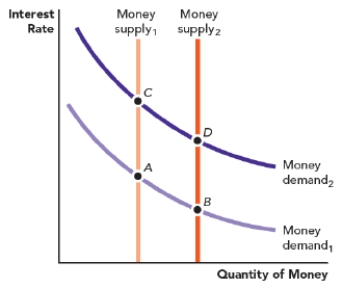
(70) Use Figure: Money Market Equilibrium II. Which one of the the following can shift the equilibrium from point A to point B?
Money Market Equilibrium II
(Multiple Choice)
4.8/5 (91)
(91) If the Federal Reserve _____ securities in the open market, the money supply will decrease, which leads to _____ in the interest rate.
(Multiple Choice)
4.8/5 (89)
(89) Which body within the Federal Reserve System is responsible for monetary policy decisions?
(Multiple Choice)
4.9/5 (69)
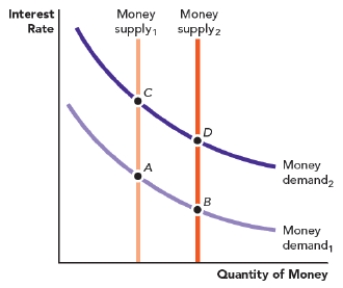
(69) Use Figure: Money Market Equilibrium II. Which one of the the following can shift the equilibrium from point B to point A?
Money Market Equilibrium II
(Multiple Choice)
4.9/5 (88)
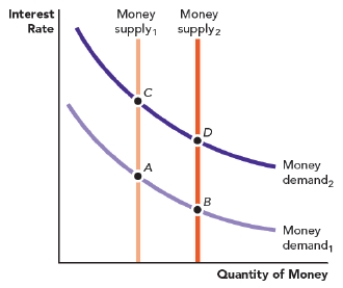
(88) Use Figure: Money Market Equilibrium II. Which of the following can shift the equilibrium from point D to point B?
Money Market Equilibrium II
(Multiple Choice)
4.9/5 (78)
(78) 
Filters
- Essay(0)
- Multiple Choice(0)
- Short Answer(0)
- True False(0)
- Matching(0)