



 Chat with AI
Exam 12: Market Failure and Government Failure

Exam 1: Foundations of Economics100 Questions
Exam 1: Extension: Understanding Graphs27 Questions
Exam 2: Markets and Economies104 Questions
Exam 3: Demand116 Questions
Exam 4: Supply118 Questions
Exam 5: Market Equilibrium118 Questions
Exam 6: Elasticity126 Questions
Exam 7: Consumer Behavior104 Questions
Exam 8: Production Costs125 Questions
Exam 9: Perfect Competition117 Questions
Exam 10: Market Power102 Questions
Exam 11: Factor Markets105 Questions
Exam 12: Market Failure and Government Failure82 Questions
Exam 13: Measuring an Economys Performance103 Questions
Exam 14: Aggregate Demand and Aggregate Supply105 Questions
Exam 15: Fiscal Policy105 Questions
Exam 16: Money and Banking74 Questions
Exam 17: Monetary Policy103 Questions
Exam 18: Economic Growth and Development49 Questions
Exam 19: International Trade and Finance110 Questions
Select questions type


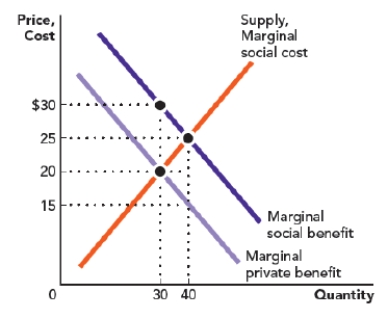
Use Figure: Externalities and Deadweight Loss I. The figure shows the marginal private benefit, marginal social benefit, and marginal private cost for a good. Based on the figure, the marginal external benefit from purchasing the good is:
Figure: Externalities and Deadweight Loss I
(Multiple Choice)
4.7/5  (78)
(78) _____ refers to the problem that arises when people take on additional risks when they are insured against the consequences.
(Multiple Choice)
4.9/5 (87)
(87) Alice decides to lend $100 to someone, but it takes $200 to hire a lawyer to write a contract for the loan agreement. In this case, the lawyer's fee is an example of a:
(Multiple Choice)
4.9/5 (73)
(73) New ideas and innovations by innovators are nonrival goods. That is, the same idea or innovation can be copied and used by several people without diminishing the original ones. Given this, do you think that the free market allocates resources toward innovation efficiently? If not, how does the government remedy this problem and encourage innovation in an economy?
(Essay)
4.9/5 (82)
(82) David lives in a farm that is 100 miles away from the nearest grocery store, so he must spend $25 in gas every time he goes grocery shopping. In this case, the cost of gas is an example of a _____ cost.
(Multiple Choice)
4.8/5 (82)
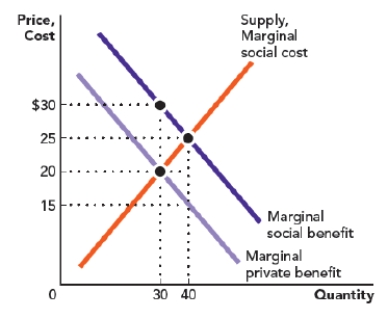
(82) Use Figure: Externalities and Deadweight Loss I. The figure shows the marginal private benefit, marginal social benefit, and marginal private cost for a good. The government should offer a _____ subsidy to arrive at the socially optimal quantity.
Figure: Externalities and Deadweight Loss I
(Multiple Choice)
4.7/5 (78)
(78) In an imperfectly competitive market, the market fails because the free-market equilibrium price is _____ than the socially optimal price, and the resulting quantity is _____ than the socially optimal quantity.
(Multiple Choice)
4.7/5 (80)
(80) Suppose that the marginal social benefit curve of a good lies above the marginal private benefit curve. In this case, the purchase of the good involves a _____ externality, and the good will be purchased in an amount that is _____ than the socially optimal.
(Multiple Choice)
4.9/5 (73)
(73) Suppose that the consumption of a good involves a positive externality. Which of the following actions by the government can lead to the purchase of a socially optimal quantity?
(Multiple Choice)
4.8/5 (70)
(70) _____ involves one party that takes advantage of information that a second party lacks when the second party is deciding what to buy or sell.
(Multiple Choice)
4.8/5 (63)
(63) For each of the following goods, state whether they are rival/nonrival and excludable/nonexcludable. Justify your answer in each case.
a. national defense
b. a personal laptop
c. streetlights
d. private parks
(Essay)
4.8/5 (77)
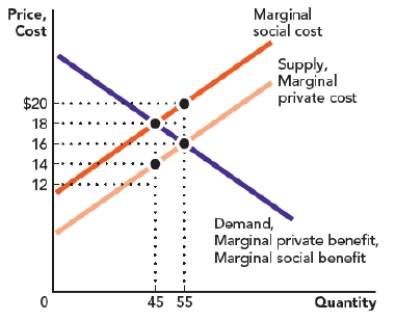
(77) Use Figure: Negative Externality and Deadweight Loss II. The figure shows the marginal benefit, marginal private cost, and marginal social cost that are associated with producing a good. The government should impose an excise tax of _____ to arrive at the socially optimal quantity.
Figure: Negative Externality and Deadweight Loss II
(Multiple Choice)
4.8/5 (85)
(85) If the marginal social benefit from consuming a good is greater than the marginal private benefit, then the consumption of the good involves:
(Multiple Choice)
4.8/5 (79)
(79) When either the buyer or seller has more information that the other party, the market is said to have _____ information.
(Multiple Choice)
4.9/5 (73)
(73) The secondhand smoke that results from smoking cigarettes is harmful to people who do not smoke but still inhale others' smoke. Therefore, cigarette smoking creates:
(Multiple Choice)
4.8/5 (76)
(76) An amount that insurance customers must pay before their insurance starts covering costs is called _____, and it is used as a remedy for the _____ problem.
(Multiple Choice)
4.7/5 (77)
(77) If the production of a good involves a negative externality, then the marginal social cost is _____ than the marginal private cost, and the equilibrium quantity produced is _____ than the socially optimal quantity.
(Multiple Choice)
4.9/5 (84)
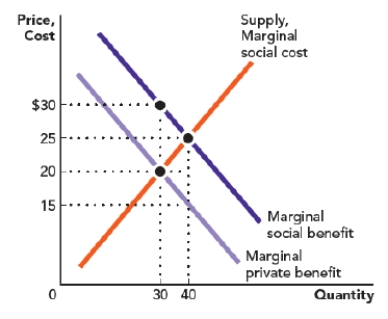
(84) Use Figure: Externalities and Deadweight Loss I. The figure shows the marginal private benefit, marginal social benefit, and marginal private cost for a good. The deadweight loss because of the externality is equal to:
Figure: Externalities and Deadweight Loss I
(Multiple Choice)
4.8/5 (92)
(92) Goods that are both rival and excludable are known as _____ goods.
(Multiple Choice)
4.8/5 (81)
(81) 
Filters
- Essay(0)
- Multiple Choice(0)
- Short Answer(0)
- True False(0)
- Matching(0)