



 Chat with AI
Exam 19: International Trade and Finance

Exam 1: Foundations of Economics100 Questions
Exam 1: Extension: Understanding Graphs27 Questions
Exam 2: Markets and Economies104 Questions
Exam 3: Demand116 Questions
Exam 4: Supply118 Questions
Exam 5: Market Equilibrium118 Questions
Exam 6: Elasticity126 Questions
Exam 7: Consumer Behavior104 Questions
Exam 8: Production Costs125 Questions
Exam 9: Perfect Competition117 Questions
Exam 10: Market Power102 Questions
Exam 11: Factor Markets105 Questions
Exam 12: Market Failure and Government Failure82 Questions
Exam 13: Measuring an Economys Performance103 Questions
Exam 14: Aggregate Demand and Aggregate Supply105 Questions
Exam 15: Fiscal Policy105 Questions
Exam 16: Money and Banking74 Questions
Exam 17: Monetary Policy103 Questions
Exam 18: Economic Growth and Development49 Questions
Exam 19: International Trade and Finance110 Questions
Select questions type


Portugal specializes in the production of wine and produces 10 million bottles. The United Kingdom specializes in the production of cheese and produces 100 million pounds of cheese. If the terms of trade is 10 pounds of cheese for a bottle of wine and Portugal consumes 3 million bottles of wine, then the UK consumes _____ million pounds of cheese, and Portugal consumes _____ million pounds of cheese.
(Multiple Choice)
4.7/5  (73)
(73) Refer to the table Comparative and Absolute Advantage I. The table summarizes the amount of tennis rackets and tennis balls that can be produced per unit of labor in Stewarton and Colberton. If both countries have the same amount of labor, then it can be concluded that Colberton has _____ advantage in producing:

(Multiple Choice)
4.9/5 (75)
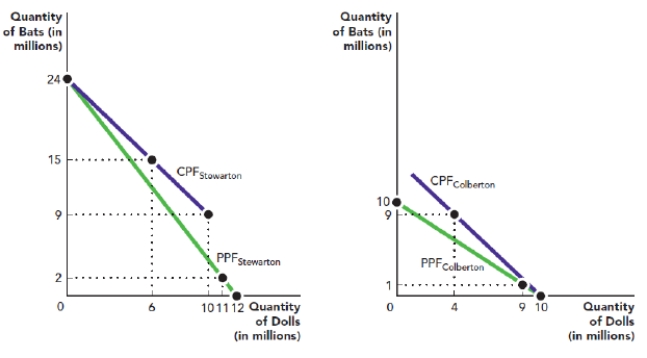
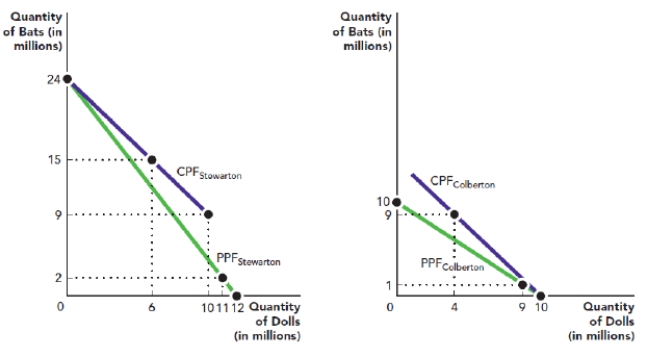
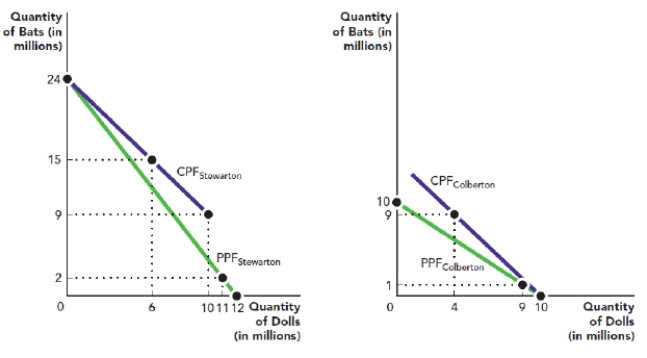
(75) Refer to the figure Mutually Beneficial Trade I. The figure shows the production possibility frontier (PPF) and consumption possibility frontier (CPF) for baseball bats and bobblehead dolls in Stewarton and Colberton. In the absence of trade, if Stewarton is consuming 6 million dolls, then it can consume _____ million hats.
Figure: Mutually Beneficial Trade I
(Multiple Choice)
5.0/5 (90)
(90) Refer to the figure Mutually Beneficial Trade I. The figure shows the production possibility frontier (PPF) and consumption possibility frontier (CPF) for baseball bats and bobblehead dolls in Stewarton and Colberton. If both countries have identical resources, then Colberton has a comparative advantage in _____ and has an absolute advantage in:
Figure: Mutually Beneficial Trade I
(Multiple Choice)
4.8/5 (70)
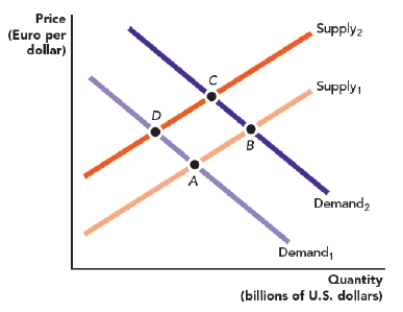
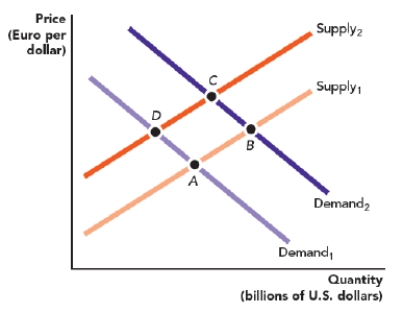
(70) Refer to the figure Currency Appreciation and Depreciation. The figure shows the supply and demand of U.S. dollars in the euro-U.S. dollar foreign exchange market. A shift in the equilibrium from D to A implies that the U.S. dollar is _____ and the euro is:
Figure: Currency Appreciation and Depreciation
(Multiple Choice)
4.8/5 (81)
(81) A country produces tennis rackets and tennis balls using only labor as an input. One unit of labor can produce one tennis racket or four tennis balls. What is the opportunity cost of producing a tennis ball?
(Multiple Choice)
4.8/5 (79)
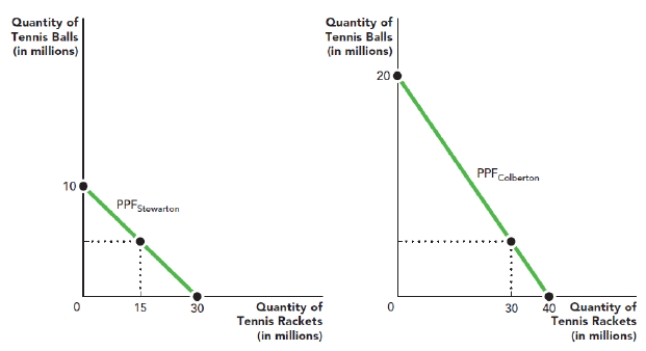
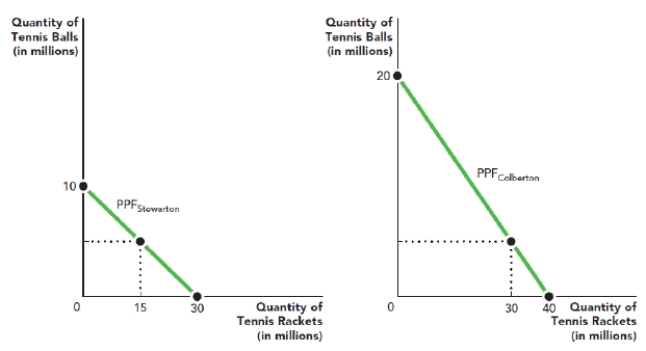
(79) Refer to the figure Mutually Beneficial Trade II. The figure shows the production possibility frontier (PPF) for producing tennis rackets and tennis balls in Stewarton and Colberton. If both countries have identical resources, then Stewarton has a comparative advantage in tennis _____ and has an absolute advantage in:
Figure: Mutually Beneficial Trade II
(Multiple Choice)
4.9/5 (69)
(69) Imposing a tariff on the import of a good _____ the price paid by the consumers and _____ the quantity consumed compared to free trade.
(Multiple Choice)
4.9/5 (61)
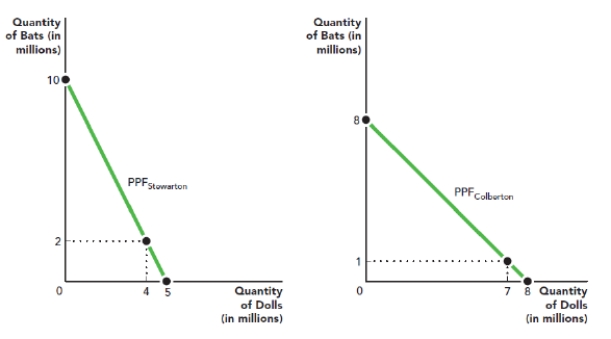
(61) Refer to the figure PPF and Comparative Advantage. The figure shows the production possibility frontier for producing baseball bats and bobblehead dolls in Stewarton and Colberton. The opportunity cost of producing bats in Colberton is:
Figure: PPF and Comparative Advantage
(Multiple Choice)
4.9/5 (72)
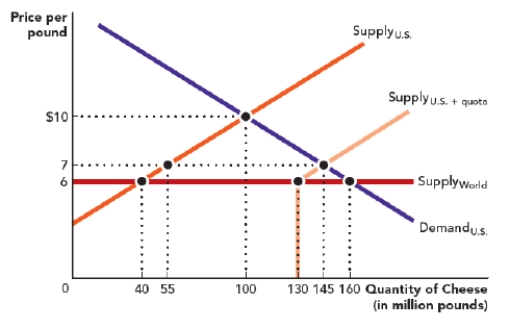
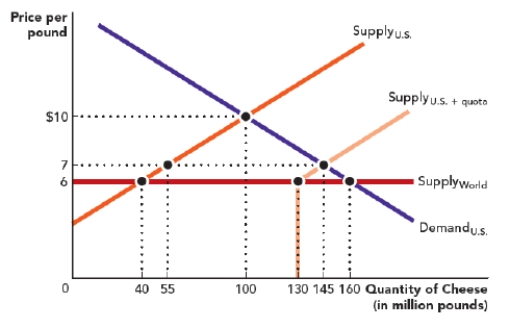
(72) Refer to the figure Import Quota. The figure shows the U.S. supply, world supply, and U.S. demand curve for cheese. If the United States imposes a quota of 90 million pounds on imports, then _____ million pounds of cheese will be supplied domestically.
Figure: Import Quota
(Multiple Choice)
4.8/5 (84)
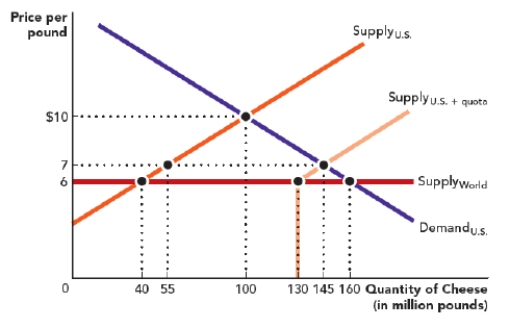
(84) Refer to the figure Import Quota. The figure shows the U.S. supply, world supply, and U.S. demand curve for cheese. If the United States imposes a quota and the resulting equilibrium price is $7, then the total domestic supply of cheese will be _____ million pounds, and the total imports will be _____ million pounds.
Figure: Import Quota
(Multiple Choice)
4.9/5 (80)
(80) Portugal specializes in the production of wine, and the United Kingdom specializes in the production of cheese. If the terms of trade for cheese is one bottle of wine, then we know that the opportunity cost of producing cheese is _____ than one bottle of wine in Portugal, and the opportunity cost of producing cheese is _____ than one bottle of wine in the UK.
(Multiple Choice)
4.9/5 (85)
(85) Which of the following can lead to an appreciation in the U.S. dollar compared to the Indian rupee?
(Multiple Choice)
4.9/5 (67)
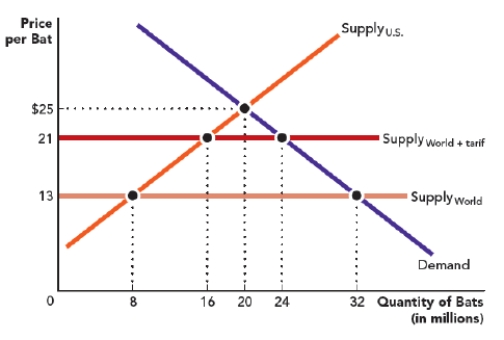
(67) Refer to the figure Import Tariffs. The figure shows the demand, U.S. supply, and world supply curves for baseball bats. If the United States imposes a $8 tariff on imports, then the government's revenue from the tariff is _____ million.
Figure: Import Tariffs
(Multiple Choice)
4.8/5 (89)
(89) Refer to the figure Import Quota. The figure shows the U.S. supply, world supply, and U.S. demand curve for cheese. If the United States imposes a quota and the resulting equilibrium price is $7, then the total import quota is _____ million pounds.
Figure: Import Quota
(Multiple Choice)
4.9/5 (97)
(97) Refer to the figure Currency Appreciation and Depreciation. The figure shows the supply and demand of U.S. dollars in the euro-U.S. dollar foreign exchange market. A shift in the equilibrium from C to A implies that the U.S. dollar is _____ and the euro is:
Figure: Currency Appreciation and Depreciation
(Multiple Choice)
4.9/5 (91)
(91) Refer to the figure Mutually Beneficial Trade I. The figure shows the production possibility frontier (PPF) and consumption possibility frontier (CPF) for baseball bats and bobblehead dolls in Stewarton and Colberton. If both countries have identical resources, then Stewarton has a comparative advantage in _____ and has an absolute advantage in:
Figure: Mutually Beneficial Trade I
(Multiple Choice)
4.8/5 (84)
(84) Refer to the figure Mutually Beneficial Trade II. The figure shows the production possibility frontier (PPF) for producing tennis rackets and tennis balls in Stewarton and Colberton. Suppose that the countries trade according to their comparative advantage and as a result Stewarton ends up consuming 15 million tennis rackets and 6.75 million tennis balls. In this case, the terms of trade for tennis rackets is:
Figure: Mutually Beneficial Trade II
(Multiple Choice)
4.9/5 (85)
(85) 
Filters
- Essay(0)
- Multiple Choice(0)
- Short Answer(0)
- True False(0)
- Matching(0)