



 Chat with AI
Exam 19: International Trade and Finance

Exam 1: Foundations of Economics100 Questions
Exam 1: Extension: Understanding Graphs27 Questions
Exam 2: Markets and Economies104 Questions
Exam 3: Demand116 Questions
Exam 4: Supply118 Questions
Exam 5: Market Equilibrium118 Questions
Exam 6: Elasticity126 Questions
Exam 7: Consumer Behavior104 Questions
Exam 8: Production Costs125 Questions
Exam 9: Perfect Competition117 Questions
Exam 10: Market Power102 Questions
Exam 11: Factor Markets105 Questions
Exam 12: Market Failure and Government Failure82 Questions
Exam 13: Measuring an Economys Performance103 Questions
Exam 14: Aggregate Demand and Aggregate Supply105 Questions
Exam 15: Fiscal Policy105 Questions
Exam 16: Money and Banking74 Questions
Exam 17: Monetary Policy103 Questions
Exam 18: Economic Growth and Development49 Questions
Exam 19: International Trade and Finance110 Questions
Select questions type


A country produces tennis rackets and tennis balls using only labor as an input. One unit of labor can produce one tennis racket or four tennis balls, and the country has 200 units of labor. If the country is operating on its production possibility frontier (PPF) and producing 100 balls, then how many rackets is it producing?
(Multiple Choice)
4.8/5  (87)
(87) Refer to the table Comparative Advantage and Trade. The table shows the number of laptops and phones that can be produced per unit of labor (the only input) in U.S and Brazil. Suppose that both countries have 100 million units of labor.
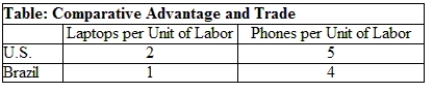 A. Draw the production possibility frontier for the United States, with the quantity of phones (in millions) on the x-axis and the quantity of laptops (in millions) on the y-axis.
B. Draw the production possibility frontier for Brazil with the quantity of phones (in millions) on the x-axis and the quantity of laptops (in millions) on the y-axis.
C. What is the opportunity cost of producing phones in the United States and Brazil?
D. What is the opportunity cost of producing laptops in the United States and Brazil?
E. Which country has the absolute advantage in producing laptops? Which country has the absolute advantage in producing phones? Explain your answer.
F. Which country has the comparative advantage in phones? Which country has the comparative advantage in laptops? Explain your answer.
A. Draw the production possibility frontier for the United States, with the quantity of phones (in millions) on the x-axis and the quantity of laptops (in millions) on the y-axis.
B. Draw the production possibility frontier for Brazil with the quantity of phones (in millions) on the x-axis and the quantity of laptops (in millions) on the y-axis.
C. What is the opportunity cost of producing phones in the United States and Brazil?
D. What is the opportunity cost of producing laptops in the United States and Brazil?
E. Which country has the absolute advantage in producing laptops? Which country has the absolute advantage in producing phones? Explain your answer.
F. Which country has the comparative advantage in phones? Which country has the comparative advantage in laptops? Explain your answer. (Essay)
4.8/5 (93)
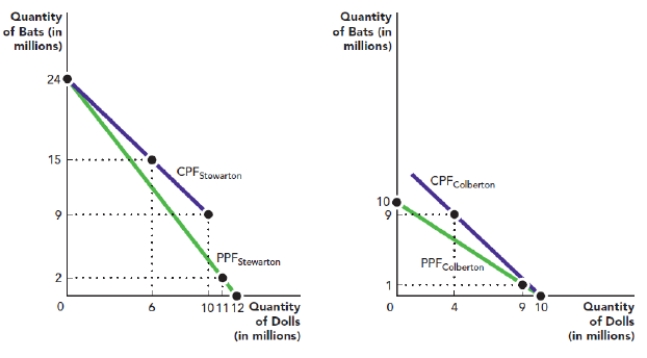
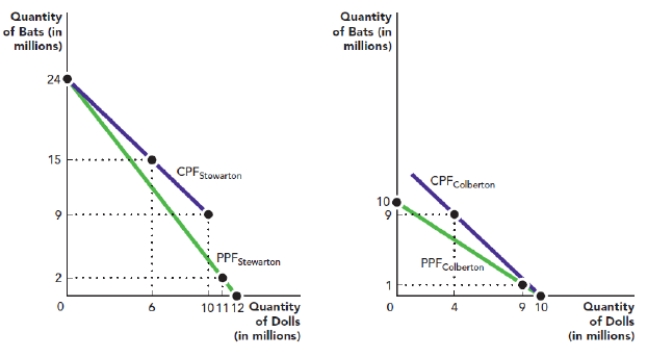
(93) Refer to the figure Mutually Beneficial Trade I. The figure shows the production possibility frontier (PPF) and the consumption possibility frontier (CPF) for baseball bats and bobblehead dolls in Stewarton and Colberton. Based on the figure, the opportunity cost of producing one doll in Stewarton is:
Figure: Mutually Beneficial Trade I
(Multiple Choice)
4.9/5 (84)
(84) In the absence of trade, the consumption possibilities frontier _____ the production possibility frontier, and trading according to comparative advantage makes the consumption possibility frontier _____ the production possibility frontier.
(Multiple Choice)
4.8/5 (81)
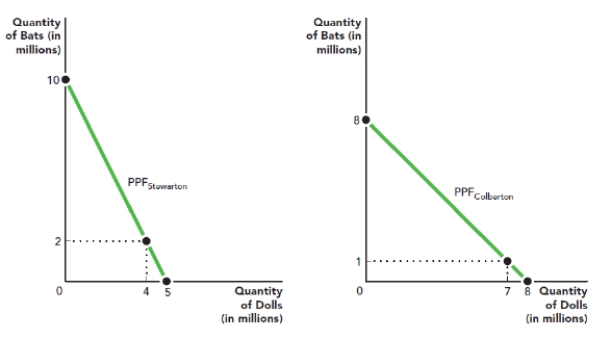
(81) Refer to the figure PPF and Comparative Advantage. The figure shows the production possibility frontier for producing baseball bats and bobblehead dolls in Stewarton and Colberton. The opportunity cost of producing bats in Stewarton is:
Figure: PPF and Comparative Advantage
(Multiple Choice)
4.7/5 (79)
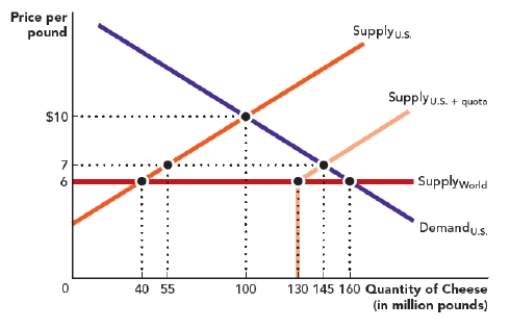
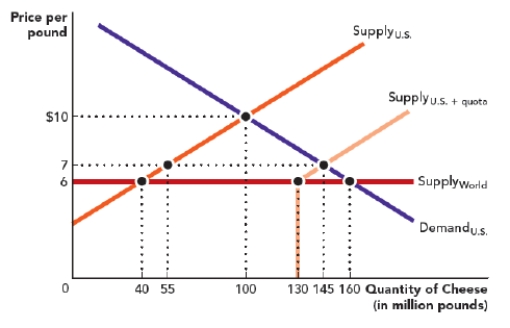
(79) Refer to the figure Import Quota. The figure shows the U.S. supply, world supply, and U.S. demand curve for cheese. In the absence of trade, the equilibrium quantity of cheese consumed will be ____ million pounds, and the equilibrium price will be _____ per pound.
Figure: Import Quota
(Multiple Choice)
4.8/5 (75)
(75) Refer to the figure Mutually Beneficial Trade I. The figure shows the production possibility frontier (PPF) and consumption possibility frontier (CPF) for baseball bats and bobblehead dolls in Stewarton and Colberton. Based on the figure, we can conclude that the terms of trade is _____ for each bobblehead doll.
Figure: Mutually Beneficial Trade I
(Multiple Choice)
4.9/5 (92)
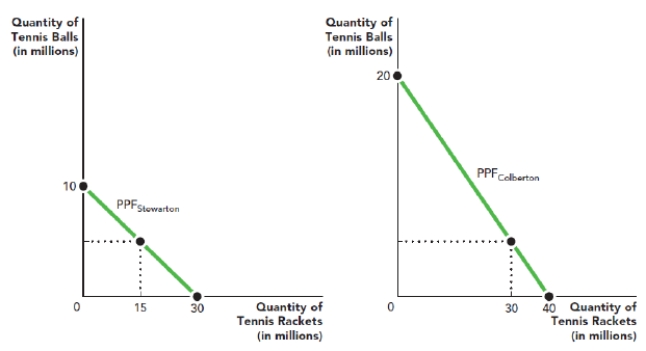
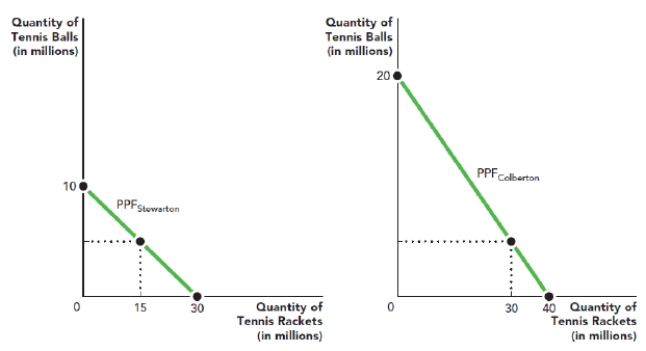
(92) Refer to the figure Mutually Beneficial Trade II. The figure shows the production possibility frontier (PPF) for producing tennis rackets and tennis balls in Stewarton and Colberton. Suppose that the countries trade according to their comparative advantage and the terms of trade for tennis rackets is 0.4 tennis ball. If Stewarton ends up consuming 15 million tennis rackets, then how many tennis balls will it be able to consume?
Figure: Mutually Beneficial Trade II
(Multiple Choice)
4.8/5 (83)
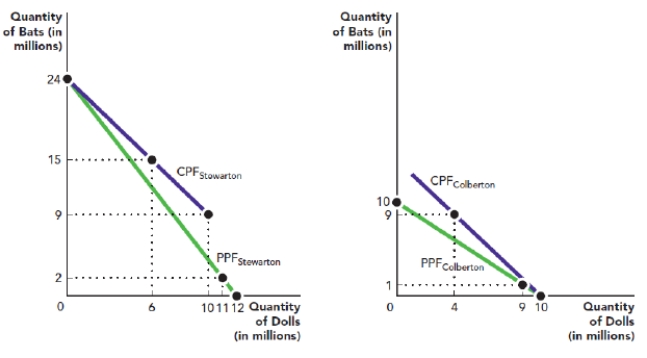
(83) Refer to the figure Mutually Beneficial Trade I. The figure shows the production possibility frontier (PPF) and consumption possibility frontier (CPF) for baseball bats and bobblehead dolls in Stewarton and Colberton. Based on the figure, the opportunity cost of producing one doll in Colberton is:
Figure: Mutually Beneficial Trade I
(Multiple Choice)
5.0/5 (72)
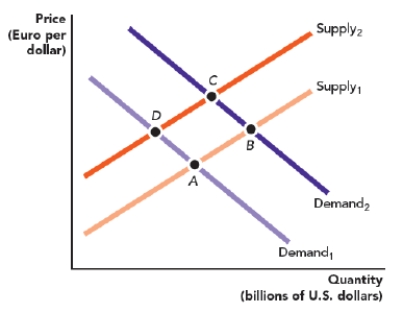
(72) Refer to the figure Currency Appreciation and Depreciation. The figure shows the supply and demand of U.S. dollars in the euro-U.S. dollar foreign exchange market. A shift in the equilibrium from C to B implies that the U.S. dollar is _____ and the euro is:
Figure: Currency Appreciation and Depreciation
(Multiple Choice)
4.8/5 (80)
(80) A country produces bobblehead dolls and baseball bats using only labor as input. One unit of labor can produce four dolls or two bats. What is opportunity cost of producing bobblehead dolls?
(Multiple Choice)
4.8/5 (71)
(71) Portugal specializes in the production of wine and produces 10 million bottles. The United Kingdom specializes in the production of cheese and produces 100 million pounds. After trading with each other, Portugal consumes 4 million bottles of wine and 60 million pounds of cheese. Therefore, the terms of trade is _____ pounds of cheese per bottle of wine.
(Multiple Choice)
4.8/5 (77)
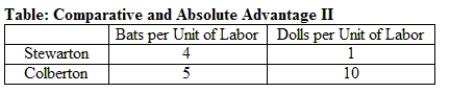
(77) Refer to the table Comparative and Absolute Advantage II. The table summarizes the amount of baseball bats and bobblehead dolls that can be produced per unit of labor in Stewarton and Colberton. The opportunity cost of producing dolls in Stewarton is:
(Multiple Choice)
5.0/5 (83)
(83) Refer to the figure Import Quota. The figure shows the U.S. supply, world supply, and U.S. demand curve for cheese. With free trade, the domestic supply of cheese will be _____ million pounds, and the total imports will be _____ million pounds.
Figure: Import Quota
(Multiple Choice)
4.8/5 (80)
(80) A country produces bobblehead dolls and baseball bats using only labor as input. One unit of labor can produce four dolls or two bats. What is opportunity cost of producing baseball bats?
(Multiple Choice)
4.8/5 (84)
(84) If a country's exports are _____ than imports, then the balance of _____ will be positive.
(Multiple Choice)
4.8/5 (70)
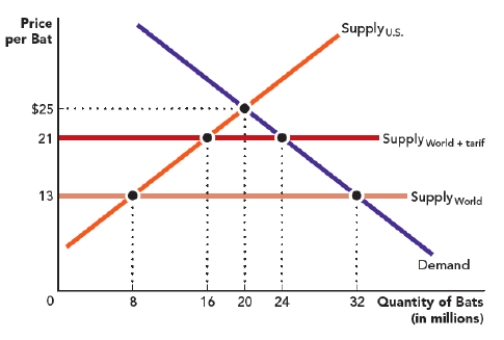
(70) Refer to the figure Import Tariffs. The figure shows the U.S. demand, U.S. supply, and world supply curves for baseball bats. If the United States imposes a $8 tariff on imports, then the consumers will buy _____ million bats, of which _____ million will be imported from the rest of the world.
Figure: Import Tariffs
(Multiple Choice)
4.8/5 (85)
(85) Refer to the figure Mutually Beneficial Trade II. The figure shows the production possibility frontier (PPF) for producing tennis rackets and tennis balls in Stewarton and Colberton. The opportunity cost of producing tennis rackets in Stewarton is:
Figure: Mutually Beneficial Trade II
(Multiple Choice)
4.9/5 (84)
(84) Portugal specializes in the production of wine and produces 10 million bottles. The United Kingdom specializes in the production of cheese and produces 100 million pounds of cheese. If the terms of trade is 10 pounds of cheese for a bottle of wine and Portugal consumes 40 million pounds of cheese, then the UK consumes _____ million bottles of wine, and Portugal consumes _____ million bottles of wine.
(Multiple Choice)
4.8/5 (92)
(92) Refer to the figure Mutually Beneficial Trade I. The figure shows the production possibility frontier (PPF) and consumption possibility frontier (CPF) for baseball bats and bobblehead dolls in Stewarton and Colberton. Based on the figure, the opportunity cost of producing bats in Stewarton is:
Figure: Mutually Beneficial Trade I
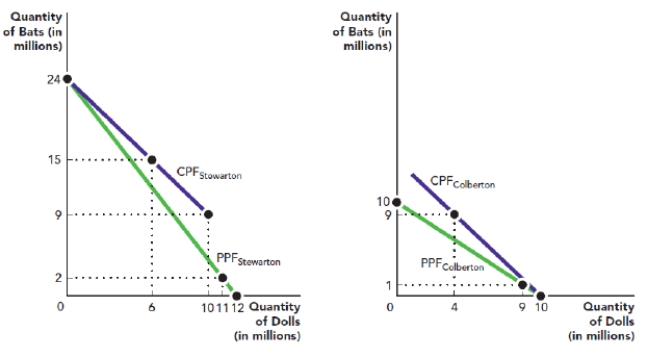
(Multiple Choice)
4.8/5 (80)
(80) 
Filters
- Essay(0)
- Multiple Choice(0)
- Short Answer(0)
- True False(0)
- Matching(0)