



 Chat with AI
Exam 11: Factor Markets

Exam 1: Foundations of Economics100 Questions
Exam 1: Extension: Understanding Graphs27 Questions
Exam 2: Markets and Economies104 Questions
Exam 3: Demand116 Questions
Exam 4: Supply118 Questions
Exam 5: Market Equilibrium118 Questions
Exam 6: Elasticity126 Questions
Exam 7: Consumer Behavior104 Questions
Exam 8: Production Costs125 Questions
Exam 9: Perfect Competition117 Questions
Exam 10: Market Power102 Questions
Exam 11: Factor Markets105 Questions
Exam 12: Market Failure and Government Failure82 Questions
Exam 13: Measuring an Economys Performance103 Questions
Exam 14: Aggregate Demand and Aggregate Supply105 Questions
Exam 15: Fiscal Policy105 Questions
Exam 16: Money and Banking74 Questions
Exam 17: Monetary Policy103 Questions
Exam 18: Economic Growth and Development49 Questions
Exam 19: International Trade and Finance110 Questions
Select questions type


Use the labor supply and labor demand graph to show the impact of the following three events on the equilibrium wage and equilibrium number of workers hired. In each case, mark the original equilibrium as point A and the new equilibrium as point B.
a. an increase in the price of the good that labor produces
b. an increase in the rate of immigration that increases the labor force
c. an increase in the productivity of workers that results from technological advancements
(Essay)
4.8/5  (80)
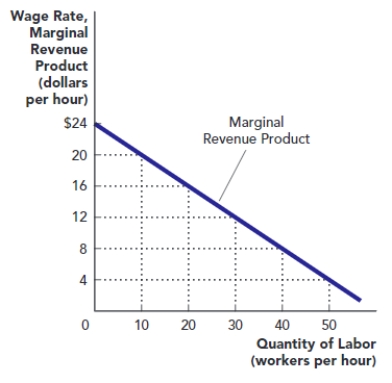
(80) Use Figure: Marginal Revenue Product and Labor Demand. The figure shows the marginal revenue product per hour of labor for a competitive firm. If hiring 40 workers per hour maximizes the firm's profit, then the market wage is _____ per hour.
Figure: Marginal Revenue Product and Labor Demand
(Multiple Choice)
4.7/5 (89)
(89) If an increase in the minimum wage above the equilibrium wage does not lead to any additional unemployment and increases the wage of workers, then we know that the _____ curve for labor is perfectly _____.
(Multiple Choice)
4.8/5 (78)
(78) All else equal, an increase in the productivity of workers in the economy will lead to _____ in the quantity of labor hired and _____ in the wage rate.
(Multiple Choice)
4.9/5 (84)
(84) The demand for factors of production is referred to as a _____ demand.
(Multiple Choice)
4.9/5 (83)
(83) Which of the following can decrease simultaneously the equilibrium quantity of workers hired and the equilibrium wage rate?
(Multiple Choice)
4.8/5 (77)
(77) According to the law of diminishing returns, all else equal, an increase in the number of workers leads to:
(Multiple Choice)
4.8/5 (92)
(92) A change in the demographics of an economy such that there is an increase in the workers of retiring age will, all else equal, lead to _____ in the equilibrium quantity of labor hired and _____ in the equilibrium wage rate.
(Multiple Choice)
4.9/5 (91)
(91) Which one of the following does NOT fall in the category of factors of production?
(Multiple Choice)
4.9/5 (87)
(87) Use Figure: Equilibrium in the Labor Market. Which one of the following can shift the equilibrium from point D to point A?
Figure: Equilibrium in the Labor Market

(Multiple Choice)
4.9/5 (89)
(89) All else equal, a decrease in the overall price level of goods and services in the economy will lead to _____ in the quantity of labor hired and _____ in the wage rate.
(Multiple Choice)
4.8/5 (90)
(90) All else equal, the effect of a decrease in the overall rate of immigration can be shown through a _____ shift of the labor _____ curve.
(Multiple Choice)
4.8/5 (69)
(69) Which one of the following will lead to a rightward shift of the labor supply curve?
(Multiple Choice)
4.9/5 (65)
(65) Each firm in a perfectly competitive labor market faces a _____ labor _____ curve.
(Multiple Choice)
4.9/5 (74)
(74) With increasing urbanization, there is usually a decrease in the opportunity cost of work. All else equal, the impact of increasing urbanization on the labor market can be shown by a _____ shift of the labor _____ curve.
(Multiple Choice)
4.8/5 (78)
(78) Which of the following will lead to a decrease in the equilibrium quantity of workers hired and an increase in the equilibrium wage rate?
(Multiple Choice)
4.9/5 (88)
(88) 
Filters
- Essay(0)
- Multiple Choice(0)
- Short Answer(0)
- True False(0)
- Matching(0)